
Walter W. “Walt” Wyatt was a World War II Army Air Forces fighter pilot who flew combat missions in China with the 16th Fighter Squadron, 51st Fighter Group. Flying the P-51 Mustang, he was credited with eleven enemy aircraft destroyed, including one confirmed aerial victory, before being shot down over Hainan Island in July 1945. His story provides a useful glimpse into both the training of a wartime fighter pilot and the air war in the China-Burma-India Theater.
In the European Theater in World War II his destruction of eleven enemy planes would have made him a double ace. However, his ten ground kills didn’t count in the C.B.I. Even his one confirmed aerial victory in China does not show up in “USAF Credits for the Destruction of Enemy Aircraft, World War II” (Air Force Historical Study No. 85). It is, however, verified in squadron records and by the research of Frank Olynk.[1] Herewith is a brief tribute to Capt. Walter W. Wyatt, O-821583. It also provides a glimpse of Army Air Force pilot training along with insights on late war air combat operations in China.
Walt Wyatt’s Path to Becoming a World War II Fighter Pilot
Walt Wyatt was born in 1922. His father passed away when he was fourteen. When the war in Europe began, he had just entered college at Virginia Polytechnic Institute. In April 1943 he became an army aviation cadet. His class, made up of candidates with at least two years of college, assembled at Richmond, Virginia. It then was sent to a classification center at Nashville, Tennessee. Two weeks of testing and assessment determined whether a candidate went to pilot, navigator, or bombardier training.
Army Air Forces Pilot Training During World War II
First came two months of pre-flight training at what is now Maxwell Air Force Base, Alabama. A lower and upper class totaling about 10,000 cadets were in residence at that time according to Walt. The course included military and physical training, Air Force history, mathematics, Morse code and other subjects. This was followed by primary flight training during July-August at Decatur, Alabama. Walt was thankful he flew the open cockpit PT-17 in the summer. He soloed after about eight flights and ten hours flying time a little better than the class average. Sixty-two hours there was about evenly divided between dual (instructor on board) and solo time. Flying involved take-off, landing, basic flight maneuvers, some acrobatics, two short cross country flights but no radio.[2]
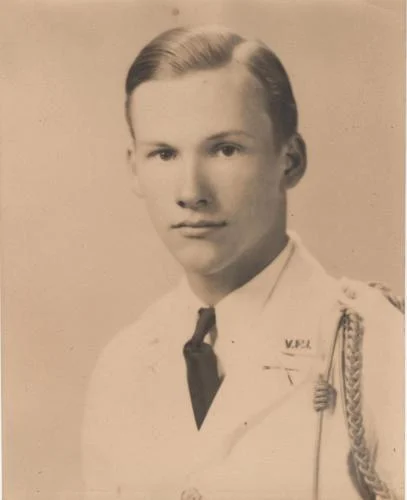
Walt Wyatt 1942
Basic training took place at Courtland, Alabama Army Airfield which had only been operational since the beginning of the year. From September to October Walt flew the BT-13 racking up 43.5 hours solo out of 76 hours total flying time. In addition to more primary-type flying he acquired some night and instrument time and flew cross-country. He also spent about ten hours in the Link instrument trainer.
Advanced training was at Craig, Alabama in an AT-6. The normal two months training was extended due to bad weather. He added 69.5 flight hours of which 39 were solo. He was commissioned a 2Lt. on 7 January 1944. About a fourth of cadets received the WW2 rank of Flight Officer one grade lower than 2Lt. In January 1944 he added 14 hours in a P-40N to his flight log, something not all cadets got to do.
Training for Combat in the P-40 and P-47 Thunderbolt
Walt’s next stop was the replacement depot at Dale Mabry Field, Tallahassee Florida. There he attended ground school and spent time in the altitude chamber. Normally this phase involved less than a month, but Walt spent six weeks there in January – February due to a backlog at advanced training schools caused by bad weather. March found him at Venice Army Airfield, Florida. He put in many hours in the Link trainer, some flying in the AT-6 and 15 hours in the P-47 Thunderbolt (D and G models) that month. In April he added additional Thunderbolt time but most of his 75 hours that month was in a new P-40N with which the 3rd Fighter Command was mainly equipped. Flying was by day and night including acrobatics with an introduction to gunnery and low level bombing. Walt won an award for highest average gunnery score. During May he racked up 110 flight hours doing gunnery, bombing and night flying as well as gaining additional Link trainer time. He added 20+ hours in June flying similar missions then returned to Dale Mabry Field for a couple weeks before heading for the Miami port of embarkation. Walt boarded ship and headed for Karachi, India.
The China-Burma-India Theater and the P-51 Mustang
At Karachi Walt was first attached to the Replacement Fighter Pilot Pool. While waiting for a permanent assignment he flew the P-40 (models E, K and M) in simulated attacks on B-24s and B-25s for the gunners’ school adding 15 flight hours in August 1944 and 16 hours in September. He then received theater indoctrination at a fighter replacement training unit. During October he flew an A-24 with rudimentary flight controls in the rear seat, P-40N, P-51A, A-36 and P-51C. This added 33 hours to his flying time. He was issued a new P-51C to fly across the “Hump” (India-China air route). He turned in the Mustang at Chengkung. He was assigned to the 16th Fighter Squadron, 51st Fighter Group. The squadron’s pilots had been flying P-40s until then. Walt helped bring them up to speed on the Mustang. He also started flying combat missions. These were mostly ground support missions. The Japanese were mainly flying “Oscar” (Type1 fighter) model III. On the few occasions when Japanese fighters were encountered, they usually avoided combat. At the beginning of January 1945, the 16th Fighter Squadron sent a detachment of twelve Mustangs to Laohokow to operate with the Chinese American Composite Wing. They were a sort of military advisory and assistance group. Walt went along initially for three days to continue coaching the old hands on their new fighters. He ended up staying until the 16th of March. Laohokow was north of the Yangtze River the geographical feature which earlier in the conflict had been the responsibility of the Chinese Air Force. The U.S. 14th Air Force had conducted most of its operations south of the river but with both air forces attacking river traffic and targets along its shorelines.
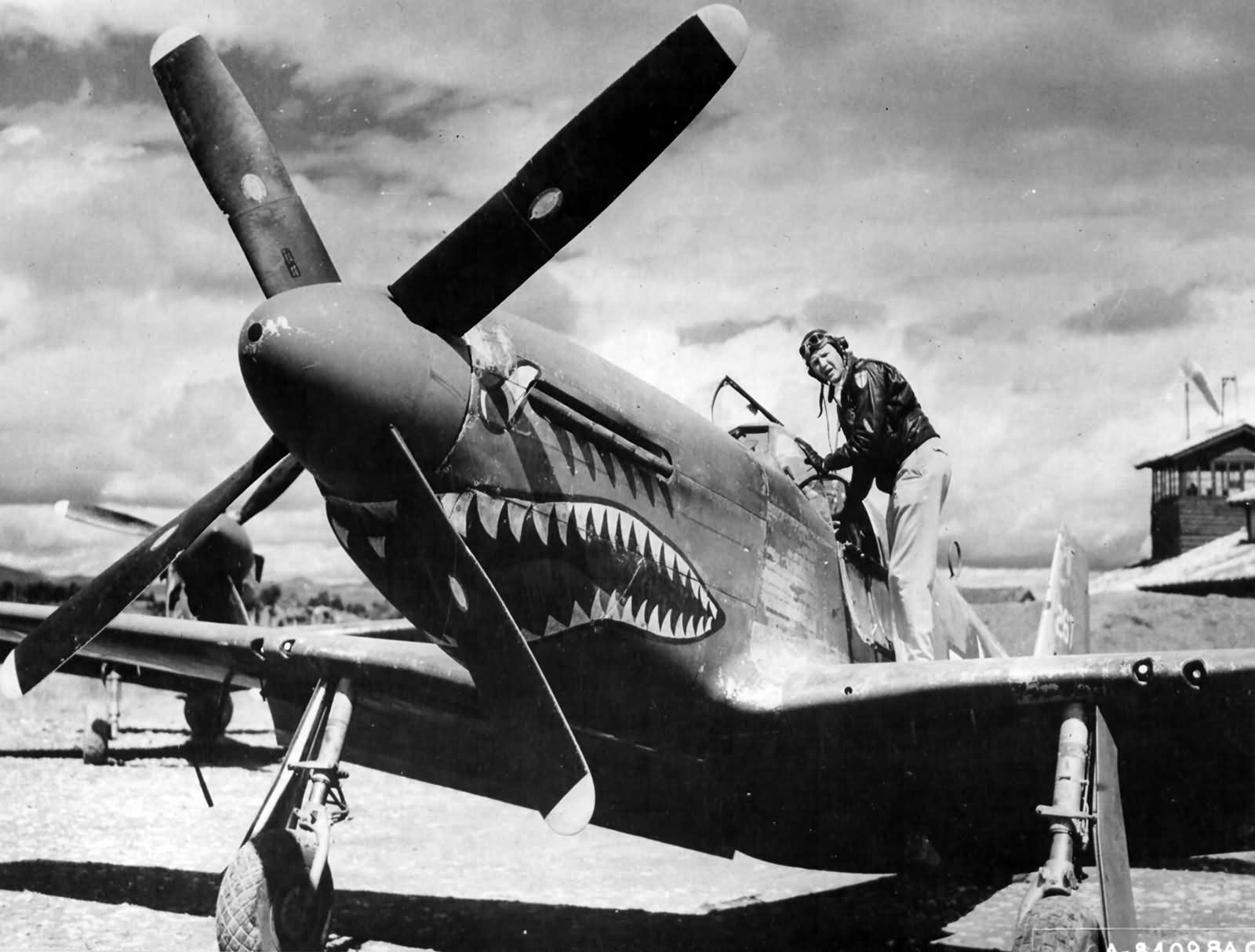
Col Tex Hill and P-51B Mustand of 51st Fighter Group
Walt Wyatt’s Air Combat Over China
My interview notes with Walt, do not record dates of his aerial combats including his claims. I have been fortunate to find details of some of his combats. He claimed an Oscar damaged on 5 January American and Chinese pilots attacked Hankow and Wuchang.[3] On 14 January 1945 large numbers of U.S. fighters and bombers hit targets at Hankow, Kengtung, and Wuchang. In addition to destruction on the ground, escort fighters accompanying B-24s to Hankow and fighters escorting fighter-bombers to Hankow and Wuchang claimed nineteen victories losing three. Walt was flying one of ten Mustangs providing top cover for P-40s dropping “daisy cutters” on Hankow airfield. He claimed one of the two confirmed kills of the 16th Fighter Squadron. They engaged Oscars of the 25th Hiko Sentai. Walt’s victim may have been the fifteen victory ace W.O. Iwataro Hazawa who bailed out of his burning fighter but died when his parachute failed. Another possibility is Lt. Kameo Yamamoto.[4]
P-51 Mustang Ground-Attack Missions and Combat Tactics
Walt had a big day on 10 February 1945 when he was credited with seven ground kills during a long range mission to Tsingtao.[5] Flying his P-51D during a ground attack mission
Walt claimed another Oscar damaged in air combat at Anqing (Anking) on 22 February.[6] This was probably the mission in which Walt was a flight leader. The formation was jumped by 18-20 Oscars from clouds at 10,000 feet and combat took place low over the Yangtze River.
Among his interview comments Walt mentioned that the defensive scissors maneuver needed to be set up to be effective presumably meaning the correct formation and timing were required. He also mentioned the difference between the P-51D he flew and earlier models. The D had six machine guns vice four on earlier models. Also, the gun placement within the wing differed which reduced the propensity for jamming. Walt stated the combat radius of the P-51 was 800 miles compared to about 250 miles for the P-40.
The 16th Fighter Squadron detachment at Laohokow returned to Chungkung on 16 March. Thereafter Walt flew mainly ground attack missions. As of 25 July 1945, had had flown 28 combat missions for 92 hours and 45 min. of combat time. He was credited with eleven enemy aircraft destroyed, one probably destroyed and two damaged. On 27 July, during a mission over Hainan Island, his Mustang was hit by 40mm ground fire. Walt bailed out at about 300 feet altitude, landed hard and badly injured his knee. After various harrowing adventures he was eventually found by Chinese communist guerillas. He stayed with them evading Japanese troops until September 1945 when he was repatriated to U.S. control. He was subsequently awarded the Prisoner of War Medal and Purple Heart while recovering from his injuries in Walter Reed Hospital. These were added to the Air Medal with Oak Leaf cluster he earned. Walt left active duty in the grade of Captain.
Walt Wyatt’s Life After World War II
Walt resumed civilian life. He married, had children, and added to his professional qualifications. In 1953 he got a job as a government civilian employee at Homestead Air Force Base. When he retired thirty-nine years later, he was the base’s chief engineer. He served the city of Homestead on its planning and zoning commission and its hospital board. It was at Homestead that I met Walt. Various business matters brought us together. The most significant was providing support to the U.S. Department of Justice in defending the first challenge to the then new preference program to encourage contracting with minority owned business firms, Small Business Act Section 8(a). The government prevailed in Ray Bailey Trash Hauling v. Kleppe (1971). An interesting side note is that the contractor was terminated for deficient performance. Having spoken to Walt briefly about his wartime service, he agreed to an interview. I kept the interview notes all these years. Walt passed away in 2015.[7] Rest in peace.
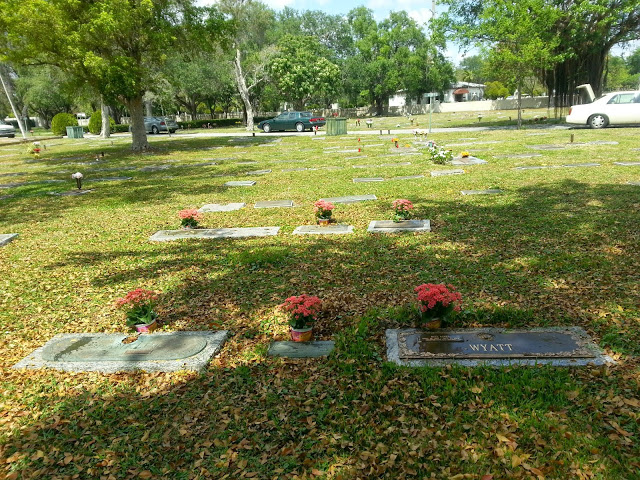
Walter Wyatts Grave Site
A Final Flyover for a World War II Fighter Pilot
After the devastation of Hurricane Andrew in 1992, Homestead Air Force Base was decommissioned and later partially restored as an Air Reserve Center. The reserve wing there (482nd) flies F-16s. Fittingly, through an unplanned set of circumstance two F-16s flew over Walt’s grave at the time of his funeral.
Footnotes:
[1] 16th Fighter Squadron history (January 1945); e-mail from Carl Moleswoth, 26 March 2008.
[2] RLD interview with Walter Wyatt, Homestead AFB, Florida, 3 November 1972.
[3] Molesworth e-mail (note i); Håkans Aviation page – Aerial Operations (5 Jan. 1945)
[4] Hakans’s Aviation page (14 Jan. 1945); Hata et al., Japanese Army Air Force Fighter Units and Their Aces Grub Street, London (2002), pp. 198-199, 277, 313.
[5] Molesworth e-mail (note i)
[6] Hakans Aviation page (note iii) (22 Feb. 1945); Molesworth e-mail (note i).
[7] For additional information see ”Family, Community Say Farewell to Decorated WWII Veteran”, South Dade Herald (12 June 2015).
I enjoyed reading this.
Nice article – thanks for sharing this!
/Håkan