
This article is Part III of a three-part series exploring the overlooked role of land-based air power in the Central Pacific during 1943. If you’re new to the series, you may wish to begin with Part I, which examines the strategic foundations of the campaign, and continue with Part II, covering the reconnaissance missions and air operations that paved the way for the invasion of the Gilbert Islands. Together, these articles provide the broader context for the events leading to Operation Galvanic and the Battle of Tarawa.
The Battle of Tarawa is remembered for its fierce fighting on the beaches, but the weeks leading up to the invasion were shaped by an extensive Allied air campaign that remains largely overlooked. During September through November 1943, American land-based bombers and carrier aircraft struck Japanese positions across the Gilbert and Marshall Islands, gathering intelligence, weakening defenses, and supporting Operation Galvanic. This article examines how the Battle of Tarawa air campaign helped prepare one of the Pacific War’s most important amphibious assaults.
Second Half of September
The command structure in the Central Pacific was dominated by the Navy. Here it is interesting to consider the thought that air power doctrine whether land or carrier-based had not been fully thought through in this massive and consequential theater of war. Without deflecting too much from the subject of this article as well as illuminating that point, a brief diversion may be appropriate. Aircraft carrier battles of 1942 had resulted mainly from tactical necessity rather than any strategic view of air power.
Planning the Air Campaign for Operation Galvanic
With an entirely new campaign under new conditions in the offing differences of strategic vision emerged. RAdm. John Towers, commander of Pacific Fleet air forces, formerly head of the Bureau of Aeronautics, saw carrier aviation as the fleet’s spear tip capable of ravaging Japanese island outposts leaving them vulnerable to amphibious invasion. “He wanted the fast carriers…to be used as attack weapons, to knock out the Japanese strength in the air and on the ground and pave the way for landings…The more conservative Nimitz, and others, thought the carriers must be used with the remainder of the fleet in a less aggressive posture.” [1]
While some modern battleships joined the Central Pacific Force (later Fifth Fleet) the lineup of aircraft carriers for the Gilberts campaign was impressive, totaling seventeen. This included six large carriers (CV), five fast light carriers (CVL), and six escort carriers formerly auxiliaries (ACV) now rated as combat ships (CVE). There were a dozen old and new battleships, fifteen cruisers and sixty-five destroyers as well as numerous lesser vessels.
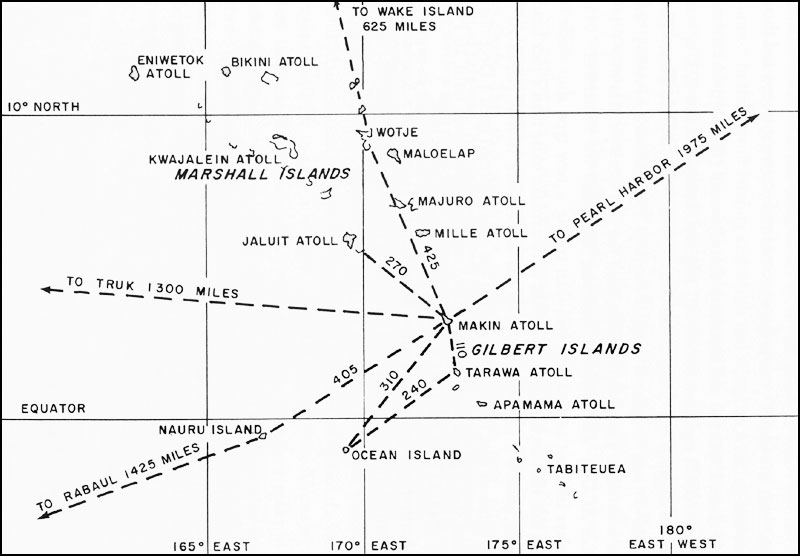
Gilberts and Marshalls Islands
Admiral Nimitz’ monthly report on September operations stated the purpose of the task force raid on Tarawa was to destroy Japanese aircraft and air installations to decrease “pressure” (air attacks/reconnaissance) on American installations in the Ellice islands and provide training for future operations. The makeup of the task force (RAdm. C.A. Pownall, commanding) and supporting operations suggests the Navy was being very cautious with its “spear tip.” The carrier group consisted of Lexington and two CVLs Princeton and Belleau Wood. There was a support group of three cruisers and a screen of eleven destroyers. More remarkably Task Force 15 included a task group consisting of aircraft operating from Canton and Funafuti commanded by Army B/Gen. Truman Landon, C.O. 7th Bomber Command (Canton) and Marine B/Gen. Harold Campbell, C.O. 4th Marine Air Wing (Funafuti). This consisted of twelve 11th BG B-24s on each island, twelve PBYs at Canton and six at Funafuti, and ten PV-1’s at Funafuti. Not officially part of the task force U.S. Army B-24s and Navy PB4Ys from Guadalcanal were to bomb Nauru on the day of the attack on Tarawa to reduce the threat of any search or attack mission from that base. The task force B-24s were to attack Tarawa pre-dawn on the day of the carrier attack and on the following day to cover the surface vessels withdrawal from the area. In addition to Tarawa, small carrier plane raids would also be mounted against Makin and Apamama atolls.
Task Force 15 and the First Attacks on Tarawa
On the night of 18 September (19th Japan time) the Canton and Funafuti B-24s took off for Tarawa. Eighteen of the twenty-four bombed the primary target Betio Island, Tarawa. Two bombed other islands including Apamama. Four Liberators aborted. Results were considered excellent. There was no interception and heavy AA fire was inaccurate. All aircraft returned to base.
Carrier planes took off before dawn and carried out six strikes, recovering planes from the last strike by early afternoon. The carriers also launched anti-submarine and combat air patrols. CAP Hellcats from Princeton and Belleau Wood each claimed a Betty search plane. Two 755 Ku rikkos flying from Maloelap failed to return. Eighty tons of bombs were dropped in 190 attack sorties. Two planes were combat losses and two others listed as operational losses. Admiral Nimitz monthly report stated that initial estimates of damage inflicted were “extravagant”. However, three large flying boats were destroyed at Makin and nine bombers destroyed or badly damaged at Tarawa. In addition, Japanese personnel casualties included two hundred killed, missing or seriously injured. The flying boats were destroyed by a strafing Hellcat from Princeton. A small cargo ship was claimed. Post-war Japanese Monograph No. 116 records the loss of a 285-ton Maru by air attack on the 21st. Other damage may have been caused by either land-based or carrier attacks.
Carrier pilots reported that 75% of the installations at Tarawa were destroyed. However, the official U.S. Army history states “the most important single achievement of the strike was the photographic coverage of Tarawa and Makin by both carrier- and land-based aircraft.” [2] Whatever damage was inflicted did not stop the Japanese from flying in fourteen single engine bombers, twelve fighters and seven land attack planes during the day. Any shortage of supplies was remedied by being flown in from other bases. Per a Japanese press account 22 of more than 200 raiders were shot down. “Personnel of the garrison and military establishments have suffered some damage.” [3]
A dozen B-24Ds from Guadalcanal deposited 196 hundred-pound bombs on Nauru hitting the runway, radio station and phosphorus plant. Three Liberators suffered AA hits. All returned to base. A dozen Navy PB4Ys were less successful. After ten turned back, two added forty 100 lb. bombs. Meanwhile the ships of Task Force 15 retired without being harassed. After refueling from two tankers they returned safely to Pearl Harbor on 23 September.
Assessing the September Tarawa Air Raids
The B-24s of the task force covered the withdrawal of the ships with a follow-up combined attack and photo mission to Tarawa on 19 September. Twenty-four took off. After four aborts twenty arrived over the target possibly not all together as the Japanese reported only seventeen. The Americans reported fifteen to twenty Zekes intercepting. Air Group 252 put up the twelve Zeros that arrived the previous afternoon. Per American count there were 131 individual passes of which about 85% were from the 10 to 2 o’clock positions. Generally, attacks were not pressed and some pilots seemed inexperienced. One badly shot up Liberator ditched on a reef off Nanomea and ten others returned with battle damage. Gunners claimed six fighters destroyed and others probably destroyed. Five Zeros were hit but all returned one flown by a wounded pilot. The Japanese claimed one bomber destroyed and seven damaged.
The 11th BG Tarawa attacks were certainly a great improvement compared to the debacle over Nauru at the end of June and the missions over Wake Island in July. However, room for improvement and the need for more training was noted in several areas.
At the end of the month the Nauru vicinity was the site of a series of encounters between SoPac PB4Ys and Zeros. On 27 September a PB4Y-1 captained by Lt. Cdr. Gordon Fowler, commander of VB-102, encountered five Zeros which attacked singly. Only two attacks were closely pressed. Gunners claimed one destroyed and one possible. The PB4Y suffered no damage and all Zeros returned to base. The following day a VB-104 PB4Y was attacked by a single Zero about ten miles north of Nauru. After two passes port and starboard from the forward quadrant the Zero was content to fire from long range. The Navy Liberator took one 20mm hit in the port vertical stabilizer. The Zero suffered no apparent damage. On the thirtieth another VB-104 PB4Y was engaged by nine Zeros executing individual, closely spaced passes for forty minutes. The bomber claimed one Zero destroyed, not verified in Japanese records, and returned to base with three 20mm scars and about fifteen 7.7mm hits. Radio Tokio reportedly announced a B-24 shot down over Nauru.
Preparing Air Bases for the Gilbert Islands Invasion
October opened with a big carrier strike on Wake. Task Force 14 included three fleet carriers, three light carriers and a host of supporting ships. For two days (5th to 6th) Wake was subjected to air attacks and bombardment by cruiser guns. The Japanese lost airplanes on the ground and in combat over the atoll. In addition, reinforcing fighters and bombers being flown in from the Marshalls suffered heavy losses in transit. Twenty-five American carrier planes were lost. The plan to attack Wake with PB4Ys from Midway was only partially successful with just six planes making it to Wake on the afternoon of the fifth.
For the land-based air forces October brought new challenges. The time of limited duration 2,000 mile “out and back” air strikes was over. With the deadline for the Gilberts campaign counting down Seventh Air Force assets committed to that campaign had to be able to operate from remote islands on a sustained basis. Four heavy bomber squadrons and two fighter squadrons were initially subordinated to Task Force 57 the tactical air command for the Gilberts campaign. Only two bases, Canton and Funafuti, had been occupied for more than several weeks. Facilities (runways including lighting, hard standings, communications, and maintenance operations) needed to be established or expanded. Progress at various bases was uneven. Basic runways were in place, but other infrastructure and support organizations were often lacking as the date for the campaign’s start came closer. This herculean task was largely accomplished by the end of October.
Even though the Navy had a powerful carrier force committed, it had been agreed at the Joint Staff level to increase the strength of the Seventh Air Force. Thus, the 30th BG (B-24s) and 41st BG (B-25s) were assigned to the Seventh Air Force arriving in Hawaii during the second and third weeks of October. Both these groups as well as other units of the Seventh Air Force were destined to play a role after the initial stage of the campaign.
On the first of October Japanese units reported their operational aircraft strengths:
Air Group 252 Zero fighters (models 21, 22 and 32) – 48; Air Group 552 T. 99 carrier bombers model 22 – 21; Air Group 755 land attack bombers (T.96 and T. 01) – 36; Air Group 802 T. 2 large flying boats – 8 and 2 T. 2 float fighters – 2.
After these reports came the actions over and in the vicinity of Wake Atoll. Total and operational numbers fell. On 15 October for Air Group 252, out of 59 Zeros, only 19 were operational. For Air Group 755, out of 23 land attack bombers, only 5 were operational. [4]
Small formations of Navy PB4Ys bombed Makin (13th) and Tarawa (19th). Air Group 802 lost one of its Type 2 large flying boats 1,000 miles from its base at Emidj (Jaluit atoll) on 23 October. Capt. Gilmer Snipes flying a P-40N of the 45th FS from Baker Island was the victor.
The possibility of a confrontation between Japanese and U.S. aircraft carriers disappeared during October. Air groups of the Japanese 2nd Carrier Division were reorganizing and training at Singapore. The 1st Carrier Division sortied from Truk to the Marshalls at mid-month based on intelligence estimates (including submarine floatplane reconnaissance) that U.S. carriers might have left Pearl Harbor. Returning to Truk at the end of the month the carriers’ air groups were sent to Rabaul to oppose the Bougainville invasion. In a few weeks they suffered significant losses and needed to be reorganized.
Operation Galvanic: Building Allied Air Strength
On the first of November the 24th Air Flotilla with its air groups (281, 531, 752 and 802) based in the far north of Japan was ordered to the Marshall Islands. The first aircraft would not arrive until late in the month with some not arriving until early December.
The Seventh Air Force units supporting Operation Galvanic (Gilberts invasion) arrived at their assigned bases by the first two weeks of November:
| Headquarters 11th Bomb. Group | Funafuti | |
| 42d Bomb Squadron | Funafuti | |
| 431st Bomb Squadron | Funafuti | |
| 26th Bomb Squadron | Nukufetau | |
| 98th Bomb. Squadron | Nukufetau | |
| Headquarters 30th Bomb Group | Nanomea | |
| 27th Bomb Squadron | Nanomea | |
| 38th Bomb Squadron | Nanomea | |
| 392d Bomb Squadron | Canton | |
| 531st Fighter-Bomber Squadron | Canton | |
| 46th Fighter Squadron | Canton | |
| 45th Fighter Squadron | Baker | |
The Advanced Headquarters of the Seventh Air Force was established at Funafuti effective 6 November (7th local time). Forward elements of VII Bomber Command and VII Air Service Command were also established there. Initial aircraft strength was 84 B-24s (D and J models), 30 P-39Qs, 30 P-40Ns, and 28 A-24s. [5]
Commander Aircraft Central Pacific established his headquarters on U.S.S. Curtiss at Nukufetau on 11 November. Navy/Marine air assets were (1) search and reconnaissance group: 12 PB4Ys, 6 photo PB4Ys, 24 PBYs, and 12 PV-1s; and (2) Ellice Islands defense and utility group: 36 F4Fs, 24 F4Us, 72 SBDs, and 14 R4Ds. [6] In addition to Central Pacific assets search missions northward into the CenPac area were flown by SoPac aircraft.
The lineup of Japanese operational aircraft as of 15 November was: 252 Ku 46 Zero fighters, 552 Ku 28 T.99 dive bombers, 755 Ku 40 medium bombers, 802 Ku 5 flying boats, 952 Ku 5 observation seaplanes, 7 reconnaissance seaplanes. Bases were Zero fighters Taroa (Maloelap), Kwajalein; dive bombers Mille; medium bombers Kwajalein, Taroa, Nauru; flying boats, Emidj (Jaluit); seaplanes Kwajalein, Makin.[7] Organizationally the seaplanes were under the local base force instead of 22nd Air Flotilla.
The date for the amphibious assault on the Gilbert Islands, Tarawa and Makin atolls, Dog Day was 20 November. Beginning several days ahead of time the pre-assault land-based bombing campaign would begin. Targets would include not only Tarawa and Makin but Japanese bases in the Marshall Islands. This might keep the Japanese guessing as to where the landings would take place plus disrupt bases from which attacks on amphibious forces could be launched. Hundreds of planes flying from aircraft carriers would add to the attack a couple days before the landings.
As of 4 November, not all the Naval aircraft scheduled to participate were yet under the direct command of Commander Central Pacific Air. Fleet Air Wing Two ordered photo PB4Ys at Canton Island to fly a photographic mission to Mille in the Marshall Islands. Four VD-1 photo PB4Ys staged into Baker Island with two others to act as escort along with six PB4Ys of VB-108. On the morning of 5 November, the photographic and bombing planes took Mille by surprise encountering little resistance. Photo coverage was excellent. The sighting report of 27 Japanese airplanes lined up on the runway corelates closely with Japanese data on serviceable aircraft of Air Group 552. Upon completion of their mission all aircraft safely returned to base. The Japanese took this as a possible precursor to a carrier raid and beefed up reconnaissance from Eniwetok in the north and Nauru in the south for a few days. Then wrongly figuring the airplanes came from Ellice Island bases decided to strike there.
Seven Air Group 755 rikkos hit Nanomea after dark on 10 November. The defenders estimated there were twelve bombers which dropped 40 to 60 bombs. There were three casualties including one killed. A fire was started in an ammunition dump. One was claimed shot down by AA, but all attackers returned to base. Nukufetau was hit by nine bombers each on the nights of 13 and 17 November. In these raids four aircraft were destroyed on the ground (2 B-24s, a PBY and an R4D) and twenty-four damaged. There were two deaths among the personnel casualties. Damage to the runway was considered serious.
Meanwhile the land based bombing campaign had begun. At sea invasion forces of the northern group were sailing from Hawaii. The southern invasion group was sailing from the New Hebrides area. Landings were slated for Tarawa (2nd Marine Division), Makin (27th Infantry Division), and Apamama (Marine reconnaissance company). Later reports showed anti-aircraft defenses at Tarawa included a dozen heavy AA guns (127 and 75mm), four double mounted 13mm AA guns and 27 single 13mm guns. The guns were supported by fire control equipment and search lights.
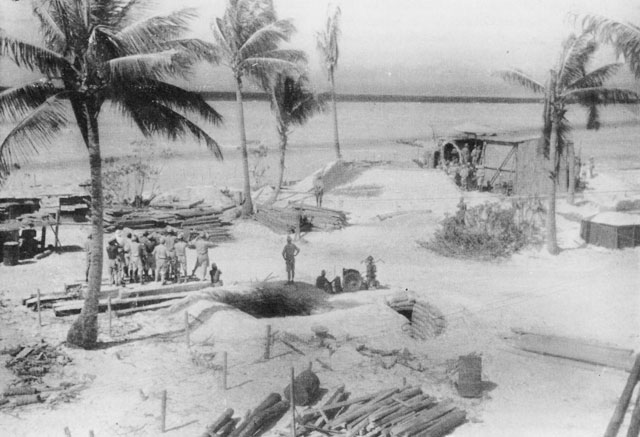
Betio Gun Position
The Land-Based Bombing Campaign Begins
The first mission was flown against Tarawa by eighteen B-24s of the 42nd and 431st BS on 13 November. One Liberator aborted with engine trouble. Fragmentation clusters were dropped from 8,500 feet and 500 lb. bombs from 15,000 feet. There was no interception. AA fire was described as intense but inaccurate. None of the returning bombers was damaged. However, one Liberator failed to return to base. The following day nine Liberators hit Tarawa with fragmentation bombs. Again, there was no interception and AA was off target. On the same day Mille in the Marshall Islands was a target for twenty B-24s from squadrons at Canton and Nanomea. On the fifteenth of eleven B-24s (26th BS) detailed for Mille, eight hit that target and three hit Makin as an alternative all without loss. Jaluit (Emidj seaplane base) was the target of seventeen B-24s. Eight dropped bombs there. Due to weather others attacked shipping in the lagoon or other island targets. No damage was caused by AA fire.[8]
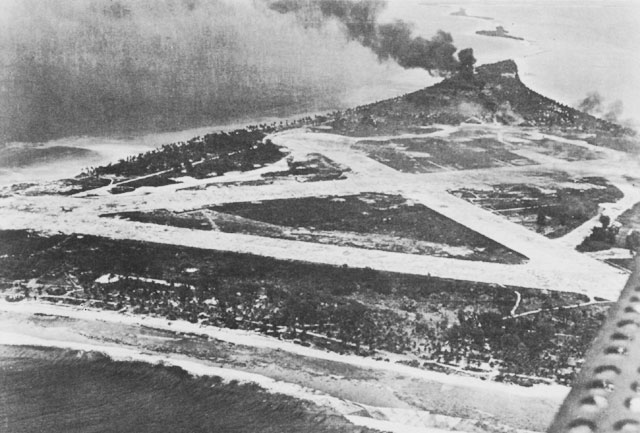
Mille Under Attack
On the sixteenth the big strike was a particularly long range mission to Roi (Kwajalein) with an additional strike against Taroa (Maloelap). For the fourteen plus hour Roi mission twenty B-24s (27th and 38th BS) were joined by two photo PB4Ys of VD-3 for the pre-dawn take off. Things did not go as planned. Three 27th BS Liberators lost the formation in darkness. Later bad weather was encountered. The lead navigator of the 38th Squadron determined that continuing to Kwajalein after rerouting due to weather would extend the mission time to nearly 16 hours. The squadron leader decided to attack Jaluit. The twelve 38th BS aircraft plus three from the 27th and the PB4Ys hit Jaluit. There they encountered two Type Zero observation planes of Air Group 952. The mission report cryptically described the action: “Two Petes intercepted our bombers over Jaluit atoll during the bomb run making two passes…The enemy pilots were…daring, aggressive and experienced. One was probably shot down.”[9] One B-24 had an engine disabled, and two other received minor hits. A Japanese message sent from Jaluit to 22nd Air Flotilla HQ stated, “some ten…B-24s raided at 0720, two type Zero observation planes engaged them.” One of the Petes made a forced landing. Its float broke and the airplane sank with personnel safe. Only one 27th BS B-24 made it to Kwajalein to drop bombs there. Others dropped bombs on Makin and Tarawa.
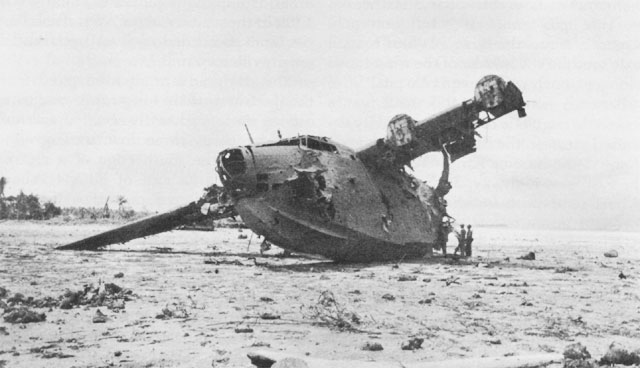
T. 2 flying boat at Makin
On the seventeenth one of three B-24s bombing Tarawa received hits from AA fire. Twelve B-24s headed for Mille on a bombing/reconnaissance mission. Three aborted. Four of the attackers returned with minor damage from AA fire. Eight of nine 26th BS bombers which started for Taroa successfully bombed there. They met fifteen Zeros from Air Group 252 that claimed one destroyed and one damaged. One Zero was badly damaged. Three Liberators were damaged. One badly damaged, crash-landed at Baker Island running into a P-40 destroying both aircraft.
On the eighteenth twenty-two Liberators started for Wotje but due to bad weather most diverted to Mille where heavy AA damaged some of the bombers. Mille was well covered by 500 lb. and 100 lb. bombs and fragmentation clusters. Two bombers hit Betio Island (Tarawa) reporting much evidence of bomb damage there and little sign of activity. Carrier planes had carried out their first strike that morning dropping 115 tons of bombs.
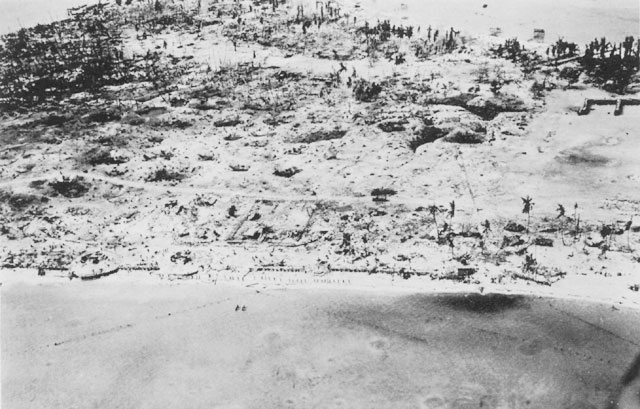
Betio After Bombardment
The Battle of Tarawa Begins
During the day invasion forces were closing in on the islands to be occupied in Tarawa, Makin and Apamama atolls. Landings took place on the morning of 20 November. Tarawa was to become famous for the bloody ground fighting that occurred despite preliminary air attacks and naval bombardment. Many concrete and coconut palm gun positions and obstacles survived despite the massive bombardments. It seems that the air and gunfire attacks had the effect of disrupting Japanese communications, command and control possibly saving the Marines from a coordinated nighttime counterattack when they were most vulnerable.
On the nineteenth twenty B-24s hit Tarawa and twelve bombed Makin. Light and medium AA over Tarawa was described as intense and accurate. Four B-24s were damaged, one was so badly hit it crash-landed at base. Light AA at Makin caused no apparent damage but one B-24 returned to Nanomea only to crash and burn on landing.
The Liberators stood down on the twentieth the date of landings at Tarawa and Makin. Later they would resume attacks with targets being Nauru and various Japanese bases in the Marshalls. For the remainder of November nearly nine hundred carrier aircraft would dominate American air activities. Of approximately 350 land-based aircraft, only about eighty operational Liberators had sufficient range to engage in daylight offensive operations on distant targets.
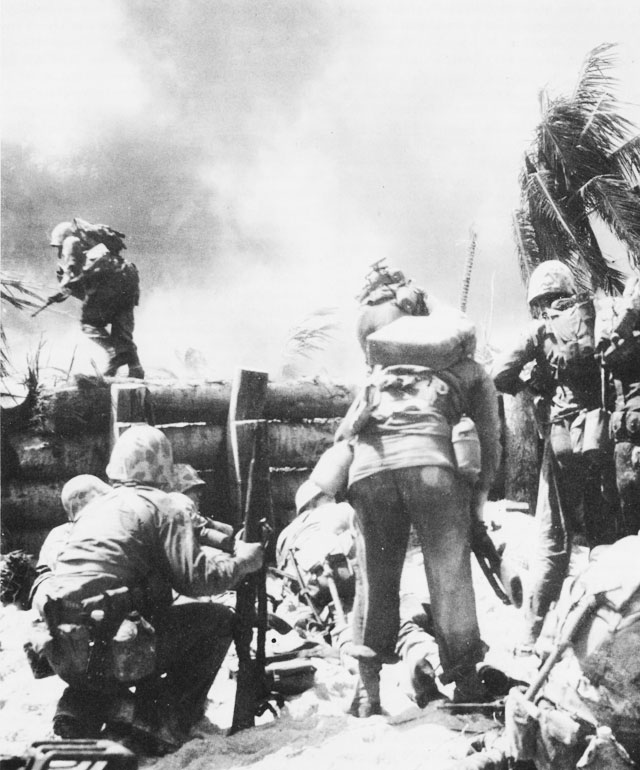
Overcoming a Barrier
Japanese Air Counterattacks After the Landings
Despite the preliminary air attacks the Japanese still had some aircraft operational. After the landing a few aircraft attempted to bomb U.S. positions on Tarawa and drop supplies to their own troops at night. On the day of the invasion two Air Group 755 searchers were shot down by CAP fighters from the carriers. Air Group 755 sent fourteen torpedo armed Type 1 land attack bombers against a group of carriers sailing about thirty miles west of Betio late in the day. They were intercepted by fighters. According to American reports nine got through to come under fire from ships’ AA. Reportedly, five torpedoes were detected. One hit CVL U.S.S. Independence. The crew suffered sixty casualties including seventeen killed or missing. Independence survived, was later repaired but was out of action for six months. Seven bombers failed to return to Kwajalein.
Rikkos of 755 Ku may have contributed to the loss of another U.S aircraft carrier. As operations wore on Japanese aircraft were noted “harassing” U.S. naval formations with flares and float lights. Rather than harassment these lights were meant to attract other Japanese planes or submarines to ships that had been sighted. In the predawn of 24 November escort aircraft carriers of Carrier Division 24 and their supporting screen were operating south of Makin. U.S.S. Franks a screen destroyer was detached from its screening position to investigate a suspicious flashing light. While this was going on Japanese submarine I-175 fired a spread of torpedoes. One hit CVE Liscome Bay igniting her ordnance magazine and blowing off the stern of the ship. The ship sank in twenty minutes with heavy loss of life.
Night flying Japanese bombers posed enough of a threat that the U.S. Navy engaged in experimental night fighting operations. This involved a radar equipped TBF Avenger operating in coordination with two F6F Hellcat fighters. On one of these missions on 26 November Lt. Cdr. Edward H. O’Hare, ace and Medal of Honor winner, was lost in what may have been a friendly fire incident.
Conclusion: Land-Based Air Power Opens the Road to the Marshall Islands
The vast array of invasion shipping soon left the area. It was left to the land based air units to continue to degrade Japanese positions in the Marshall Islands until another armada assembled to take on the next invasion objectives. After the invasion of the Marshalls, central Pacific bombers took on Truk and other islands in the Carolines.
A mission of seven hundred miles – the distance from Funafuti to Tarawa – would have been considered extremely long by heavy bombers in the Eighth Air Force in Europe. Heavy bombers in the central Pacific were called upon to hit targets at nearly twice that distance.
Although the Battle of Tarawa is remembered for the fierce fighting that took place after the landings, the campaign was shaped long before the first Marines reached the beaches. Months of reconnaissance, long-range bombing, carrier strikes, and the construction of forward air bases gradually shifted the balance of power in the Central Pacific. These operations did not eliminate Japanese resistance, but they disrupted communications, gathered vital intelligence, and limited the enemy’s ability to respond effectively. The Central Pacific air campaign of 1943 demonstrated the growing ability of Allied air power to project force across immense distances while supporting amphibious operations. It also marked the beginning of a sustained offensive that would carry the war from the Gilbert Islands through the Marshalls, the Carolines, and ultimately to Japan itself.
Footnotes:
[1] Hoyt, Storm Over the Gilberts, Mason/Charter (New York) 1978, p.22.
[2] Crowl & Love, Seizure of the Gilberts and Marshalls. U.S. Army (1955), p.54.
[3] 22 Enemy Planes Attempting Raids on Gilbert Islands Are Shot Down, Mainichi, Eng. lang. ed. (21 September 1943), p.1.
[4] Intercepted Japanese radio telegram reports, “Crane documents”, RG 38, U.S. National Archives.
[5] Aircraft locations per Craven & Cate, The Pacific: Guadalcanal to Saipan, Univ. of Chicago Press, Chicago (1950/1983), p. 298. Numbers per War Diary, Commander Aircraft Central Pacific (31 Oct.-30 Nov. 1943).
[6] War Diary (note 5).
[7] Izawa, Rikko and Ginga, unpublished Eng. lang. draft (1995), p. 153 (copy in possession of author) and intercepted reports (see note iii). Locations as of 1 November, U.S.S.B.S., Campaigns of the Pacific War (1946), p.199.
[8] Summarized Mission Reports in “Operational History of the 7th Air Force 6 November 1943 – 31 July 1944”, Army Air Forces Historical Study No. 38.
[9] Extract, Advon 7th Air Force Mission Report 6, 16 Nov. 1943.
Im 4466,yahoo