
The Hollandia air combat of 1944 marked the beginning of a rapid Allied advance into western New Guinea. With Japanese air strength already badly reduced by attacks on Hollandia and nearby bases, American heavy bombers pushed farther west against Noemfoor, Biak and other Japanese positions. The air operations that followed were relatively small compared with the larger Pacific campaigns underway, but they included hard-fought engagements and helped clear the way for the next stage of the Allied advance.
At the end of September 1943 Japan’s Imperial General Staff promulgated a new absolute national defense line. Part of the line ran from the Banda Sea northeast across New Guinea to the Caroline Islands. [1] This made western New Guinea a key component in the defense line.
This article highlights operations that seem a rather modest part of a much larger picture of aerial activities in the Pacific. In the month of April 1944, the U.S. Fifth Air Force conducted more than 5,600 sorties and dropped over 7,200 tons of bombs in New Guinea. Over the course of just a few days during the month U.S. Navy carrier based aircraft flew over 2,000 sorties there. Amphibious operations along New Guinea’s northwest coast in May were soon overshadowed by the invasion of Saipan and the related carrier battle in the central Pacific. This study attempts to illuminate operations which have received relatively little attention.
Prelude to the Hollandia Invasion
By early 1944 the Japanese had managed to install only a single army division for the defense of the northwest coast on New Guinea. Two regiments of the 2nd Army’s 36th Division were posted between the army boundary (140 degrees east) and the Sarmi region while a third regiment occupied Biak Island. Navy guard units, components of special base forces of the Navy’s 4th Southern Expeditionary Fleet, were assigned to various bases in the region along with contingents of the Army’s 2nd Field Base Unit. Based on experiences in recent campaigns in the Solomons and eastern New Guinea Japanese operational orders emphasized the need for a strong air response to any offensive moves by the Allies.[2]
The headquarters of the 4th Air Army fell back to Hollandia at the end of January 1944. Its 7th Flying Division (FD) withdrew to Amboina with most of its greatly weakened flying units to cover the Banda and Flores Sea areas. On 25 March 1944 the 4th Air Army left the command of the 8th Area Army moved to Menado in the Celebes Islands becoming subordinate to the 2nd Area Army.
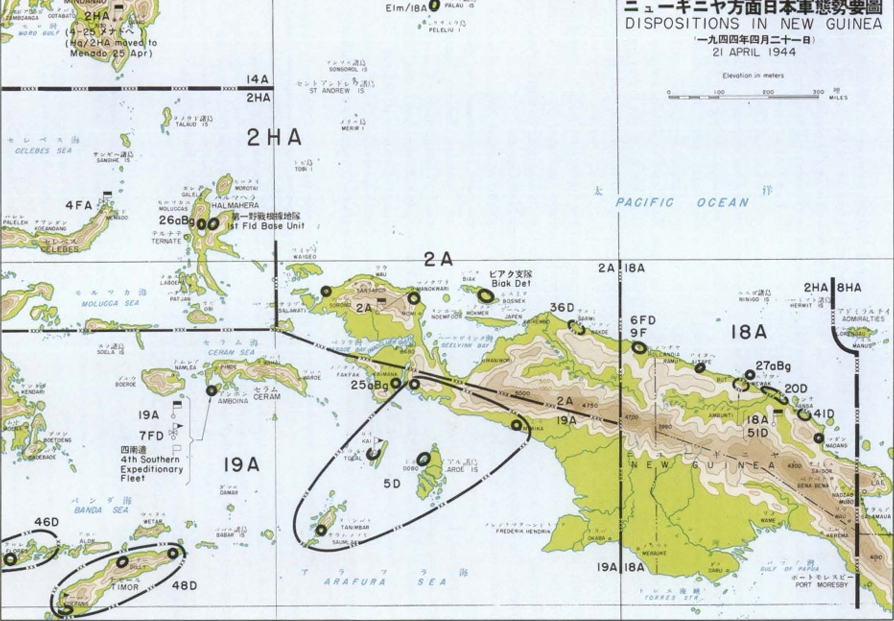
Dispositions in New Guinea
Things began to happen fast after the surprise Allied landing in the Admiralty Islands at the end of February 1944. An Allied decision was made to bypass Hansa Bay and Wewak with the next landing at Hollandia (a shocking 500 miles west of the forward Allied position at Saidor). An increased tempo of air attacks pounded the Wewak airfield complex. Units of the 6th Flying Division abandoned Wewak area airfields and concentrated at Hollandia’s three airfields and bases farther west in the second half of March. U.S. aerial photos showed 208 aircraft at Hollandia area airfields, thirty at Wakde and several that were the first seen at Sawar on 30 March. These were mainly aircraft of the 6th FD plus some stragglers from the 7th FD. The 6th FD reported 127 aircraft operational.[3] The photo count missed any airborne aircraft or those at other bases.
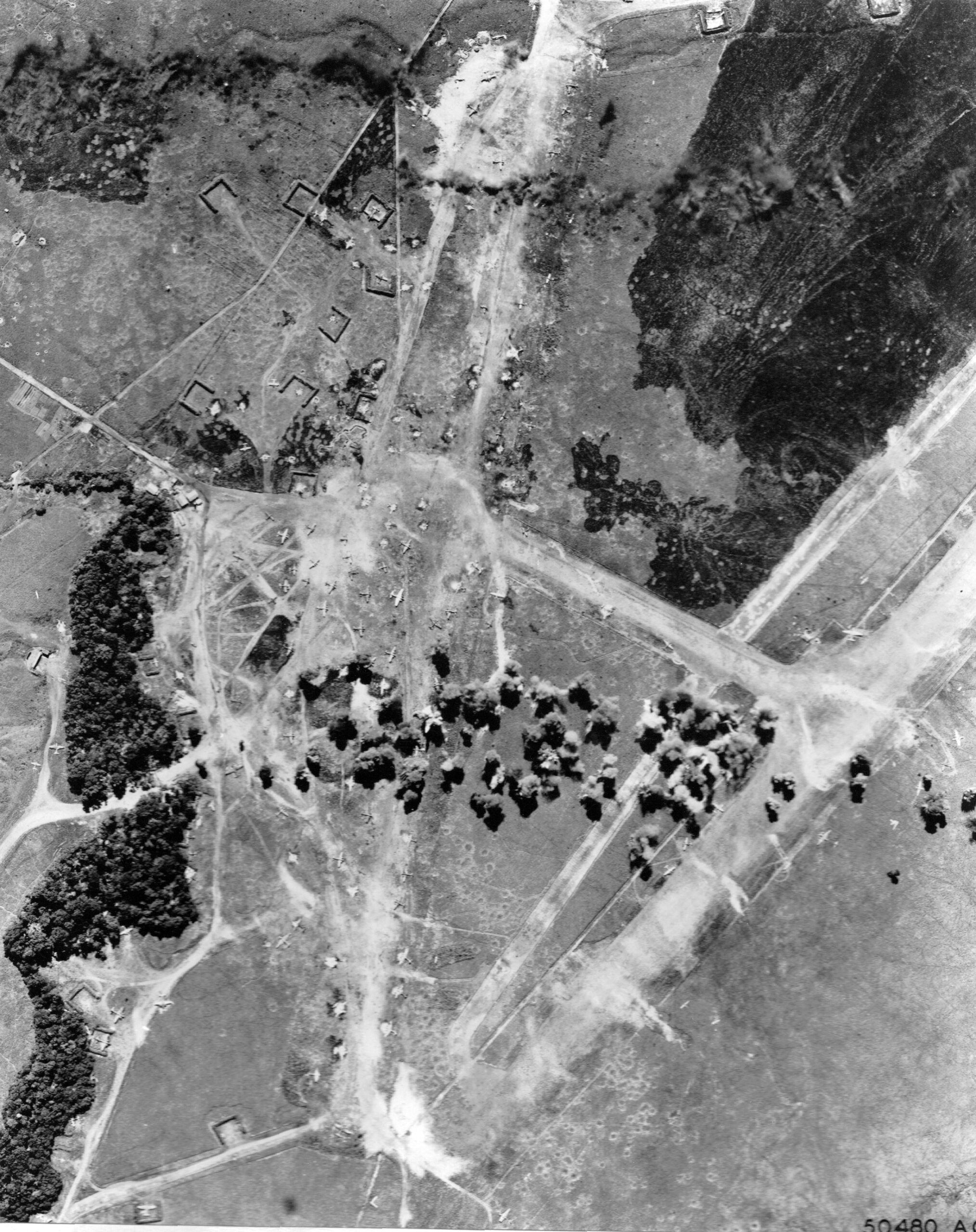
Hollandia
Allied Air Attacks on Hollandia
The daylight air assault on Hollandia commencing on 30 March came as a surprise to the Japanese. While Wewak was being heavily hit by bombers escorted by fighters, 5th Air Force B-24s conducted night raids on Hollandia airfields two or three per night. The Japanese reckoned the Americans could not escort bombers to Hollandia from their current bases. This meant Hollandia was safe from mass bomber raids (and seaborne invasion). But escorted mass raids, the first with sixty-five B-24s escorted by eighty P-38s, did occur. To the Japanese “it seemed that the effective range of the P-38 fighters had suddenly increased.”[4] It had. During February 5th Air Force fighter squadrons received fifty-eight P-38J models with fuel tanks in the leading edge of their wings. Gen. Kenney, 5th Air Force commander, ordered his depot in Australia to modify older model P-38s by installing leading edge tanks. That process was on-going when the attacks began. Moreover, in the lead up to Hollandia Kenney had ordered his fighter squadrons not to penetrate farther than Tadji (Aitape area) to keep the Japanese in the dark about the range extension. The first few attacks were at high altitude. After it was clear the AA defense had been neutralized twin-engine bombers joined in with low level attacks. In just the first few attacks about seventy planes were destroyed on the ground, many damaged and others shot down in air combat all with minimal U.S. losses. By 3 April Japanese operational fighter strength had fallen to twenty-eight. On 12 April, photos showed twelve fighters and four bombers on Hollandia fields, fourteen fighters and twenty-one bombers at Wakde, and five airplanes at Sawar. These included not only those present at the end of March, but aircraft that had arrived as reinforcements. Wakde was hit in night attacks by Liberators and Catalinas of the army and navy. In addition to remnants at Wakde other surviving aircraft or reinforcements enroute were scattered among air bases in the Celebes and other islands.
On 20 April the 6th FD issued a final strength report. It could field only thirty-two operational aircraft. There were twenty-three fighters (fourteen Type 1 and nine Type 3), three light bombers, four headquarters reconnaissance planes and two army reconnaissance planes.[5] Its aircraft were dispersed at a variety of bases. The next day the Hollandia invasion force including twelve aircraft carriers closed in with no Japanese opposition. The day began with massive airstrikes by hundreds of carrier based aircraft against Hollandia, Wakde and other Japanese bases. Resistance to the landings on the 22nd came mainly from personnel in line-of-communication units. Within days the three airfields were captured. Aviation personnel that could not be evacuated were ordered to retreat through the jungles. The 6th FD effectively ceased to exist. Later it was officially disestablished. Meanwhile Allied operations to suppress Japanese air power in the far west of New Guinea had already begun.
Japanese Air Power After Hollandia
The Japanese had failed to establish strong combat air power in western New Guinea. The Army’s 7th FD numbered about a hundred operational aircraft at the beginning of April some of which were at Wakde while most were based on Halmahera Island or islands of the Banda Sea. The Japanese Navy’s air power was represented by the 23rd Air Flotilla, likewise, spread between western New Guinea and islands farther west, with about fifty of its one hundred aircraft operational. In addition to Navy Type Zero fighters, the attached army 24th Flying Regiment (FR) flew the Type 1 (Ki 43) Oscar fighter. Headquarters of the 23rd and some of its fighters (Sentotai S311) and newly assigned bombers (732 Kokutai) moved to Sorong at the western tip of New Guinea in mid-April.
B-24 Liberator Operations Over Western New Guinea
The Allied air campaign was part of an operational plan to move forward beyond Hollandia to Wakde and Biak as a preliminary to occupying the far western tip of New Guinea. This would facilitate an invasion of the Philippines. Initial Allied air operations over far western New Guinea were limited to heavy bombers due to the range involved.
Operating from northwestern Australia under RAAF tactical control was the 380th Bombardment Group (BG). B-24 squadrons from this group had operated over western New Guinea episodically in 1943 and continued such attacks in 1944. Flying from bases near Nadzab in New Guinea’s Ramu Valley were Liberators of the recently re-equipped 22nd BG and the veteran 43rd and 90th BGs. Initially bomb loads were limited by the need to carry bomb bay fuel tanks due to the long range of missions. Joining the assault from Momote in the Admiralty Islands were Liberators of the 5th BG part of a 13th Air Force task force sent to operate with the 5th Air Force. They would be joined by the 307th BG, another 13th Air Force unit in May. Also, at Momote were PB4Y-1 navy Liberators of VB-106. Their main mission was long range search, but they could and did conduct occasional bombing missions. U.S. Navy PBYs and Australian Catalinas engaged in patrols and occasional attacks.
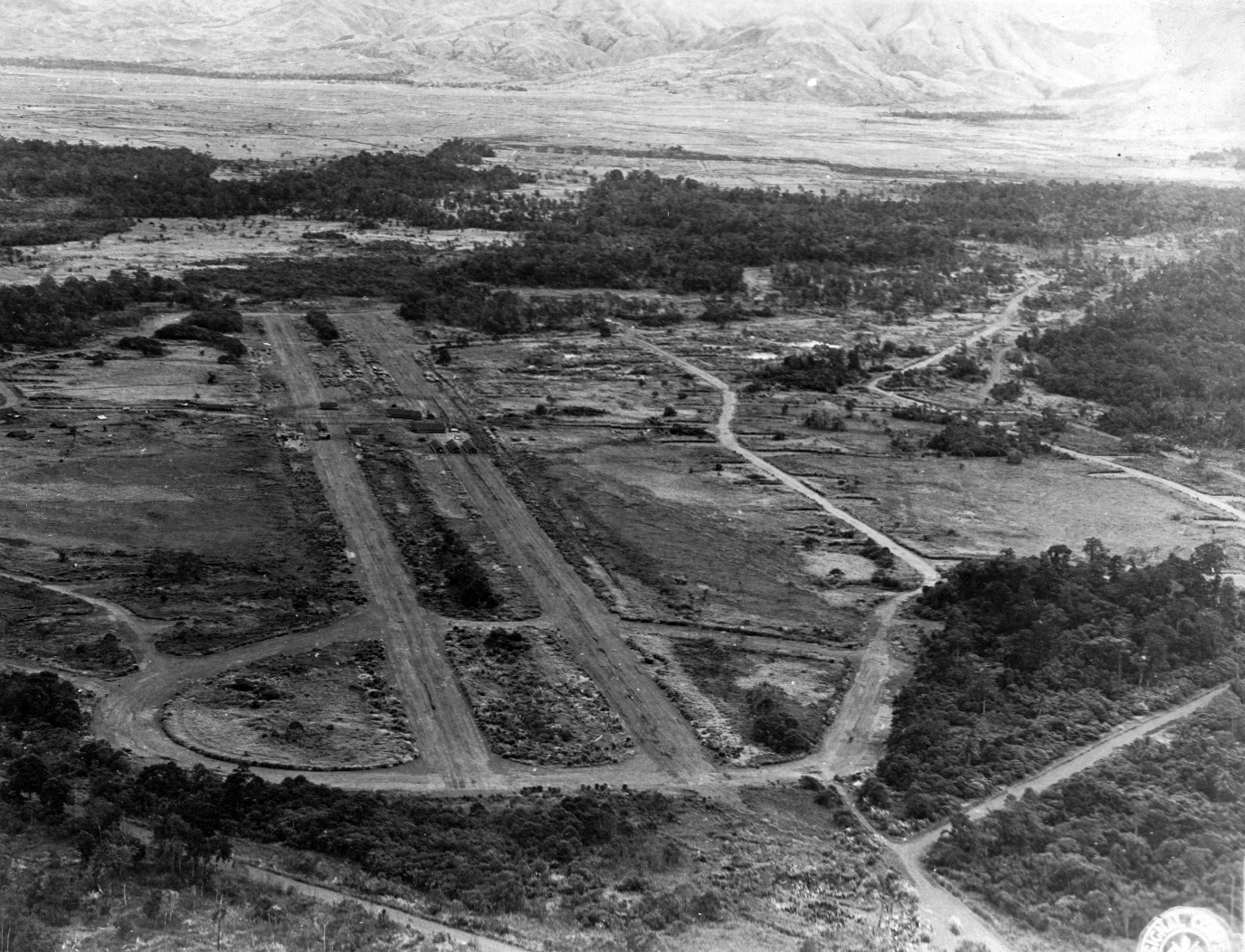
Nadzab
The 380th BG flew two missions against airfields in the Kai Islands in the first week of April. Although bombs holed runways, later after reviewing mission photos, RAAF Command thought these strikes were unproductive. The Japanese recorded a reconnaissance plane and a cargo plane damaged.[6] One additional strike by 22 B-24s was carried out on the 17th. A detachment of Japanese army Type 1 fighters of Maj. Hisao Machida’s 13th FR, whose main base was Wasile on Halmahera Island, at Langgoer to cover a convoy (the principal mission of Japanese fighters in the area) sighted the Liberators. Three fighters took station to protect the convoy. Three others intercepted the bombers. The Japanese reported they caused one bomber to emit white smoke and that one fighter received four hits. The Americans reported seeing six to eight fighters and claimed one “Zero” probably destroyed. Strikes were extended to Babo and Manokwari on the 18th and 19th. Eight aircraft including four fighters were observed on the ground at Babo. In the Manokwari raid nine B-24s reached the target. Ten aborted and bombed Utarom on New Guinea’s south coast. Three Zeros intercepted B-24s over the Kai Islands and claimed one probable (“uncertain”) victory and four damaged. In this and subsequent April operations several B-24s were damaged but all returned to base. The 380th BG’s B-24s were primarily B-24J’s with some B-24D’s and D-1’s (B-24D modified with a power nose turret). They carried a reduced bomb load of about a ton per plane.
The Air Campaign Against Noemfoor
Beginning on 20 April, a series of attacks were directed against Kamiri and Namber airfields on Noemfoor Island as support for the Hollandia landings.
The Noemfoor attack on the 20th involved a maximum effort for the four squadrons of 380th BG. Two dozen Liberators constituted the main strike force, dividing their effort between the two airfields. Another B-24 was on standby at Darwin to aid in search and rescue if needed. Two B-24s acting independently were detailed to conduct reconnaissance over Geelvink Bay, one early and the other about the same time as the bombing attack. Three bombers aborted. At Kamiri most bombs hit the runway or nearby. At Namber about half the bombs hit the runway. Photographs showed fourteen bombers and twenty fighters at Kamiri. One fighter was assessed destroyed and three believed to be wrecked. One fighter was seen taking off from Namber. There was little if any AA fire. A mission report described the interception:
One NATE [Army Type 97 fighter] made one attack from 11 o’clock…at 10,000 feet. The attack was broken off at 500 yards. One [B-24] received minor damage from machine gun fire…No injury to crew. The fighter took off from Kamiri strip followed the formation for 50 miles but made no further attack.[7]
The identification of the attacker as a Type 97 Nate fighter is extremely dubious. However, based on Noemfoor at that time was a detachment of the 73rd independent squadron (FCs) flying the Type 99 Army Reconnaissance Plane (Ki 51A). Like the Type 97 fighter this recon plane had a fixed undercarriage and two forward firing machine guns. One of the recon Liberators was attacked by a fighter identified as a Zeke (navy Zero). It made a single pass pressed to 150 yards and then followed the Liberator for five minutes out of range.
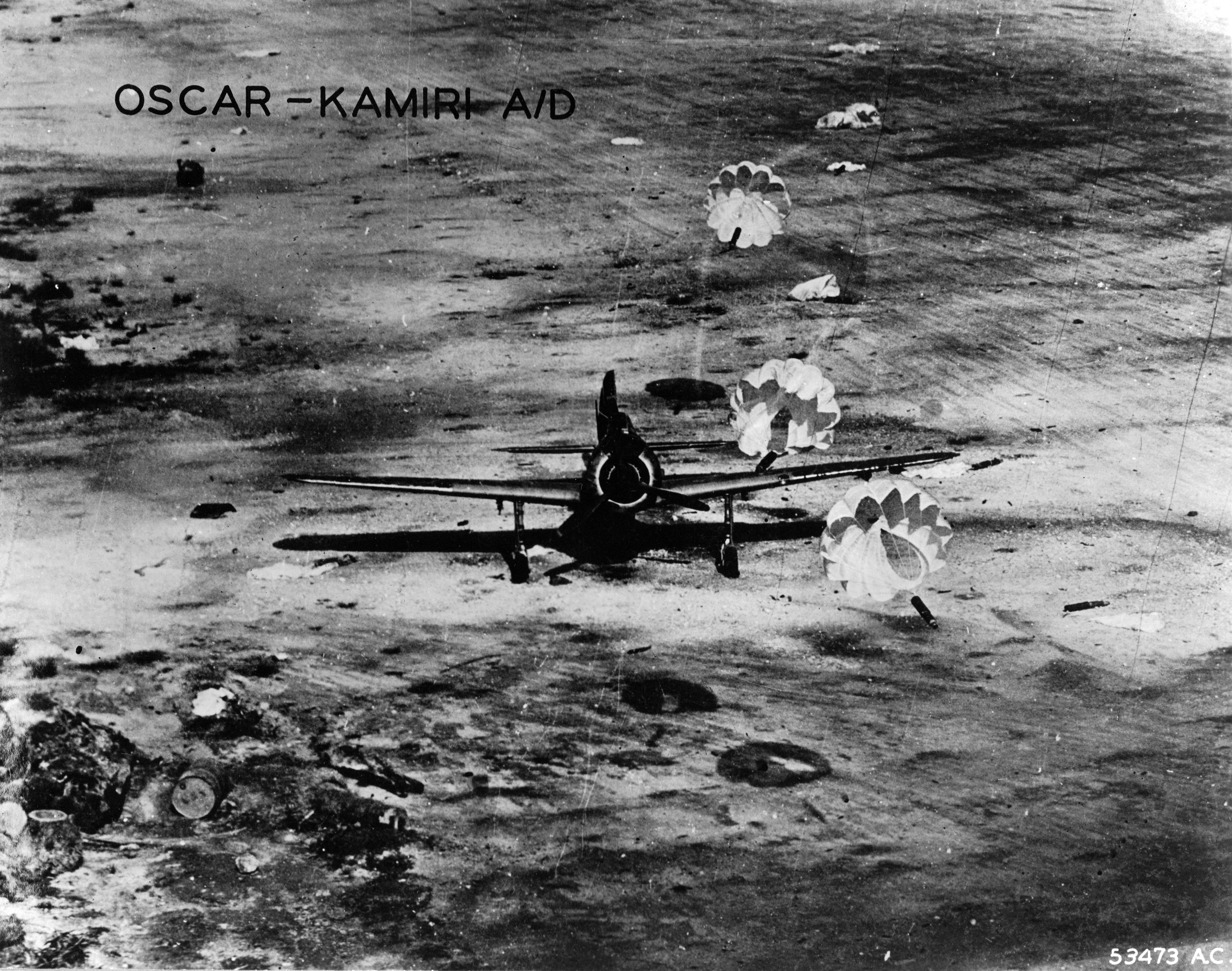
Noemfoor Oscar
The following day twenty-one Liberators delivered 24 tons of bombs on the airfields. Photos showed twenty-eight aircraft on the fields, fifteen of which were apparently serviceable. Three Type 1 fighters scrambled. The Americans reported:
One Zeke, two Oscars and one unidentified fighter, airborne over Namber intercepted immediately after the bombing run and over Kamiri four Zekes intercepted during the bombing run. One Zeke and one Oscar were probably damaged during the interceptions, which were not too eager, and three Liberators were slightly damaged.[8]
Attacks were repeated by twenty-two B-24s on 22 April with a mix of demolition and fragmentation bombs. Four or five reported Zekes and Hamps intercepted but did not eagerly press their firing passes.[9] Japanese records available to the author provide no information on this or the previous day’s interception.
Before 23 April, Japanese reports placed only three Type 1 Model II fighters of the 13th FR at Noemfoor; most were based at Wasile. U.S. photographs taken on 22 April showed five apparently serviceable aircraft at Kamiri and none at Namber. However, a Japanese message reported twenty-two 13th FR fighters arrived at Noemfoor by 23 April.[10]
The U.S. plan of attack for Noemfoor on the 23rd called for eighteen B-24s evenly divided between Kamiri and Namber. Four were loaded with 15x 120lb. fragmentation clusters, the rest with 5x500lb. demolition bombs. In contrast to eighteen bombers, farther east ninety Allied bombers including forty-five B-24s hit airfields and ground positions in the Wewak area that day. Eighty bombers and attack aircraft including sixteen B-24s struck targets in the Hansa Bay area. No aerial opposition was encountered. Also active during the second half of April, Navy PB4Ys flew patrol missions along and beyond the northwestern coast of New Guinea. They attacked any shipping encountered and shot down some Japanese patrol planes.
The April 23 Air Battle Over Noemfoor
For the 380th BG and particularly its 528th BS 23 April was a most notable mission. Things did not begin well when one Liberator failed to take off. Two others suffered mechanical problems, jettisoned their bombs in the sea and returned to base. The lead B-24 of the Namber flight also had some mechanical difficulty and bombed Nabire on the southern shore of Geelvink Bay. Three other B-24s followed suit and bombed the same target which was the site of a little used airfield where strike photos showed no aircraft were present. The remaining Liberators reorganized into two flights of five and six bombers. The first flight found Kamiri covered by clouds.
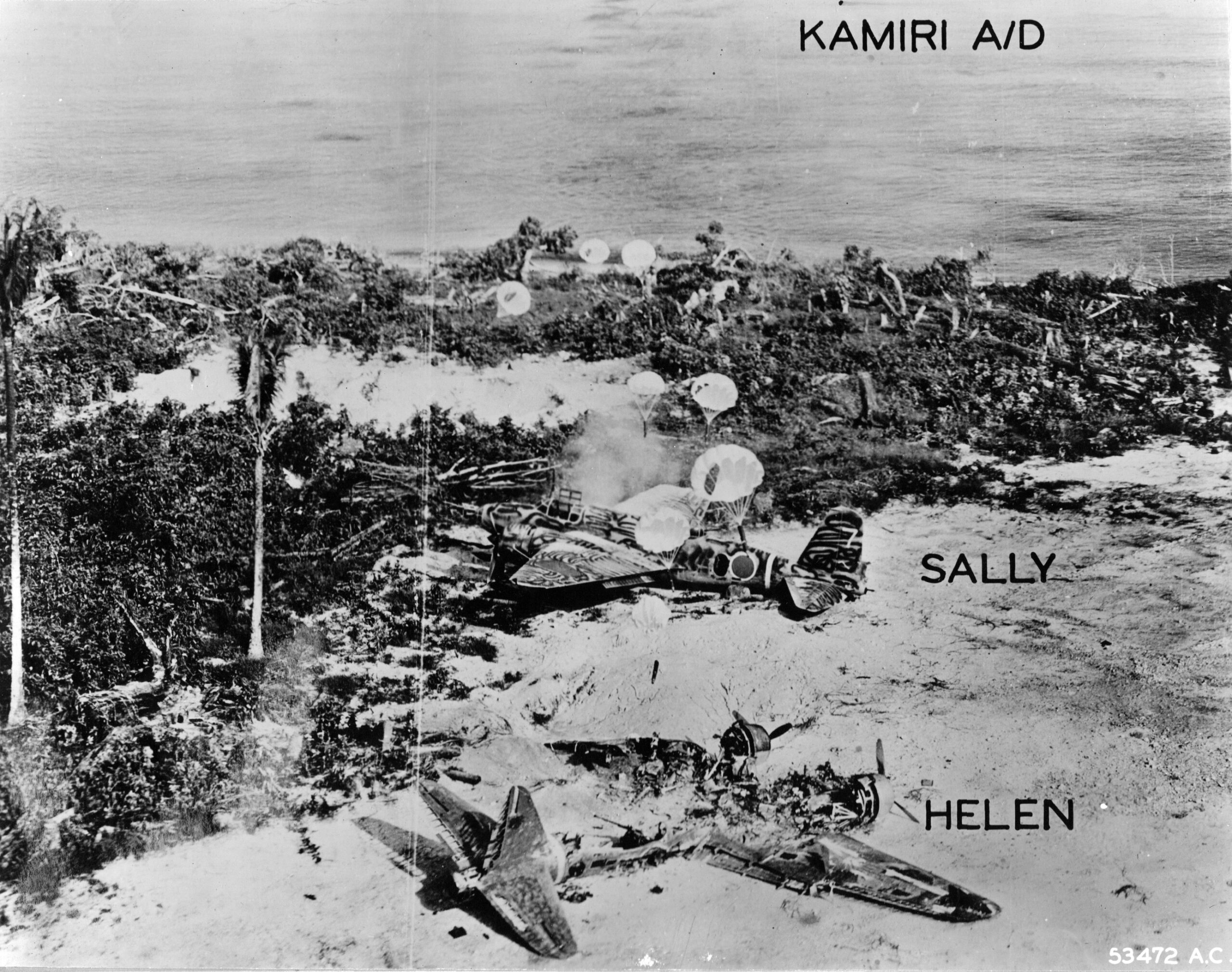
Noemfoor
The first formation made its bomb run from 10,000 feet without encountering AA or fighters. “After the first formation of Liberators had dropped the demolition and fragmentation bombs on Namber, eight Zekes, Oscars and Hamps intercepted. During thirty minutes both individual and coordinated attacks were pressed by experienced pilots. As the second formation which included [529th BS] Liberators neared the target, twenty Zekes, Tonys, Oscars and Hamps were observed 1000 feet above. Combat began during the bomb run, attacks from frontal positions being pressed to 100 yards by eager enemy pilots…During these two combats ten enemy fighters were destroyed and three were claimed probably destroyed.” Several air burst bombs were dropped.[11] One crew reported that a twin-engine Nick carried out an attack.
For one B-24 the combat was not over. The 528th BS Liberator piloted by 1Lt. Robert Dunseth had its No. 4 engine shot out and No. 3 damaged. It was subjected to an hour long battle with fourteen fighters in two formations of seven each. Two Zekes and two Hamps were claimed destroyed and an unidentified fighter damaged. The bomber landed on just two operative engines with the wounded pilot aided by the flight engineer replacing the badly wounded co-pilot. One crewman was killed and two wounded. In addition to two engines out the wings and fuselage suffered numerous hits. Another Liberator landed with three working engines carrying three wounded crewmen. Ten Silver Star medals and twenty-one Distinguished Flying Crosses were awarded for this mission.[12] In total seven of the group’s Liberators were damaged, five seriously, and ten crewmen wounded in addition to one killed.
It seems likely that by overflying Nabire the Liberators gave the Japanese advanced warning. Navy Zeros scrambled from Biak and the reinforced 13th FR Hayabusas were up from Noemfoor. Either six possibly eight navy Zeros were involved, in addition to fourteen Type 1 fighters that intercepted. The Zeros claimed their attacks caused three bombers to emit black smoke with only slight damage to themselves. The Army suffered the loss of four planes (possibly including ground losses) and one pilot wounded claiming three bombers certain and two probable.[13]
The next day a dozen B-24s returned to hit Kamiri. About thirty planes were sighted on the ground, some of which were destroyed. There was no interception. Noemfoor was not attacked on the twenty-fifth. On the twenty-sixth Jefman Island off the western tip of New Guinea was bombed by ten B-24s. Numerous aircraft were sighted and one fighter taking off was destroyed. This strike may be the reason navy bombers failed to send an attack from Sorong against Hollandia shipping during the night. The time of the 380th BG as the main force striking western New Guinea was about over. With Hollandia’s airfields in Allied hands other B-24 groups were detailed for long range missions to western New Guinea beyond Wakde.
Air Strikes on Biak and Western New Guinea
Navy PB4Ys struck shipping targets in the vicinity of Biak Island during April patrol missions and on the 18th, bombs fell on land there inflicting a few casualties and causing some damage. Biak received its first heavy attack by Liberators flying from Nadzab on the 28th of April. In the morning bombs from thirty-two B-24s of the 90th Bomb Group inflicted casualties, damaged aircraft and airfield installations. Several navy Zeros had arrived a couple days earlier. During the interception by a reported dozen fighters, B-24 gunners claimed two destroyed and two probably destroyed. The 43rd Bomb Group divided its efforts between Wakde and Biak with thirteen adding to the Biak damage in the afternoon. All U.S. bombers returned to base. Seven 380th B-24s visited Sorong where they claimed one destroyed and one probable of several intercepting fighters. The Japanese claimed two bombers heavily damaged. Also, on the 28th Japanese Imperial General Headquarters belatedly issued a communique announcing that on 22 April “the enemy began landing in the vicinity of Hollandia and Aitape, New Guinea and since has been strengthening his position. Our land and air units…intercepted the enemy and are presently engaged in fighting.” By that date all three Hollandia airfields were in Allied hands and personnel from the Japanese army and navy garrisons were retreating to the west.
The last day of April saw the 380th BG mount two missions to western New Guinea. Seven B-24s dropped 100lb. and 500lb. demolition bombs on Kamiri where several Japanese fighters were aloft but none came within 500 yards from the bombers. Three other Liberators conducted an armed reconnaissance over Geelvinck Bay. They first met three Zekes near Manokwari and then a reported fifteen Zekes, Hamps and Oscars in the vicinity of Biak Island. Gunners claimed six kills and two probables. Two B-24s were damaged, one of which crash landed upon return.
Japanese Bomber Attacks During the Hollandia Campaign
Admiral Nimitz’ monthly report for April reflected the intelligence assessment that in New Guinea Japanese army bombers had mounted only about twenty sorties mainly in single plane raids. Targets included PT boats and Allied positions in the Saidor region.[14] The Japanese had little to show for their efforts, but what they did accomplish suggests that had they been able to mount a more fulsome effort the vast assembly of ships close offshore and troop concentrations on land might have been dealt significant blows.
By early April Japanese bombers abandoned Wewak and Hollandia. Surviving bombers of the 6th FD were scattered at various bases. Those of the 7th FD were still somewhat effective. The Type 100 heavy bombers (Helen) of the 61st FR had withdrawn to Galela on Halmahera Island flying over ocean patrols with occasional forward deployments to Noemfoor. Most remaining Type 99 light bombers (Lily) of the 75th FR had retreated to Kamiri airfield within range of the invasion area. They mounted night attacks, some of which were aborted by weather. On 6 April a single bomber dropping three bombs inflicted casualties near Saidor, 16 killed and 34 wounded. Five nights later a single bomber raid caused material damage in the same area. During daylight on the day of the landings navy Hellcats encountered a formation of four twin-engine bombers identified as Sallys. They were flying at 135 knots, taking no defensive measures and were all shot down.[15] Transport versions of the Type 97 bomber were flying missions to Hollandia to evacuate aviation personnel. These aircraft were probably on a transport mission rather than bombing. They were among several aircraft claimed by Hellcats during the day.
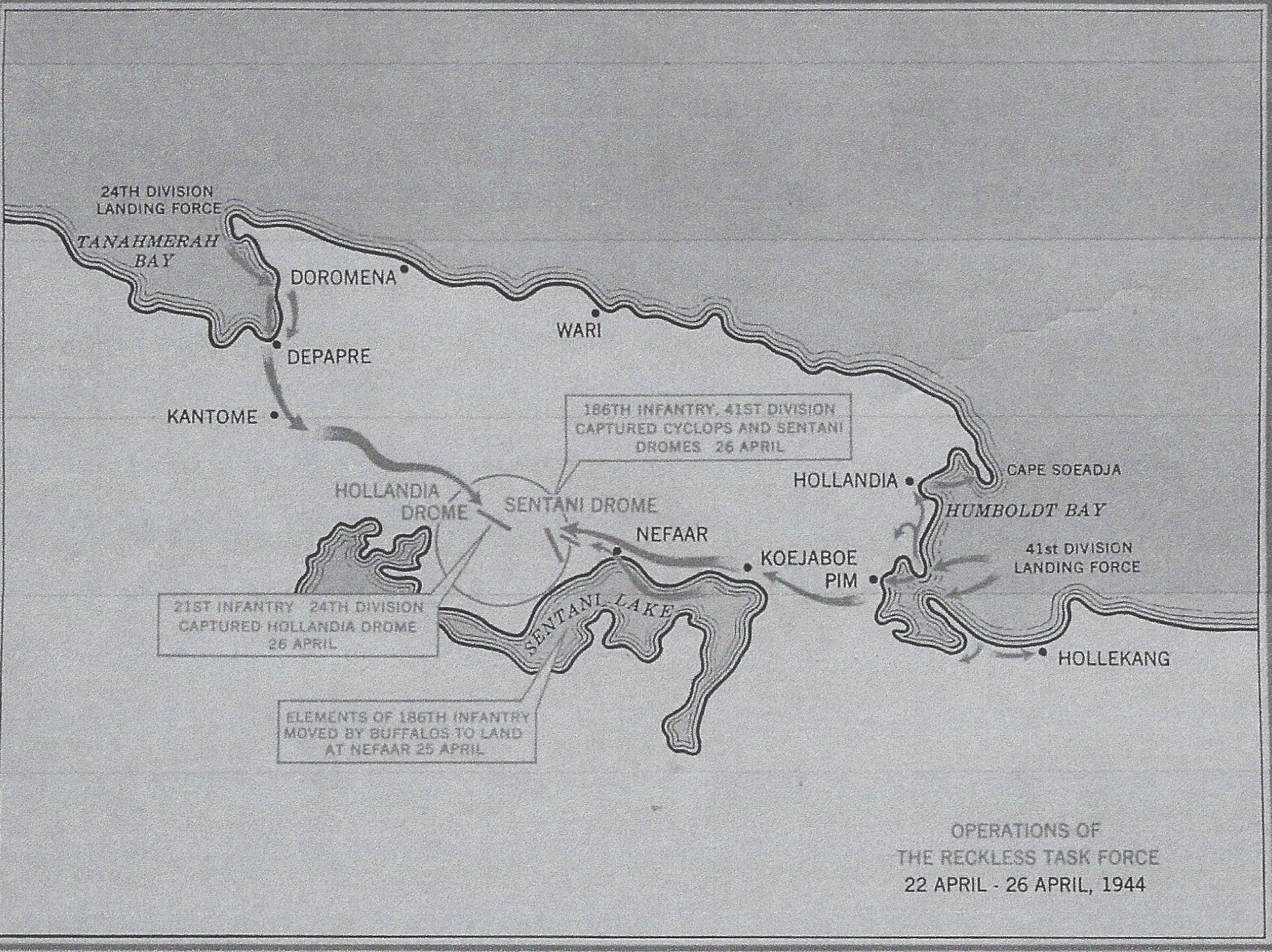
Operations of the Reckless Task Force
During the landing operations on 21 April U.S. Navy carrier planes bombed a Japanese supply dump close to the landing beaches at Humbolt Bay causing damage and fires. Two nights later some of the fires still burning provided an aiming point for a Type 100 heavy bomber (Helen) piloted by Capt. Koji Ogino.[16] The beach area was crowded with surviving Japanese supplies plus eleven recently landed LST loads which included ordnance and fuel. A stick of four bombs fell near both Japanese and U.S. supplies. One bomb caused multiple explosions from a Japanese bomb dump starting widespread fires. Twenty-four men were killed and over a hundred wounded. The fires, destruction and accumulation of mangled equipment on White Beach One at Humbolt Bay was so great it interfered with unloading operations. Cargoes destined for the bombed beach were redirected to other beaches some as far as Tanahmerah Bay.[17]
Japanese Navy Attacks on Allied Shipping
The Japanese Navy area “North of Australia” lost its veteran Air Group 753 (former Takao Ku) in February 1944 after two years of successful bomber operations. The group was transferred to the Caroline Islands after American carrier raids there subsequently returning to Japan to reconstitute after heavy losses. Relatively new Air Group 732, which had been based in Malaya as an operational training unit since December 1943, took on an operational role in the Southwest Area mainly anti-submarine patrols. Initially operating from Malaya, its twenty Type 1 land attack bombers (Rikko) moved to the Philippines in April.
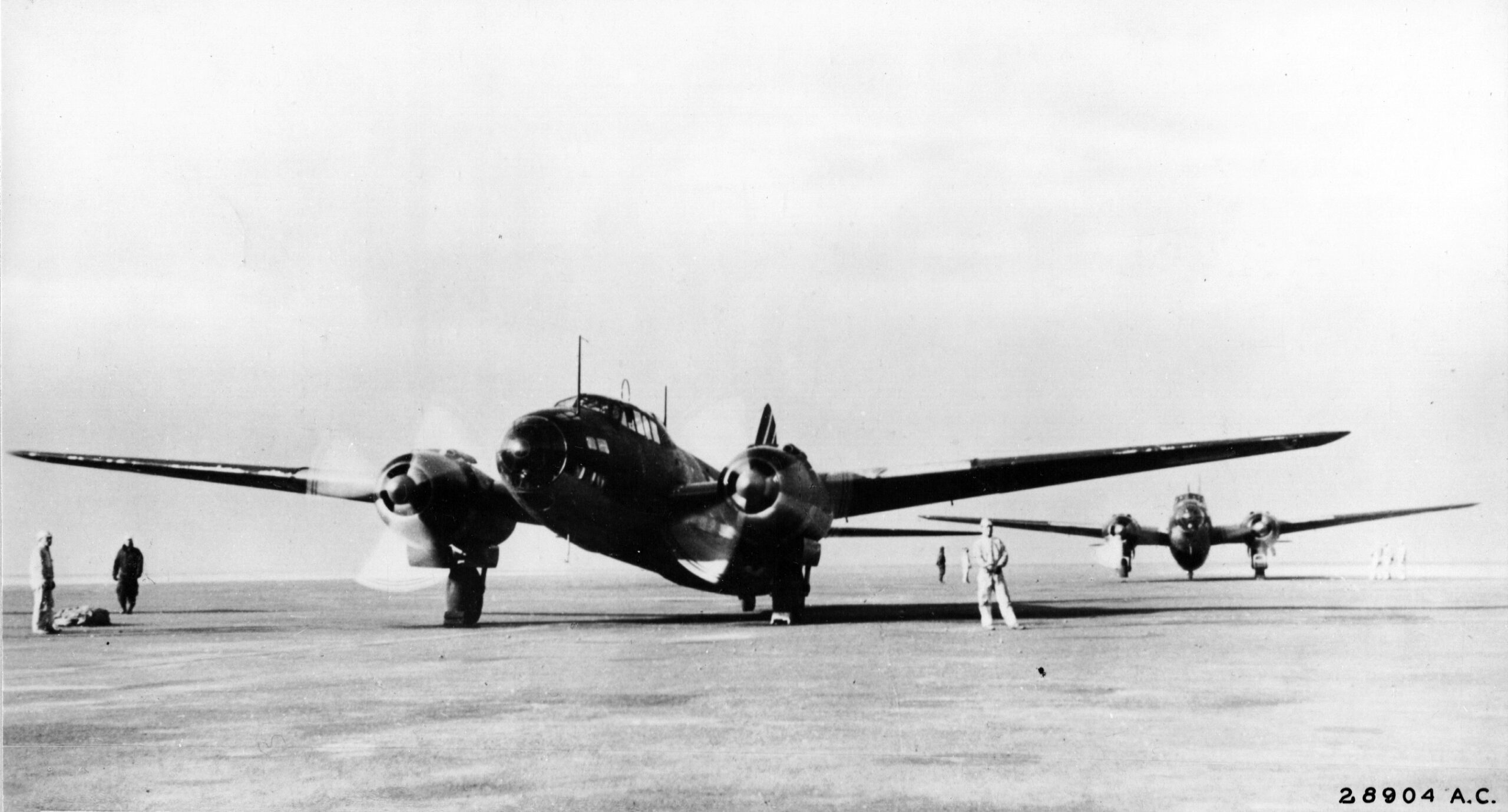
Type 1 Rikko
The Hollandia invasion caught the Japanese army with their main ground troop dispositions by-passed. Their air power was in shreds from the recent Fifth Air Force blitz against airfields at Hollandia, Wakde and Sawar. For the Japanese navy the crowd of shipping near Hollandia created a rich target opportunity. Where would they get the fire power to take advantage?
The 23rd Air Flotilla had recently been placed under the command of the land based 1st Air Fleet vice the Southwestern Area Fleet. Western New Guinea was the southern flank of the key area (Marianas/western Carolines) the 1st Air Fleet was expected to defend. Air Group 732 was ordered to transfer from Digos on Mindanao, Philippine Islands to Sorong where 23rd Air Flotilla had moved its headquarters. Although air groups of the 1st Air Fleet’s 61st Air Flotilla had recently suffered losses in American carrier raids an ad hoc unit was formed from Air Groups 755 and 761 and sent to Sorong.[18] The Umeda Unit of thirteen rikkos arrived at Sorong on April 23rd. Seventeen Bettys of the 732 Air carried out their first attack on Hollandia shipping after dark that day in bad weather. They failed to contact any shipping and two bombers failed to return from the 600 mile flight. Thirteen bombers from the combined air groups tried again on the 24th. Only one returning bomber claimed to have carried out a torpedo attack. The destroyer U.S.S. Schroeder reported eight to twelve Japanese bombers dropped flares and some carried out torpedo runs. No damage was inflicted during the attacks. Disaster befell the Japanese bombers. Encountering stormy weather eight failed to return. The following day was spent searching for the missing bombers. Eventually two crews were recovered. Two days after the attack Schroeder captured one of three bomber crewmen in a rubber raft. Two others refused to be rescued.
On the 27th, eleven of the bombers led by Lt. Toshimasa Ueyama attacked Allied vessels east of Aitape. They claimed sinking a cruiser and a transport. Four bombers failed to return. U.S.S. Etamin a Liberty ship in naval service reported being attacked by three planes. One torpedo scored a hit in the vicinity of No. 5 hatch causing much damage in engineering spaces and inflicting casualties. Etamin did not sink. She was towed to Australia. Her damage was so significant that she was decommissioned. For a time, she served as a kind of floating warehouse. Etamin was the only vessel to receive damage from air attack in the Hollandia invasion.
Part 2 will deal with air operations in May and early June 1944.
Footnotes:
[1] Dunn, South Pacific Air War, Schiffer, Atglen PA), pp. 431-432.
[2] History of the 2nd Area Army (1943-1945), Japanese Monograph No. 13; Western New Guinea and North of Australia Area Naval Operations (April-September 1944), Japanese Monograph No. 87; North of Australia Operations Record (January 1944-August 1945), Japanese Monograph No. 136; Records of General MacArthur Vol. II, Pt. I, U.S. Army (1966/1994).
[3] Southeast Area Air Operations Record (November 1942-April 1944), Japanese Monograph No. 32, Appendix (Vol.) 6, p. 38. Allied intelligence credited the Japanese with a total of 313 aircraft in New Guinea of which 279 were combat types including 145 single-engine fighters. This indicates a serviceability rate of about 40 per cent. In the case of single-engine fighters (54) it was a little less than 40 per cent. As many as 59 aircraft including 26 fighters were observed at Wakde (31 March).
[4] Monograph No, 87 (note 2), p.5.
[5] 6th FD msg. 365, 20 April 1600 hrs. (ATIS translation F-14,300). Remnants of the 6th FD units in the Indies came under the jurisdiction of 7th FD.
[6] Odgers, Air War Against Japan 1943-1945, Australian War Memorial, Canberra (1957), p. 217; 23rd Air Squadron Battle Diary (WDC No. 160158), p.2. This document is poorly translated; compare with other sources if possible.
[7] Mission report FEN. 27 (20 Apr. 1944); the reconnaissance mission, FEN. 28.
[8] U.S. reports that both Zekes and Oscars intercepted may be correct. The 23rd Air Flotilla Battle Diary (note 6) claims one four-motored plane was shot down but does not specify the aircraft type involved.
[9] Mission reports and “The History of the 380th Bomb Group (H) AAF, November 1942-September 1945”, (no author, no date) p. 39, visited at Fold3.com) differ somewhat as to types and numbers of intercepting fighters, damage given and received. The involvement of navy Zeros is not supported in available Japanese records.
[10] Hata et al., Japanese Army Air Force Fighter Units and Their Aces 1931-1945, Grub Street, London (2002), p.47 states 13th Sentai moved to Noemfoor with 26 fighters on the 23rd. A translated Japanese message credits the 13th FR with 32 fighters of which 24 were operational on that date.
[11] Mission report, 529th BS. U.S. reports call the aerial bombs “phosphorus bombs” suggesting Japanese navy No. 3 bombs. Japanese army aerial bombs were hollow charge bombs.
[12] Mission report 528th BS and “The History…” (note 9) pp. 39,133.
[13] Army report: 4th Air Army Msg. No. 3,515 (27 Apr. 1944/1655). Message says, “3 to 7” before “certain”. Navy report: Seisau msg. No. 222 (25 Apr. 1944/2020), translation F 15,322 NARA RG 457 mentions six Zeros. 23rd Air Flotilla (note 6) mentions eight Zeros, misstates target as Biak and says 3 American planes and 1 Japanese plane was shot down.
[14] CINCPAC, Operations in Pacific Ocean Areas, April 1944
[15] Comtask-group 58.3, Report of Operations Hollandia…, 1 May 1944, p. 5.
[16] Author’s notes from a translated summary of Izawa, Nihon Rikugun Jubakutai, U.K (1982).
[17] McCartney, Jungleers A History of the 41st Infantry Division, Infantry Journal Press, Washington (1948), p. 96; Seventh Amphibious Force war diary April 1944.
[18] Data in this and next two paragraphs rely on Izawa, Rikko and Ginga, Eng. lang. unpublished manuscript, n.d., pp. 173-177 (copy in possession of author); April 1944 war diaries of Seventh Amphib Force (note 17) and U.S.S. Schroeder; Pacificwrecks.com profile of U.S.S. Etamin.
Trackbacks/Pingbacks