
In Part I of this series we examined the broad contours of Japanese pilot training and experience during the Pacific War. Part II goes deeper — and gets more specific. The evidence presented here comes primarily from prisoner-of-war interrogation reports, captured flight logbooks, translated unit operation orders, and intercepted radio traffic, sources that allow a more granular picture than postwar memoirs or official histories typically provide. What emerges is a story of a training system that functioned with notable rigor in the early war years, then buckled under the weight of combat attrition, accelerated quotas, inexperienced instructors, and a persistent — and costly — reluctance to equip pilots and aircraft with the protective measures their Allied opponents had already adopted. The data are not always tidy, and the reader should weigh them accordingly. But the arc they describe is consistent and, by 1944, unmistakable.
Information provided in this Part comes mainly from primary sources. Mainly does not mean everything which will be evident. Moreover, primary source data are not necessarily equally factual, nor does it exclude opinions. A collection of primary source statistical data is presented in the last section. I also understand that for some, this may be more than you really wanted to know.
Japanese Army Air Force Pilot Training: What POW Records Reveal
Initially we will try to at least partially remedy the dearth of material concerning the Japanese Army Air Force in Part I. An informative summary of a prisoner of war (POW) interrogation report gives interesting details of J.A.A.F. training.[1] The POW is not identified but from internal evidence is almost certainly W.O. Takashi Noguchi, who graduated from pilot training in early 1939 and served as a flight instructor until April 1942. He joined 68th Flying Regiment in Manchuria as a fighter pilot. The unit converted to a new aircraft in Japan before deploying to the Southeast Area in April 1943. He flew in combat from mid-1943 until being shot down and captured off the coast of Saidor, New Guinea in January 1944.
POW stated that youths in the Juvenile Soldier program entered at age 15-16 and had a Higher Primary School (Young Men’s School) education. Upon graduation they received the rank of Superior Private. They were given the same flying training as soldiers who transferred from other branches of the service, but who typically would have a higher rank. Primary flight training lasted about six months. Students received dual instruction for about twenty hours until becoming proficient in take-off and landing and basic elements of flying. They then mainly flew solo, flying with instructors episodically. Subjects included aerobatics, instrument flying, cross-country, altitude and formation flying.
Flight training was conducted in the morning with students flying 30 minutes to an hour per session about 20 days per month. There was no flying on Sundays or rainy days. Afternoons were devoted to studying engines, airplanes, weather, flight tactics and other subjects. By the end of primary training students had accumulated about 90 hours of flying time. Aircraft used were Type 95 Trainer, model 1 (biplane, fixed undercarriage) and Type 99 Advanced Trainer (monoplane, fixed undercarriage). Washout rate was about 10 percent.
All students in primary training flew the same type aircraft. Students could express a preference for their flying branch, but the primary determinant was the evaluation and report of instructors as to the student’s aptitude. In two to three months of secondary training students were split up into bomber, fighter or reconnaissance tracks gaining thirty to forty additional flying hours. Aircraft types used were Type 97 and T. 1 model I for fighters; T. 97 heavy bombers for bomber pilots; T. 97, model II headquarters reconnaissance, T. 99 army reconnaissance, or T. 100 twin-engine headquarters reconnaissance planes.
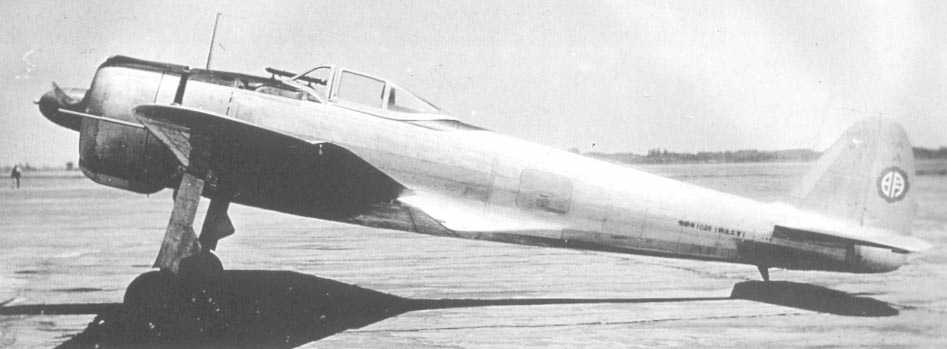
Type model 1 fighter
Next came “advanced specialist flying school”. Fighter pilots were trained at Akeno, bomber pilots at Hamamatsu, and reconnaissance at Hokoda or Shimoshizu flying schools. Fighter and reconnaissance pilots received about 120 flying hours (240 total hours). Bomber pilots gained about 200 flying hours (320 total hours). Skills included aerobatics, formation flying, combat tactics, attack methods including firing practice, and night flying.
Fighter and light bomber pilots after graduation were rated as (1) suitable immediately for combat. (2) requires one month’s additional training, or (3) requires six months additional training. Usually, all pilots were given combat training in the units to which they were assigned until flying hours totaled five hundred before being sent into combat.
As an interesting corollary to Noguchi’s POW testimony, two Japanese army officer fighter pilots captured respectively in China and Burma (see The Last Mission of Lieutenant Noriyuki Saito – RLDunn) in late 1943 reported acquiring hundreds of hours as additional training or as instructors before doing any combat flying.
The interrogation report of a POW fighter pilot captured in Burma in 1942 whose initial training took place at Tachiarai from February 1940 to February 1941 generally agreed with Noguchi’s report. Average flight time in a year was given as 150 hours. When interrogators pointed out that the data he gave meant average daily flying time was forty minutes, POW maintained that was accurate.[2]
An officer POW captured in Burma started his primary training in early 1942 while a cadet in officers’ school.[3] While there he reportedly logged 90 hours in a Type 95 biplane trainer and 20 hours in a Type 98 monoplane trainer. At Akeno beginning in June 1943, he flew more than 150 hours in a Type 97 fighter and 50 hours in a Type 1 model II fighter by the time he completed operational training in early March 1944. He flew only a few combat missions in April 1944 with the 204th FR before suffering engine failure during a combat mission in early May.
There were variations to the pattern laid out in the POW interrogation reports. An incomplete but interesting flight record of Minoru Toyama was captured at Hollandia, New Guinea. He had received some flight training before the first entry in the record in early 1941. His recorded time in training planes involved 190 flights and 50 hours of flying time in the Type 95, model I (350 h.p.) trainer and Type 99 (450 h.p.) advanced trainer. He then trained 3-½ months in the Type 98 (800 h.p.) light bomber accomplishing 144 flights and adding 96 hours to his flying time up to early 1942. There is another gap in the record. In 2 plus months at Hokoda Flight School in early 1943 he was introduced to the Type 1 twin-engine (450 h.p.) advanced trainer, adding 36 hours to his flying time. By July 1943 he had transitioned to the Type 99 light bomber (Ki 48) and was assigned to the air transport command. He flew air transport missions for several months before being assigned to the 208th Flying Regiment in November 1943. He continued to fly air transport missions and participated in only three bombing missions by February 1944. Total flying time as of 12 February 1944 – 527 hours.[4]
Combat Readiness in Question: The 208th Flying Regiment’s Rocky Debut
Mention of the 208th Flying Regiment (FR) brings up another type of example – the readiness of an entire unit for combat. In 1941 and most of 1942 the regiment was known as the 208th Air Training (or Instruction) Regiment.[5] It was part of the Peichengtsu Air School (later Peichengtsu Air Instruction Brigade) located in central Manchuria. The regiment commanded by Col. Kenzo Furuyu primarily flew single-engine fixed landing gear light bombers. The twin-engine Type 99 Model I light bomber (Ki 48-I) was added in mid-1941. Early in December 1942 six officer and non-commissioned officer pilots were sent to Hokoda Flying School to train on the Type 99 light bomber model II. In mid-December the regiment was ordered to Gifu, Japan to reequip with the new aircraft prior to deployment to Japan’s Southeast Area where intense combat was occurring. The transfer involving rail and sea transport took place and transition training commenced. Details are unknown but pilots and other aircrew members may have been a mix of instructors and men who had recently been students. Reequipping and training in Japan apparently lasted less than a month. By 1 February 1943 the unit’s personnel and thirty-six Type 99 model II light bombers were aboard auxiliary aircraft carrier Unyo bound for Truk. Arriving on 7 February the original plan was to get them to Rabaul as soon as possible.
The original plan was not executed. An order dated 19 February directed the regiment to carry out training on Truk’s Moen Island “for the time being.” A month later a brigade staff officer was ordered to Truk to inspect the 208th. It seems the regiment was not deemed ready for combat. After that inspection another month passed before the regiment was ordered to fly to Rabaul/Kokopo effective 27 April. The regimental headquarters flight started the movement on 24 April but turned back due to weather.[6] Weather apparently delayed further attempts until 3 May. On that date one light bomber caught fire on take-off and was destroyed, crew safe. Other bombers and the fighters accompanying them turned back due to weather. One bomber was damaged in landing. Two fighters were destroyed in a head on collision. Three days later a bomber failed to return from another attempt. Finally on 9 May the regiment got to Kokopo and on the 14th reached its operating base at Wewak, New Guinea. One might think the worst was over. But no. The following day the 208th flew its first combat mission. It not only failed to find its target but dropped bombs on a Japanese position inflicting casualties on many of its own troops.[7] The 208th engaged in support of ground operations for the remainer of May. At the end of May twenty-eight of its thirty-four aircraft were operational. Its pilots included fifteen officers and twenty-seven warrant officers and lower graded men. In June operations intensified and operational strength fell to fifteen bombers. Thereafter the 208th received episodic replacements after suffering losses. It contributed to J.A.A.F. efforts for nearly a year until it was virtually wiped out at Hollandia and in the retreat from western New Guinea.
A lengthy report issued by the Imperial Army Headquarters in early 1944 includes some interesting commentary on the comparative training and experience of American and Japanese pilots at least officer fighter pilots. The comments below come several pages after an introductory section outlining four instances when a small number of American fighters surprised Japanese formations and shot down several aircraft without loss to themselves.
Most of the enemy’s flight personnel are inexperienced, the products of hasty training; a few newcomers have even been placed in the position of squadron (CHUTAI) and group (SENTAI) commander. The other planes in the squadron or group follow these men recklessly, eagerly. Most of the new group (squadron) commanders are young reserve officers, hastily appointed. Their training, insofar as length is concerned, does not compare with that of our officers in similar lines. The fact that they are able to show considerable fighting ability may be mainly attributed to the mechanization of their planes and other equipment and to the simplification of operating methods. In the exigencies of this war we should give greater consideration to the accelerated training and increase in efficiency of personnel, and to the mechanization of weapons and the simplification of their operation for greater fighting power.[8]
Aircraft Protection and the Cost of Neglect
In 1939 Japanese army pilots clashed with Soviet pilots in the border war known as the Nomonhan Incident. Japanese pilots such as those flying the Type 97 fighter with the 64th Flying Regiment had gained combat experience in China. Some Soviet pilots had gained combat flying experience in the Spanish Civil War. It is unclear how many pilots with Spanish experience were involved over the Mongolian Manchurian border in 1939. “Though the ratio of fighter forces was 10 to 1 from the first to last, the numerically inferior Japanese fighter force proved superior due to its pilot quality and the maneuverability of the 97 Fighter…the Japanese Army fighter force confirmed its belief in dogfighting techniques but went from individual plane dogfighting tactics to dogfighting by elements of three…the 64th Sentai scored 52 victories for the loss of eight pilots…”[9]
This J.A.A.F. example provides a nice transition to our next subject. During the fighting the Soviet fighter force supplemented its biplane Polikarpov I-15 fighters with monoplane I-16s. Pilot armor was introduced in both types. Another innovation was fuel tank protection provided by piping cooled engine exhaust gases to the fuel tanks to reduce the volatility of their contents. Various western military attaches took notice of these developments. If the Japanese noticed them, they were unimpressed.
The 64th FR was one of two regiments equipped with the J.A.A.F.’s latest fighter – the Type 1 fighter (Ki 43) – at the start of the Pacific war. The regiment’s commanding officer Maj. Tateo Kato was a highly skilled pilot who had claimed aerial victories in China, Malaya and Burma. The Type 1 Hayabusa was not equipped with an armored windscreen or pilot back armor. It had only the most rudimentary fuel tank protection, a thin rubber and fabric sheath outside the tanks.
In May 1942 elements of the 64th were based at Akyab on the Burma coast. On the morning of the 22nd a single R.A.F. Blenheim IV light bomber appeared over the airfield, bombed it and then withdrew low over the Bay of Bengal. Dr. Izawa described Maj. Kato’s demise:
Five pilots of the 64th Sentai…ran to their Hayabusa I’s and took off singly. Sgt. Maj. Yoshito Yasuda…chased the bomber, attacked from above and behind but was wounded by return fire of the turret gun manned by Flt. Sgt. J.S. McLuckie and returned to Akyab. The Blenheim…was then attacked by Capt. Masuzo Otani, also from above and behind, whose plane was damaged so that he too had to go back to Akyab. Finally, Lt. Col. Tateo Kato…attacked…but he suffered damage from the turret gun and his Hayabusa was set on fire…made a half loop and dove straight into the sea.[10]
The famous Japanese Navy ace, Saburo Sakai, attacked an SBD from directly behind over Guadalcanal in August 1942. The rear gunner’s fire smashed through the windscreen wounding him, including permanent blindness in one eye. Despite a damaged fighter and serious wounds, he managed an hours long return flight to his base at Rabaul.[11] Eventually Japanese tactical doctrine cautioned fighter pilots to avoid attacking a bomber whether single or multi-engine from directly behind.
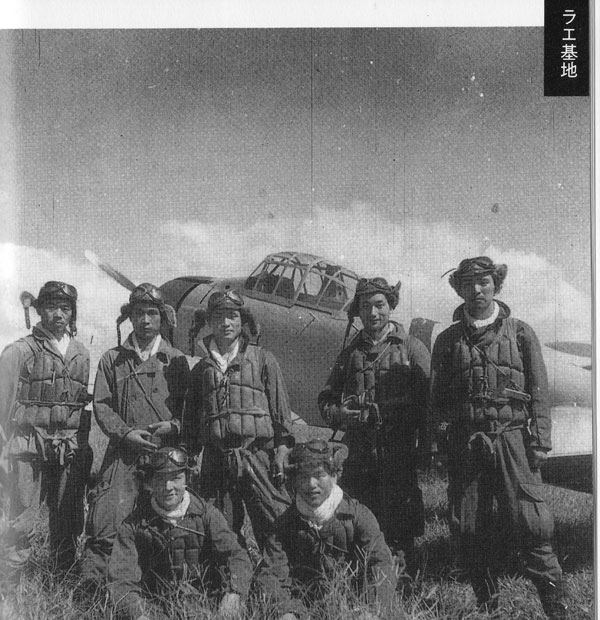
Saburo Sakai on left
These examples are not isolated instances. “The Japanese underestimated the value of their original highly trained pilots and the difficulty of training replacements. Consequently, they sacrificed safety factors in aircraft for performance…” [12] That statement may be a bit too sweeping. The Japanese did make some efforts at aircraft protection, the thin fuel tank coverings pioneered in the Army Type 97 heavy bomber (Ki 21) and later adopted in other army aircraft types may have provided some protection against rifle caliber fire but was completely ineffective against .50 caliber and heavier weapons. Both the Army and Navy had ongoing internal debates about the value of armor. Neither the Army nor Navy ever developed a successful completely non-metallic protected fuel tank such as was common on Allied aircraft. By mid-1943 the Japanese Army was equipping fighter and bomber fuel tanks with a 12mm thick rubber covering that proved reasonably effective. Pilot armor became common. The Navy lagged. The Army’s approach required a reduction in metal tank size and consequent reduction in range which was unacceptable to the Navy. Among Navy expedients were CO2 systems and an external rubber sheet on the bottom of the Type 1 land attack bomber’s wing. By mid-war a few navy aircraft, Gekko night fighter, Type 2 large flying boat, and Ginga bomber, were fitted with effective protected fuel tanks. The Type 2 large flying boat (Emily) was the first Japanese aircraft that Allied crash inspectors found to have armor. Later models such as the Shiden fighter also featured protected tanks and armor.
Another factor is that American aeroengines were typically more powerful than those on Japanese aircraft of a similar class. Thus, the addition of the same weight of protective equipment would have a proportionally greater adverse effect on Japanese aircraft. The Japanese approach was not entirely negative. Armor protection sometimes added hundreds of pounds of weight to aircraft that were already heavy and paid penalties in maneuverability, range and altitude for the added weight of protection. Japanese Navy and Army fighters outperformed many of their Allied opponents in terms of range and maneuverability throughout the war.
The results in pilot survival is illustrated in my book on aircraft protection Exploding Fuel Tanks. Even when the Japanese were trading aircraft combat losses on an even basis, their pilot losses were significantly greater than Allied pilot losses.[13] In 1940 some R.A.F. and German fighter pilots were not pleased with the addition of protective windscreens and pilot armor to their aircraft. A few examples of the value of such features usually changed their minds. Japanese pilots had no examples to cause them to request the adoption of protective equipment.
Query, what accounts for the slower acceptance of protective features by the Japanese compared to the Allies. The Japanese knew about protective features on Allied aircraft from airplanes captured in the Philippines, Malaya and Netherlands Indies. While impressed with some of the technology involved there seemed no imperative to adopt similar features for their own aircraft. In the early months of the war the latest Japanese fighters (Navy Zero, Army Type 1) seemed well able to hold their own or exceed Allied types in performance. With a few notable exceptions Japanese bombers accomplished their missions without excessive losses.
This situation began to change in the second half of 1942. The Japanese Navy’s bomber mainstay the Type 1 land attack bomber deserved the reputation it gained as being particularly vulnerable to fire. Near the end of the year the P-38F, the first Allied fighter with clearly superior speed and high altitude performance was introduced. In early 1943 the F4U Corsair joined the P-38 in the high performance category. The Japanese also noted improved Allied fighter tactics that tended to decrease the superiority they demonstrated in one-on-one combat.
Lt. Cdr. Mitsugu Kofukuda spent much of the war as a test pilot. He served in the Solomons as flight leader (Hikotaicho) of Air Group 204 from November 1942 to March 1943. Upon return to Japan, he wrote a lengthy after action report on battle lessons learned. It was published by Yokosuka Air Group.[14] Kofukuda considered the performance of the Zero fighter “generally excellent” but cautioned that the high altitude performance of the P-38 and Corsair needed to be considered. He had opinions on future fighter developments but also drew attention to pilot production and aircraft protection. Thanks to the Navy’s training program Kofukuda considered “the ability of crews, with the exception of younger men, is generally superior to the that of the enemy…” He thought the training produced “excellent material but in small numbers” and that quantity as well as quality needed to be considered. Because of intense combat activity there was no surplus time or aircraft to train youthful crews, but they are sent into combat “unavoidably inexperienced” and losses are “comparatively great…”
Kofukada pointed out “In aerial combat…the majority of fighters are destroyed by fire…if we can prevent fires, the combat efficiency of fighters will be surprisingly improved, thus I feel that research is needed to give them as much defense as possible. If we make up our minds that ‘The defense of fighters is technically impossible’, and neglect research, we will surely have cause for future regret.”
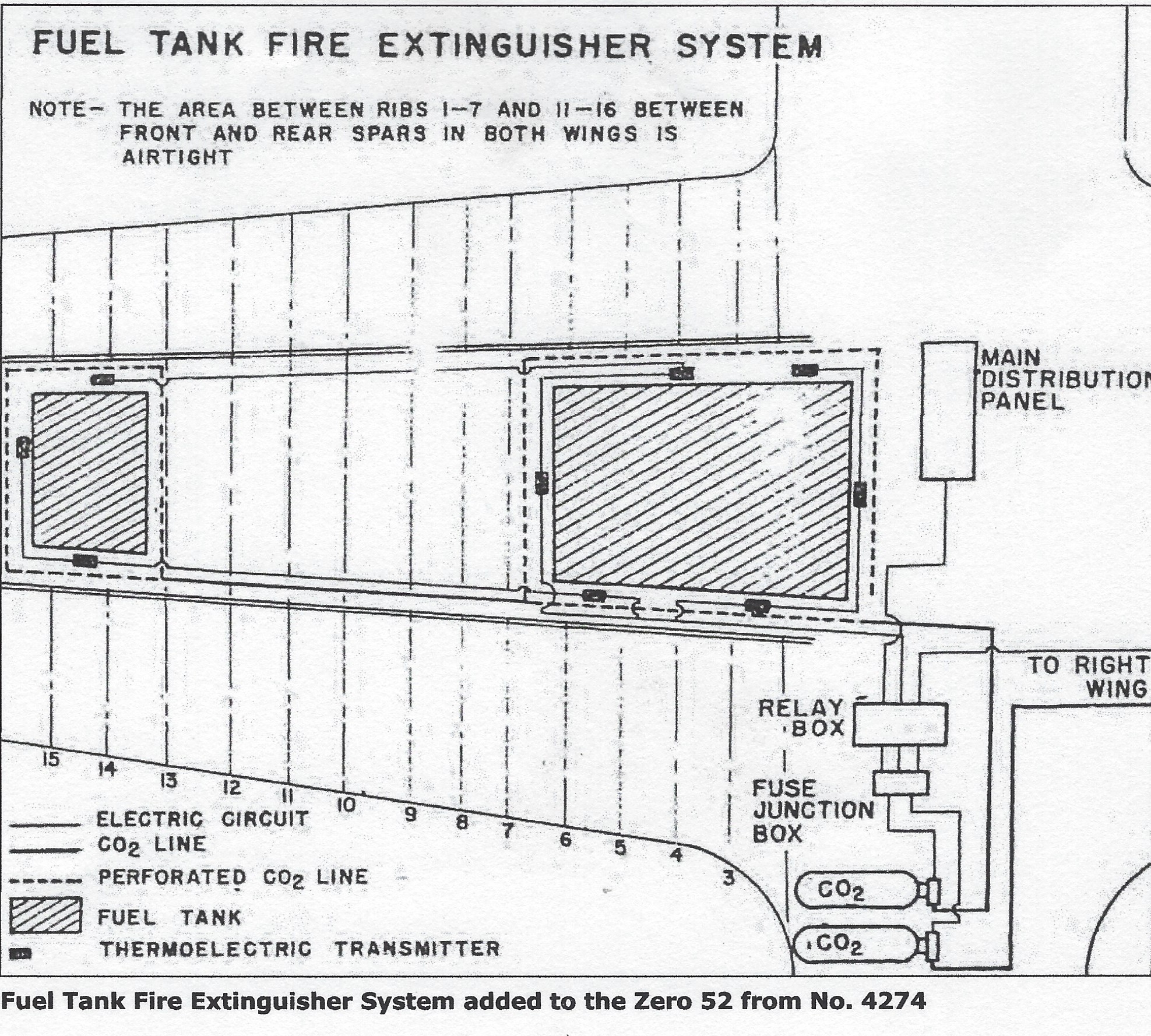
Zero 52 fuel tank protection
Production of the Zero model 52 by Mitsubishi started in August 1943. Fuel tanks were not self-sealing and there was no CO2 system. Mitsubishi Zero 52’s produced in late December 1943 and early 1944 added a CO2 system to protect the wing fuel tanks. Unlike American CO2 systems that purged a tank of volatile gases the Zero was equipped with CO2 that flowed over the tank externally when the system was activated by the heat of a fire. Nakajima-built Zero 52’s adopted the same system from February 1944. In June 1944 the fuselage tank was similarly protected. The small emergency tank in front of the pilot was not protected but its use was generally discontinued. These efforts were half measures but provided a noticeable improvement. An Aircraft Action Report from VF-25 flying from U.S.S. Cowpens on 19 June 1944, Battle of the Philippine Sea, claiming five Zekes destroyed for two F6F-3 Hellcats missing in action stated:
Zeke showed usual maneuverability. Zeke outclimbed 3 F6F’s at 11,000 feet but was caught by a fourth F6F-3 with water injection. One F6F-3 without water injection had difficulty in overtaking Zeke at sea level despite a slight altitude advantage, with 2600 rpm at full throttle. All Zekes absorbed a lot of bullets before being destroyed: none exploded in air and some did not burn at all, indicating probable use of self-sealing fuel cells.
Unfortunately for Japanese pilots at this stage of the war their average training and experience was in freefall.
Training Under Pressure: Instructors, Quotas, and Japan’s Worsening Pilot Shortage
As 1943 wore on older veteran pilots who were serving as flight training instructors were increasingly transferred to combat assignments. Training quotas were ramped up and the need for additional instructors at both the basic and more advanced levels increased. These roles were often filled by pilots who had recently been students themselves. Some combat veterans were reassigned as instructors; however, their tenure was often relatively short due to the pressing need for experienced combat pilots in front line roles.
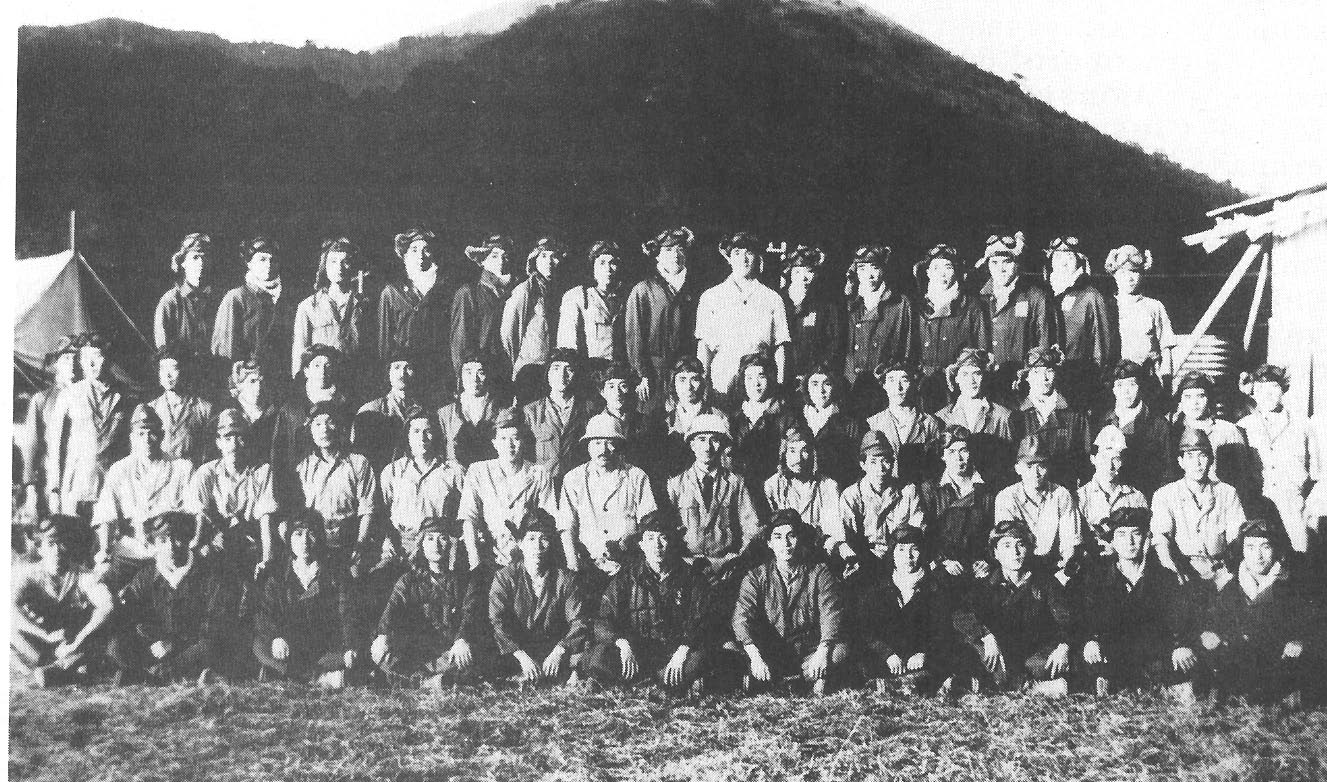
Many Tainan Ku pilots became casualties late in 1942
Saburo Sakai mentioned above, was seriously wounded in combat in August 1942. Released from the hospital, he returned to flying with his old unit Air Group 251 (former Tainan Air Group) then stationed in Japan in February 1943. When 251 was ordered to return to Rabaul in April 1943 he was considered medically disqualified due to blindness in one. Sakai was sent to Omura Air Group as an instructor. While with 251 he took note of the replacements arriving to fill the slots opened by the combat veterans lost in the Southeast Area.
They were eager and serious young men, unquestionably brave. But determination and courage were no substitute for pilot skill, and these men lacked the fine temper they would need against the Americans who stormed the Pacific in ever increasing numbers…Many appeared gifted but…their numbers were distressingly few, and there would be no painless interval for them to gain many hours in the air or any combat experience before they were thrown against the Americans.[15]
Sakai stayed at Omura training pilots for a year where he found everything rushed, facilities too few, demands too great and students too many. After nearly a year he was transferred to Yokosuka Air Group. By June 1944 the war was heating up coming closer to Japan. Sakai was included in a group of Zero pilots sent to Iwo Jima where the half blind formerly “medically disqualified” pilot resumed his air combat career.
In July 1942 the aircraft carrier Zuikaku was in Japan where its air group needed to be rebuilt after losses in the Coral Sea battle and other operations. Despite the need for veterans to train newcomers to the air group, a few seasoned pilots from Zuikaku and Shokaku were detailed for transfer to the Omura training base. One of the Zuikaku pilots was Petty Officer Tetsuzo Iwamoto a leading ace with experience in China and carrier battles. Iwamoto objected to the assignment at first but was convinced it was necessary by his buntai leader. “Lt. Okajima persuaded me to go…We had to win the war and to win, we had to educate excellent pilots in a hurry. Therefore, I should not cling to my personal ambition.”[16]
At Omura Iwamoto found things different compared to his training days in the 1930’s. “The air corps was equipped with only a few old planes. On the other hand, there were many students. When I was studying, there were only six students to a class, and we each could spend enough time in learning. But…there were many classes with 50 or 60 students. The instructor’s job was more troublesome than I imagined.” Iwamoto rated the new pilots sent to the front as “more or less well trained.” Iwamoto’s time at Omura was short. He soon transferred to Yokosuka Air Group then in November to Oppama Air Group again as an instructor. In March 1943 he was assigned to the newly formed Air Group 281.
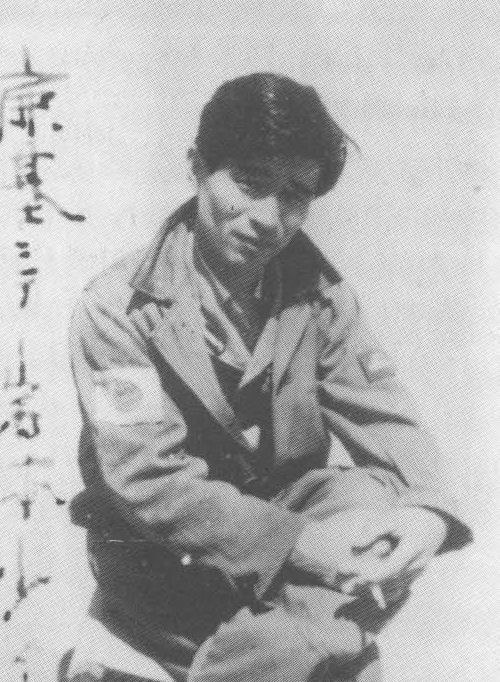
Tetsuzo Iwamoto
Iwamoto noted “when an air corps is formed, it is impossible to use it immediately for operations. At least three or four months of training was necessary before the air corps became operational…We hastily received planes, equipped them with armament and started basic training at once. Training in landing, formation, aerial combat and marksmanship were rigorous as the pilots had to be made operational as quickly as possible.”
Two chutais of Air Group 281 were sent to Paramushir base on 21 May due to the situation in the Aleutians. There were several alerts and some American raids on nearby locations but pilots of 281 did not see any action before returning to Tateyama in September. Meanwhile the Gilbert Islands were invaded and air combat in the vicinity of Rabaul was intensifying. The main body of 281 was ordered to the Marshall Islands late in November. Two chutais (including Iwamoto) equipped with Zero model 21’s were sent to Rabaul where they were incorporated in other air groups. Extracts from the flight log of a pilot who joined Air Group 281 in June 1943 is included in the next section.
The expansion of the Japanese Navy pilot training program began slowly in 1942 but soon gained momentum. This led to great pressure on the training establishment as comments by Sakai and Iwamoto suggest. In addition to pilots, the system was also training observers (navigation including bombardiers, communication, and gunners). Flight engineers typically funneled through the part of the system devoted to maintenance training. Airfield overcrowding in the home islands led to training bases being established in Taiwan, Hainan Island and even Shanghai. By U.S. estimates the 1942 training program involved 3,000 trainees resulting in 2,300 graduates of which 1,700 were land plane pilots. As of September 1944, the annual program involved 13,873 trainees and 10,400 graduates of which 8,700 were land plane pilots.[17]
By the Numbers: Pilot Experience Data from Captured Japanese Documents
The data presented in this section comes from translations of captured documents, intercepted radio messages, and prisoner of war interrogations. Documents and radio communications normally contain factual information as far as known to the originator. POWs sometimes misrepresent facts, however, their training is generally not a subject about which they intentionally lie, although they may have forgotten or garbled details. In recounting pilot strength early in the war three categories (A,B,C) were used. A = suitable for all missions, typically with 1,000 hours’ flying time. B = suitable for day missions (including dawn and dusk) with more than 400 hours but less than 1,000 hours flying time. C = fully trained but less than 400 hours flying time. Later a D category was added, indicating operational training had not been completed. Beginning later in 1944 an E category began to show up which was associated with very little flying time.
Two pilot logbooks (JICPOA Items Nos. 8447 and 8466) belonging to a pilot who went on to train in carrier attack planes and another who went on to train in land attack planes allow a detailed comparison of time devoted to various subjects in primary flight training at the end of 1939 and beginning of 1943 respectively. Adv = total with advanced training.
|
|
Graduated 1 December 1939 |
Graduated 10 March 1943 |
|
Familiarization |
4 hr. 50 min. |
20 min. |
|
Take-off/landing |
26:00 |
15:00 |
|
Aerobatics |
31:30 |
21:25 |
|
Formation |
19:05 |
14:25 |
|
Instruments |
10:20 |
23:00 |
|
Navigation |
14:30 |
6:45 |
|
Gunnery |
10:00 |
nil |
|
Night |
2:05 |
0:25 |
|
Cross-country |
4:00 |
5:30 |
|
Communications |
0:40 |
nil |
|
Spot landing |
1:55 |
0:55 |
|
High altitude |
1:15 |
nil |
|
Test flight |
0:25 |
0:25 |
|
Total |
123:55 |
88:10 |
|
Adv Total |
256:50 (May 1940) |
238:05 (June 1943) |
Petty Officer Tamotsu Tsujioka graduated from flight training between the two examples above. Graduating in November 1942, he joined Air Group 251 at Toyohashi a couple months before Saburo Sakai rejoined the same unit. Tsujioka was likely one of the eager young pilots observed by Sakai in the February to April 1943 time frame. Shot down and captured on Vella Lavella in July he outlined his training during his POW interrogation.[18] Beginning in early 1942 Tsujioka spent about six months in basic flight training gaining 80 hours of flying time in a Type 93 trainer. In July 1942 he transferred to Omura where he gained about 60 flying hours in the Type 96 fighter. Radio and gunnery were included in the training. In mid-November he transferred to Toyohashi with about 15 other young pilots. By mid-April 1943 he acquired over 100 flying hours on “Mark I and Mark II Zeros.” He was aboard auxiliary aircraft carrier Unyo 25-30 April en route to Truk. On May 10 he flew one of the fifty-nine Zeros that arrived at Rabaul their new base. A few supernumerary pilots probably arrived aboard land attack bombers of Air Group 702. The unit was soon engaged in air combat over New Guinea and the Solomons.
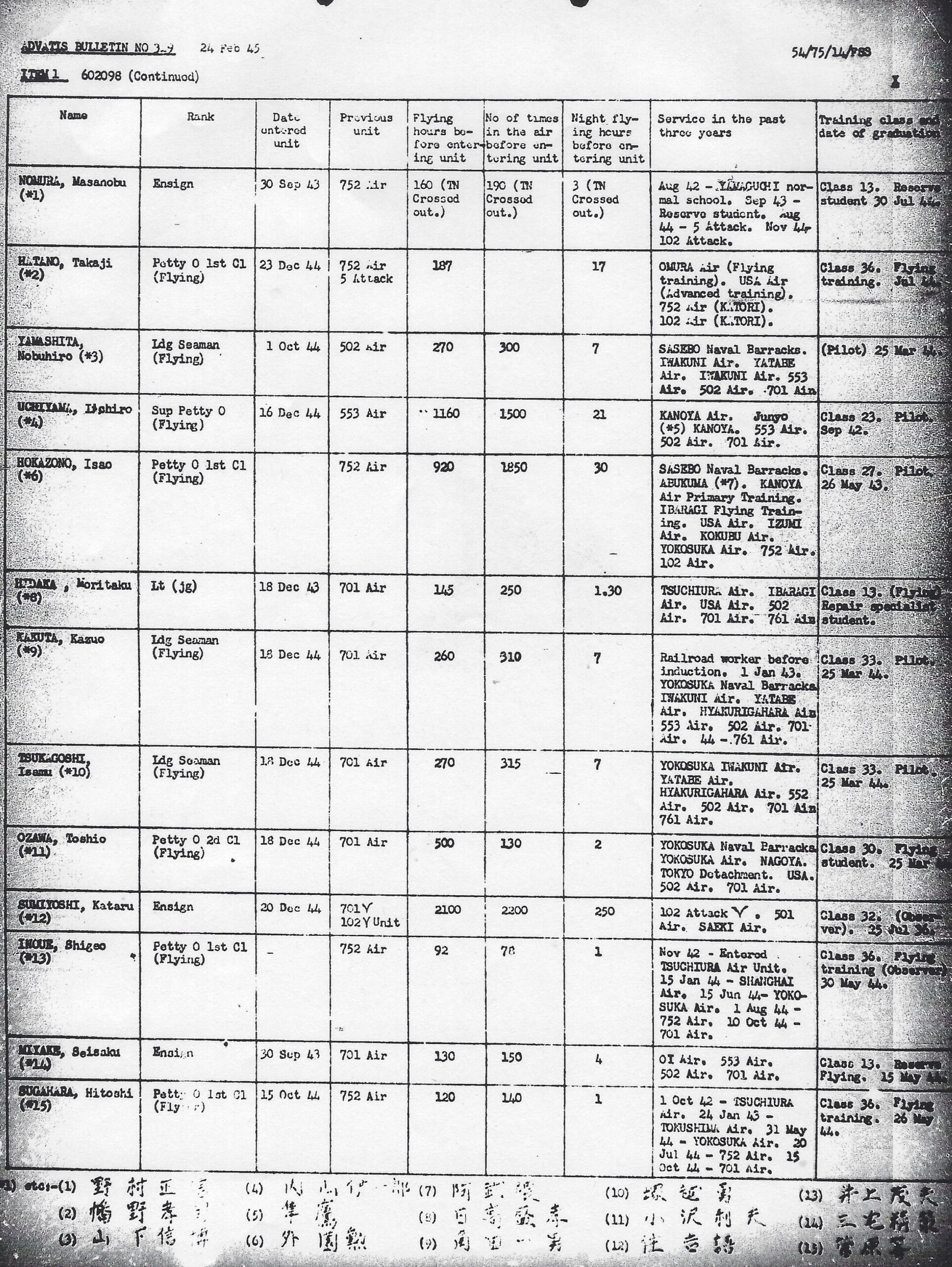
partial list of aircrew data from carrier attack Air Unit 102 early 1945
From mid-May to early July 251 lost twenty-four pilots shot down or failing to return from combat including both novices and senior pilots. Tsujioka was shot down on 12 July. A 15 July 1943 status report on Air Group 251 showed it had thirty-three pilots on hand of which seven were unavailable due to injury, illness or other causes (shown in parenthesis). They included 6 – A, 0 – B, 18(5) – C, and 2(2) – D.[19]
As mentioned above Air Group 281 was ordered to the Marshall Islands. It arrived at Roi I., Kwajalein Atoll with thirty-nine Zero 21’s in early December. The logbook of one of the pilots, Seiji Hasegawa, was captured at Roi after the U.S. Invasion. The contents were summarized in an Allied translation:
28 May – 21 Nov 42: Training with Hyakurigahara Naval Air Unit. Total flying hours – 100 hours 45 minutes.
23 Nov – 10 Mar 43: Training with Tokushima Naval Air Unit. Total flying hours – 64 hours
11 Mar – 1 Jun 43: Training with Iwakuni Naval Air Unit. Total Flying hours – 42 hours 50 minutes.
14 Jun – 26 Jan 44: (TN date of last entry) 530 hours of flying over various places with 281 Naval Air Unit.
Grand total of flying hours – 737 hours 55 minutes.[20]
Almost as soon as the first echelon of Air Group 281 arrived at Roi, Kwajalein was attacked by a strong U.S. Navy carrier task force. Air Group 281 suffered four pilots killed as well as material damage. On 15 December 1943 281 reported the status of its 29 pilots at Roi as: 4(1) – A, 8 – B, 15(1) – C. At that time, they had twenty-seven Zeros on hand of which five were model 52s and the rest model 21s. A month later the breakdown for 23 pilots was: 3 – A, 9 – B, 6(2) – C, 3 – D.
Japan’s carrier pilots were generally considered the Navy’s best at the beginning of the war. They fought four carrier against carrier battles in 1942 with mixed results but generally excellent performance. There were no carrier battles in 1943, but carrier air groups participated in important campaigns when deployed to land bases on several occasions. The 2nd Carrier Division air groups fought from land bases on three occasions from January to August 1943. When they withdrew from the Solomons in late August 1943 they had not only suffered losses but transferred twenty-nine fighter pilots to land based air groups. The new air groups were sent to Singapore (close to fuel supplies) to rebuild in September 1943. Second Carrier Division air crew status as of 15 October 1943 was:
Fighter pilots 13 A, 0 B, 3 C, 26 D
Bomber pilots 4 A, 12 B, 0 C, 3 D
Attack pilots 7 A, 10 B, 2 C, 1 D
Effective 1 December 1943 Junyo’s air group transferred to Truk. Later in December it transferred to Kavieng where it was joined by Hiyo’s air group. There it was subject to intermittent attacks by land based bombers and American carrier strikes. In January 1944 2nd Carrier Division air groups transferred to Rabaul and engaged in daily air combat for a month. Just before entering combat at Rabaul (16 January 1944 report) the status of fighter pilots of the 2nd Carrier Division was:
Junyo 5 A, 0 B, 16 C
Hiyo 6 A, 0 B, 18 (1) C
Ryuho 4 A, 1 B, 15 (1) C
After the Rabaul battles the air groups had to be rebuilt once again before engaging in the climactic Battle of the Philippine Sea in June 1944.
Comments in Part I of this article indicate Japan’s attempt to ramp up pilot training to a mass production level beginning in 1943 had a severe deleterious effect. No doubt this was impacted by lack of adequate numbers and types of training aircraft, novices acting as instructors, and limited training space and facilities at training bases. However, official directives virtually guaranteed training would be inadequate. Flying training class No. 35 was the flight training associated with Special B Enlisted Trainee Pilot Class 2. It was special because the original Otsu (B) pre-flight training had been 2-½ years. For this class it ran from only June to November 1943. Class 35 flight training was projected to last from November 1943 to August 1944. The schedule for Flying Training Course No. 35 changed with a message transmitted from higher headquarters:
Instruction in training aircraft to be completed at end of February 1944. Completion of course advanced to end of May.
Further one section of the course will be transferred to 1st Air Fleet at end of March after completing landing and take-off practice in Type 94 service type aircraft and solo flying.
On the first of June 1944 the commander of the 22nd Air Flotilla received the pilot status report for Zero fighter pilots of his command. At the time fifty-five Zero fighters were in serviceable condition or undergoing short term repair. Pilot status: 8 (3) A, 6 (3) B, 14 C, 36 D, 70 E.
After the Battle of the Philippine Sea many of the fighter air groups of the land based 1st Air Fleet were consolidated under Air Group 201. As of 30 July 1944, that air group had assembled at Davao, P.I., 35 Zero 52s and 18 Zero 21s. Pilot status was 14 A, 12 (2) B, 10 (5) C, 37 D.
For the combat performance of Japanese Army and Navy aircraft at the time of the battle of Leyte Gulf in October 1944 see: Ten Days to Kamikaze – Part VII – Mass Japanese Attacks – RLDunn.
Footnotes:
[1] Allied Air Forces, Southwest Pacific Intelligence Summary No. 229, 29 July 1944, para. 181 et seq.
[2] India Command, 6th Supplemental Interrogation Report, P.W. Air/005 (1943).
[3] India Command, Consolidated Interrogation Report, P.W. Air/010 (31 May 1944).
[4] Allied Translator and Interpreter Section (ATIS) Bulletin No. 1256, Doc. 12991.
[5] Much of the data concerning the 208th in Manchuria and Japan prior to transfer to the Southeast Area is contained in a series of translated operation orders in ATIS Bull. 1329 (Doc. 13532); and Air Operations Record Against the Soviet Union, Japanese Monograph 151, pp. 3,6,13.
[6] Additional details are provided by the diary of a 208th air crew member. ATIS Spot Report No 110.
[7] Dunn, South Pacific Air War, Schiffer, Atglen PA (2024), p. 299.
[8] Imperial Headquarters, Army Section: Battle Lessons Report # 28 (5 February 1944) – “Lessons Learned in Aerial Combat in the Eastern New Guinea Area”. CINCPAC-CINCPOA Translation Item # 9083.
[9] Izawa, 64th Flying Sentai, Aero Album, vol. 3, no.1 (1970), p.8.
[10] Izawa, 64th Flying Sentai, Part 2, Aero Album, vol.4, no. 3 (1971), p.2.
[11] Sakai et al, Samurai, Ballentine Books, New York (195/1958), pp.154-165.
[12] Japanese Air Power, U.S. Strategic Bombing Survey, Pacific War Military Analysis Division Report No. 62 (1947), p.2.
[13] Dunn, Exploding Fuel Tanks, (2011), p. 108. Second edition available on Amazon.
[14] Research on Fighter Tactics Learned in Battle, Yokosuka A.G. Reference Materials #44 (3 May 1943). CINCPAC-CINCPOA Translation Item #9101.
[15] Sakai (note11), p. 191.
[16] Tetsuzo Iwamoto, unpublished memoir translation, M. Nakamura trans. (1972), p.65. (copy in author’s possession). In contrast another top ace, H. Nishizawa, strenuously objected to assignment as an instructor, Sakai (note 11), p. 187.
[17] Hata et al., Japanese Naval Air Force Fighter Units and Their Aces, Grub Street, London (2011), App. C, pp. 427-429, includes details of class size and dates of various Flight Reserve Enlisted Trainee classes.
[18] South Pacific Force (CIC) POW Interrogation Report No, 103.
[19] Translations of intercepted message traffic come from U.S. National Archives Record Groups 38 or 457.
[20] ADVATIS (Advanced ATIS) Bulletin No. 722, Doc. 605725.
Excellent analysis!