This article attempts to contribute to the story of the Pacific Air War by exploring the dynamics of the aviation training and experience of the combatants. In doing so some comparative information will be presented on the Allied, primarily American, side. A reader wishing more information on the American approach will find that a variety of resources are available including those cited in footnotes below. The primary focus will, however, be on Japanese methods. Failure to appreciate relative pilot experience and skill can result in, among other things, a distorted picture of the relative performance of the aircraft they flew. This has certainly occurred in the context of the Pacific War.
Addressed will be social and educational differences at the national level that resulted in different approaches to military aviation training. Considering this basic context will help explain profound differences in pilot procurement and training.
A following section will focus on, primarily through quoting or summarizing published sources, both Japanese and American perspectives of Japanese pilot proficiency and its tactical effectiveness under combat conditions.
Part II will present a collection of hard data on Japanese training and operations which can serve as a basis for verifying, qualifying or debunking the published information and analysis in Part I as the reader sees fit.
The Educational Foundations Behind Japanese Military Aviation
The National Setting
In 1940 the population of the United States was 132 million. Japan’s population was 105 million.[1] About seventy-five million were in Japan proper, the rest in offshore territories primarily Chosen (Korea) and Taiwan. Japan had instituted strictly secular compulsory public education in 1908. In the United States compulsory education had a long history but was not uniformly implemented throughout the various states. By 1930 compulsory education existed in all the states. Unlike Japan under the U.S. Constitution public education was not mandated. Private institutions including religious institutions and home schooling could fulfill the requirement. In Japan six years of education were mandated. In the U.S.A. usually eight years of instruction or schooling up to a certain age (typically fourteen to sixteen) were the norm.
In Japan there were educational opportunities beyond the free public education of elementary schools. About a third of male elementary students participated in an additional two years of instruction in “Young Men’s Schools”. There were numerous trade and technical schools but due to the expense involved participation was limited. Beyond elementary school, the next step in academic advancement was Middle School involving a five-year curriculum. Each Prefecture was required to have at least one Middle School. Entrance into Middle School was highly competitive. In 1939 26,000 elementary schools had a student population of 12 million. There were less than 600 Middle Schools with a student population of 380,000. About half the students that applied to Middle School gained entrance. Assuming a sixth grade population of about 2,000,000 and Middle School openings of 100,000 only about 5% of elementary students advanced to Middle School. Graduates of Middle School could compete for university admission, entrance to service academies and had basic qualifications for many government and private sector opportunities. One factor that affected procurement of pilots was that the percentage of students that needed corrective lenses (glasses) rose along with years of education acquired.
In 1940 the average American adult had nine years of school including a minority who had no formal education at all. A quarter of adults had completed high school (twelve years of instruction). Ten per cent had acquired at least one year of college and five percent were college graduates. Compared to a Japanese Middle School population of 380,000 the U.S. high school population was 4,400,000 or more than ten times higher.
The differences in educational structure and policy led to significant differences in pilot procurement between the Japanese and American militaries. Both countries’ air forces had a cadre of regular officer pilots who were graduates of their service academies. In the U.S. reserve officer college graduates who had participated in the Reserve Officers Training Corps (R.O.T.C.) also were represented in pilot ranks. Reserve officers were typically released from active duty a few years after completing flight training subject to recall to active duty. By law both the U.S. Army and Navy were able to train enlisted men as pilots. This was rare, however, and prior to the war enlisted pilots numbered only in the dozens. A prime source of pilots for both the Army and Navy was the aviation (or flight) cadet program. Among various standards was an education requirement. Prior to the war this was typically two years of college. Successful completion of preliminary and flight training resulted in award of a reserve commission and an initial tour of flying duty. In the early and mid-1930’s pilot procurement numbered a few hundred per year and training was conducted at just a few bases.
How Japan Selected and Trained Naval Aviators Before WWII
From 1920 to 1930 the Japanese Navy procured pilots from its Eta Jima Naval Academy graduates (after a year of service at sea) and from non-commissioned officers serving with the fleet.[2] Beginning in 1930 a new source of pilots was added via the Shonen Hiko-hei (Youth Flight Enlisted Training) program. Fifteen to seventeen year olds who demonstrated knowledge equivalent to elementary school plus two years were accepted. The two and half year preliminary course included a mix of general education they would have encountered in Middle School plus military and aeronautic subjects, drill and discipline followed by flight training. To increase the production of pilots and other aircrewmen in May 1937 a new program was added in which inductees were expected to have knowledge equivalent to Middle School. This was the Ko (A) version of the Youth Flight course. The original program became the Otsu (B) version.
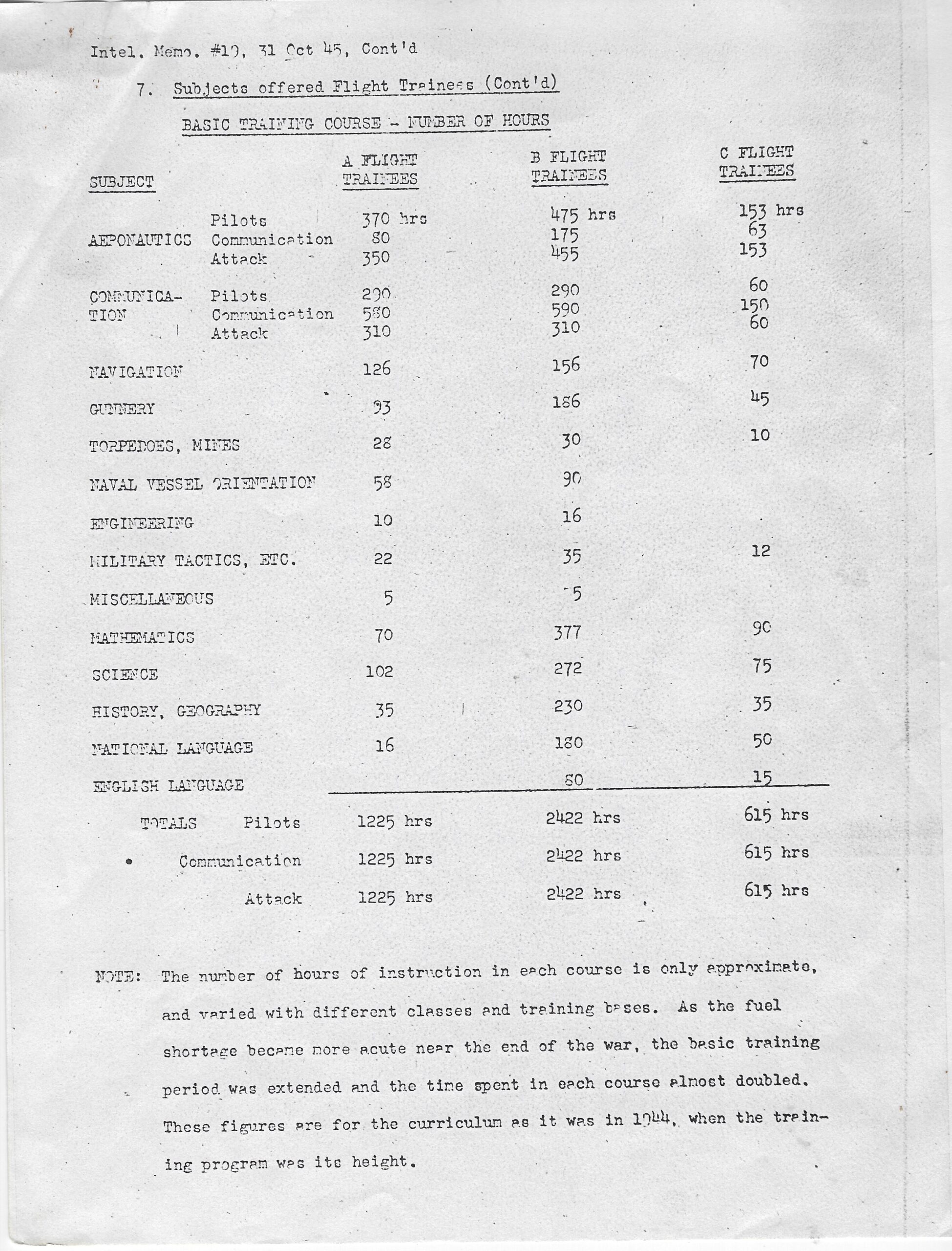
With the need to speed up training the pre-flight B course was reduced from the original 30 months and 2815 hours of instruction successively to 26 months and 2422 hours of instruction. The A course was compressed from eighteen months and 1576 hours of instruction to fourteen months and 1225 hours of instruction. NCO (C course) pre-flight training dropped from a nominal six months and 615 hours of instruction to three months and 315 hours of instruction.[3]
In 1934 the Japanese Navy started a program aimed at college and university graduates mainly those with majors in oceanography or related disciplines who were given a short course of military training followed by flight training after which they were commissioned as reserve officers. This program remained very small, producing only handfuls of pilots. Later, in mid-1943 the Japanese government changed its policy regarding university students remaining in school until graduation. Beginning that year they were urged to join the war effort. Significant numbers of college and university students entered Navy pilot training. Many finished training just in time to join in climactic air battles in the central Pacific and Philippines including Kamikaze operations. In 1940 a little over a hundred regular officers, two dozen reserve officers and one hundred eighty non-commissioned officers graduated from flight training. The two youth training programs supplied the balance of the new pilots amounting to over a thousand.
Japanese Army Air Force Pilot Training and Recruitment
The Japanese Army primarily relied on regular officers and non-commissioned officers recruited from other branches of the service for pilots in the early days of military aviation.[4] In 1934 the Army initiated a Youth Flying Soldier program, somewhat like the Navy program which took two or more years to produce a pilot. Small numbers of civilian pilots were accepted as reserve non-commissioned officers. Some university graduates were selected for pilot training and received reserve commissions. The Army produced about 750 new pilots in the year before the war.
Another aspect of Japanese air “training” is that in the late 1930’s some of their pilots gained experience in actual combat. This resulted from the second Sino-Japanese War beginning in 1937 and the Nomonhan Incident between Japan and Russia in 1939. According to the U.S.S.B.S report Japanese Air Power [5]about half the Japanese army pilots gained combat experience between the two conflicts and about ten per cent of navy pilots gained experience in China. The report questions the value of experience gained in China due to lack of serious opposition from the Chinese air force.
American Pilot Training Expansion Before the Pacific War
A brief look at U.S. pilot training just before the war will allow for comparison with Japanese data presented below. In 1939 Navy pilot training took 26 weeks in three phases nominally resulting in 207 hours flying time. Primary – 14 weeks 74 hours (N2S trainer); basic 5-½ weeks 45 hours (various basic trainers); advanced 6-½ weeks 88 hours (SNJ). Flight hours increased slightly. Pilots going on to aircraft carrier qualification logged an additional 75 flight hours. For the Army prior to the war there were also three phases of twenty-seven weeks with flight hours nominally being 65 primary, 75 basic and 75 advanced for 215 hours.
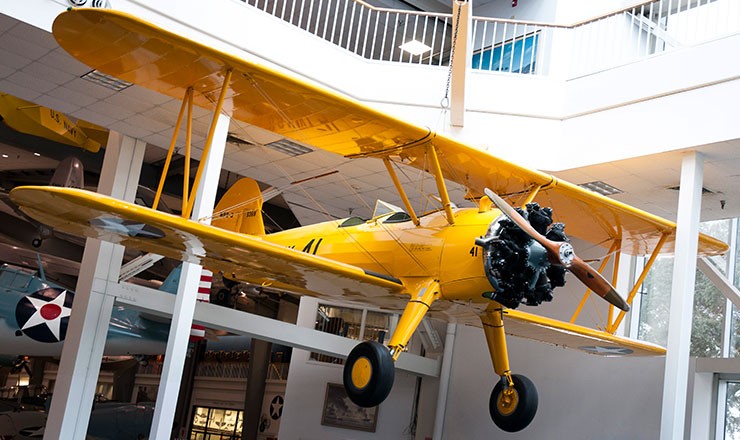
N2S "Yellow Peril"
The Civilian Pilot Training Program and American Expansion
In considering differences between American and Japanese pilot training and experience a couple of other items seem pertinent. One is the Civilian Pilot Training Program (C.P.T.P.).[6] Originally conceived as an economic development program to counter the Great Depression it was soon understood to have military implications. Programs were started at numerous colleges and other institutions in conjunction with private flight training schools. Enrollees could receive 75 hours ground school and 35 to 50 flight hours at government expense. Although C.P.T.P. graduates did not receive accelerated training in the military, the program proved to be a kind of elimination phase with C.P.T.P grads having a somewhat lower dropout rate from military flight training than those without such training. There were thousands of C.P.T.P graduates before the program ended in 1944. Another factor to consider is the reserve officers who left active duty during the 1930’s. They were recalled to active duty in mid-1941 swelling the ranks of pilots as calls for increased pilot acquisition were made.
In the late 1930’s both U.S. Army and Navy flight training accelerated dramatically.[7] During 1939 the goal for Army pilot acquisition rose from 300 per year to 1,200. In 1940 the target pilot population was first established at 7,000 but soon became 12,000 and continued to grow. One key to this increase was to conduct primary training at civilian flight training centers. The first nine contract schools were in operation by summer 1939. By the end of 1941 forty contract schools were operating. Advanced training production at Randolph Field jumped from 275 to 2,000 pilots in one year. In addition to Randolph, Kelly and Brooks, other permanent training bases were established to conduct basic and advanced flight training. The U.S. Navy went from 2,900 pilots in 1940 to 4,600 by mid-1941. Five hundred reserve officer pilots were recalled to active duty. The Navy successfully reached its goal of training 20,000 pilots by 1943. The increase in pilot production had profound effects. Early in the war some U.S. pilots were rushed to combat assignments with little more than 300 total flying hours. Later it was not uncommon for the experience level goal to be 300 hours beyond training hours and on the specific type aircraft the pilot would fly in combat.
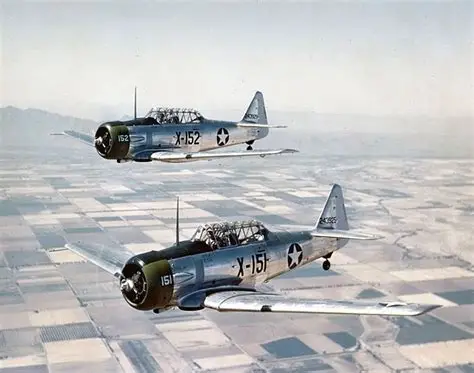
AT-6
Differences Between American and Japanese Flight Training
In addition to increased pilot production, U.S. training also benefitted from the production of more and better training aircraft. American flying training received updated primary and basic trainers. The AT-6 (Navy SNJ) was introduced at advanced training. Pilots thus experienced retractable landing gear, trim tabs, and a full array of flight instruments before encountering them in service aircraft in operational training. In contrast Japanese Navy pilots started pilot training in the Type 3 Trainer (K2Y). A Japanese version of the World War I era Avro 504 an 80 knot biplane with a wooden structure and canvas covered wings and fuselage, it reached the end of its service life in 1941. Many Japanese pilots arrived at operational training units having never flown an aircraft with retractable landing gear.
Japanese Assessments of Pilot Training and Combat Readiness
Commander Yoshimori Terai, A Japanese Navy staff officer described three phases of Japanese naval aviation training up to December 1940.[8] Elementary training for thirty flight hours in a Type 3 trainer (K2Y); intermediate training forty hours in a Type 93 Intermediate Trainer (K5Y); and, thirty hours of advanced training in various types of obsolete service aircraft. This was followed by an additional fifty hours of training in operational aircraft. He advised that in December 1940 elementary and intermediate training were combined but total flight time was reduced by two hours.
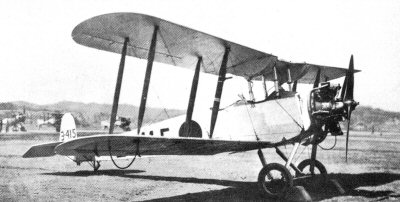
Type 3 trainer, K2Y
Terai’s description differs somewhat from that illustrated in Japanese Air Power (note 5) where officers receive sixty hours of flying time in trainers during primary and basic training with enlisted pilots receiving forty-four hours. Officers received a hundred hours in combat aircraft in operational (advanced) training while enlisted pilots received sixty hours. Numbers for enlisted pilots thus track closely with Terai’s numbers. In either case pilots then received 150 flight hours in tactical flight training. It is interesting to note that a captured Japanese Navy Administrative Orders Manual which contained top level directives regarding flight training dating from pre-war to mid-war specified details of skills to be acquired and time frames involved but did not specify flight hours.[9] Presumably details regarding flying time issued from the Combined Air Groups (Rengo Kokutai) in charge of training.
Saburo Sakai and Japanese Pilot Training Culture
Saburo Sakai, who became famous as co-author of the book Samurai described his experience in pilot training.[10] Entrance into pilot training from other ratings in the fleet was highly selective with only a small fraction of applicants accepted. Interestingly Sakai goes into detail describing discipline and physical training but says very little about flying training. In his class barely a third of entering candidates graduated. Sakai was in one of the four NCO classes graduating in 1937. Flight training for each class lasted eight to nine months. The four classes in total produced ninety-nine pilots. Within a year of graduation Sakai was in combat as a fighter pilot in China claiming his first aerial victory in October 1938.
Masatake Okumiya wrote regarding training at the start of the war that pilot training for all three classes of enlisted pilots lasted twelve months after their differing lengths of preliminary training. Likewise for officers. He then stated:
These students were regarded as adequate pilots following a year of preliminary flight training…but required at least one additional year of training to qualify as carrier-based pilots and forward combat area pilots.[11]
Japanese Air Power provides less detail about Japanese Army air training compared to the Navy. It does provide some comparative data while indicating both Army and Navy pilots were highly trained at the beginning of the war. Based on the post-war interrogation of Japanese officials at the start of hostilities the average flying time for Japanese Navy pilots is given as seven hundred hours while Army pilots were credited with five hundred hours on average. Another difference relates to the officer/enlisted mix of pilots. About ten per cent of Navy pilots were officers – 8% regular officers and 2% reserve officers. In the Army about one-third of the pilots were officers. Virtually all officers, including former NCOs, attended a military academy (for former NCO’s, a course of about a year). Various sources make it clear Army aviation training was not rushed, and Army leaders thought their pilots were well trained. Data on the Japanese navy is more available than that for the army. Army conditions can probably be inferred to some extent from navy data.[12]
The Decline of Japanese Pilot Quality During the War
We have seen in the first section of this article that the U.S.A. began a major expansion of its pilot training in 1939 before the war in Europe even began. The Japanese were already embroiled in conflicts in China and the Russian-Manchurian border. One might expect that if Japan’s air-minded officials anticipated a war with America they would have expanded its pilot production dramatically. According to Japanese Air Power:
At the beginning of the war the Japanese Navy was producing pilots at a rate of 2,000 a year as compared to the Army’s 750, and accordingly it made no large changes in the structure or size of its training organization…The 1942 expansion gave the Japanese Army a training organization which produced more than 2,700 pilots in both 1942 and 1943. Meanwhile, the Navy training organization was operating at a slightly increased tempo, and produced 2,300 pilots in 1942 and 2,700 in 1943…During 1942 and 1943, the Japanese Army and Navy together lost about 10,000 pilots, mainly in the Solomons, Bismarcks, and New Guinea.
Consider that from 1942 to 1943 about 10,000 pilots were produced and about 10,000 killed. Others were likely out of action due to wounds or illness for various periods or permanently. Many pilot candidates in the replacement pipeline required a year or more of preliminary training before entering flight school which lasted up to a year. Then, according to Okumiya, they required another year to become seasoned pilots prepared for front line combat. This was not a formula for rapid expansion of the pool of pilots ready for combat.
Pilot Losses, Attrition, and the Limits of Japanese Expansion
It is true that America was fighting a global war but initially most resources went to the Pacific before the “Europe First” policy took full effect. Moreover the U.S.A. did not fight alone. Australia and New Zealand and even a small Netherlands contingent joined the Pacific fight. The conflict was even broader. In the Asian theater the U.S.A. air contingent was initially relatively small compared to the British Empire effort. Japan not only had to deal with the Pacific, China and Burma but a substantial Japanese Army air resource (2nd Flying Division) was sequestered in Manchuria for training and as a potential counter to any incursion by the Soviet Union their old foe from 1939. Even after the German invasion of the Soviet Union the U.S.S.R. maintained a large air force in the Far East.[13]
Japanese Pilot Experience at Pearl Harbor and Midway
Capt. Takeshi Mieno accumulated 2,000 flying hours after graduating from Eta Jima in 1924.[14] He was staff officer of Carrier Division 5 aboard Zuikaku for the Pearl Harbor attack and subsequent operations through July 1942. He later served as air officer aboard Hiyo. From March 1943 to April 1944, he was on the Training Command staff at Usa Naval Air Station. Thereafter he was assigned to Naval Air Headquarters as Director of Training. According to Capt. Mieno pilots in the Pearl Harbor attack averaged 800 hours of flying time with the minimum being 300 hours and the maximum 2,500. His opinion was that the experience of land based pilots was higher than carrier pilots in December 1941. In the case of twin-engine bomber pilots, it was as high as 1,500 hours. That level was maintained by first line pilots until the Battle of Midway then fell off gradually through 1942. Flying experience declined considerably in 1943 as “field training” (operational training?) declined. Another factor in the decline was that the best instructors were sent to combat units and were replaced by less experienced men often recent graduates of pilot training.
Fuel Shortages, Reduced Flight Hours, and Wartime Decline
Lt. Cdr. Shigeki Takeda, Eta Jima 1938, graduated from pilot training in 1942. He received 330 hours in pilot training; 160 hours in training aircraft and the rest in tactical aircraft. According to Takeda from 1939 through 1941 each student received at least 300 hours of flying training. In 1942 hours began to decline. Takeda ended the war as chief of training at Kowa Air Base. He gave as reasons for reduced pilot quality: (1) pilot mass production resulted flying hours going down, (2) instructor quality declined (sent to combat and lost), students finishing flying training were used instead, (3) fuel shortage, (4) general curriculum reduction, basic subjects such as navigation were reduced.[15]
The land based First Air Fleet was formed in mid-1943 with the aim of creating a huge land based mobile Air Force. Many pilots graduating from elementary/intermediate flight training were sent to units of the First Air Fleet without the benefit of operational training which was to be accomplished after students reached their tactical units.[16]
The Japanese Army was also seeing a reduction in time devoted to training. Two Army General Orders (No. 1432, 16 May 1942 followed by No. 7162, 30 Oct. 1943) issued by Gen. Tojo, in his capacity as Minister of War, shortened the time of a variety of courses impacting flying training.[17] For example, student pilots who were to have graduated in March 1943 had their course shortened by four months. The changes affected preliminary training as well pilot flight training and extended to technicians, signals specialists, and others.
In assessing the dynamics of Japanese pilot training and experience we start with the general proposition that Japan’s pilot experience and its tactical employment of air power at the start of the Pacific War was of a high level. Examples include the Pearl Harbor attack, gaining air superiority over the Philippines, the long range (nearly 700 miles) over ocean bombing of Wake Island from Kwajalein, and sinking two British battleships off Malaya. These were accomplishments of the naval air force. The Japanese army air force provided convoy cover and later ground support for the Malaya and Philippine invasions demonstrating solid if less spectacular performance at the outbreak of hostilities.
Allied Intelligence Assessments of Japanese Pilot Quality
This section concludes with excerpts from a lengthy report, Quality of Pilots from the Standpoint of Training, Office of Naval Intelligence Weekly, 26 January 1944 (reprinted in Allied Air Forces Southwest Pacific Intelligence Summary No. 181, 12 February 1944).
- The diversity of quality of Japanese pilots from the attack on Pearl Harbor to the present time has been widely noticed. Information from combat areas indicates that there have been four relatively distinct periods. These represent the general trend, to which there are of course exceptions.
- In the first period, extending roughly from December 1941 to about July1942, the quality of Japanese pilots was high. Well-trained, they assumed and held the initiative. Their tactics, their individual and collective fighting skill and their successes demonstrated their worth.
- However, in the second period, extending roughly from August 1942 to January 1943, a deterioration in the quality of pilots was evident. They were at times hesitant, bewildered, lacked the daring and resourcefulness of their predecessors, and made glaring mistakes.
- The third period, roughly from February 1943 to June 1943, marked a partial resurgence of higher quality pilots. Some of the pilots fighting at this time seemed much better trained. New types of aircraft as well as new techniques (such as night-flying) appeared in forward areas at about the same time.
- Although it is still too early to draw definite conclusions concerning the fourth period, which may be said to have begun about July or August 1943 and to be still in progress, it seems that the quality of Japanese pilots is at best fair or spotty. The constantly recurring ratio of about five or more Japanese planes shot down to one Allied plane, even though in most cases the Japanese outnumbered the allied planes about two to one, demonstrates the inferior quality of these airmen.
- It is therefore believed that Japan is facing serious shortages of trained air personnel, which way prove an even more serious deficiency then that of aircraft.
- The implications of these statements with respect to the Japanese air training program should be examined…It should be borne in mind that the evidence is limited.
The report continues with a review of the Japanese training program based on available information and some speculation. Selected interesting observations and commentary follow.
- It became apparent in the second period after Midway, that the Japanese had no real reserve of well-trained pilots…
- Some…pilots…in the third period, beginning February 1943, showed marks of far better training…(possibly) veteran pilots of the first period were reappearing after rest and special training…some of the new pilots…may have been held back long enough to allow them to…gain further training and experience.
- The length of the advanced training course seems to vary widely…Other pilots…after completion of a minimum advanced training course, may be sent directly to overseas stations, where opportunity for further advanced training is limited and dangerous.
- The number of flying hours of captured pilots…has varied greatly, from about 300 hours to 1,000 hours…a number of captured pilots evidently had very few hours – as few as 200 or 300 – having been sent to the combat area after completing a minimum of advanced training.
Paragraph 139 mentions a “partial resurgence of high quality pilots” beginning in early 1943. Comments by Commander Okumiya confirm that any resurgence was definitely partial. Prior to the Second Carrier Division’s participation in Operation A in April 1943, Okumiya:
…was required to train many lieutenants directly out of pilots’ school. These men had behind them barely thirty days of carrier training and our veteran air leaders hesitated to send the fledglings into combat against the aggressive and experienced American pilots. Not only did we fear for the safety of the new pilots in combat, but many had great difficulty merely in properly flying their fighters and bombers.[18]
Part II will primarily be a collection of primary source material on the subjects covered in Part I.
Footnotes:
[1] Japanese education data is from the Japan Yearbook 1944-1945, Nippon Times Press (Tokyo Dec. 1944); U.S. education data is from U.S. census data available on-line; Japanese census data is from U.S. diplomatic Report No. 93-41, 5 September 1941.
[2] A description of Japanese naval aviation training and related statistics can be found in Hata et al, Japanese Naval Air Force Fighter Units and Their Aces 1932 to 1945, Grub Street, London (2011) pp. 409-427.
[3] Pilot Training in the Japanese Navy, Report No. 20 (31 Oct. 1945), Technical Intelligence Group.
[4] Japanese Army aviation training categories are described in Japanese Army Fighter Units and Their Aces 1931 to 1945, Hata et al, Grub Street, London (2002) pp. 275, 288.
[5] U.S. Strategic Bombing Survey, Pacific War Military Analysis Division Report No. 62 (1947).
[6] Pilot Training Plans Progress, American Aviation (15 August 1939) p.2. CPTP Reported Supplying 200 pilots Weekly for Army and Navy, American Aviation (1 July 1941), p. 14.
[7] Goldberg, A History of the United States Air Force 1907-1957, Van Nostrand, Princeton (1957) pp. 49-51; Portz, Aviation Training and Expansion, Naval Aviation News (July-August 1990), p. 22 et seq. White House Announces Vast National Defense Program, American Aviation (1 November 1938) p.3.
[8] Japanese Naval Aviation Training, U.S.S.B.S. Interrogation No. 692, Yoshimori Terai (November 1945).
[9] Naval Aviation Training, CINCPAC-CINCPOA Bulletin No. 35-45 (Special Translation No. 49) Feb. 1945.
[10] Sakai et al, Samurai, Ballentine Books, New York (195/1958), pp. 20-26.
[11] Okumiya & Horikoshi, Zero! Ballentine Books, New York (1956/1971), p. 37.
[12] Marchant, The Development of Japanese Army Air Force Pilot Training, Military Review (Nov. 1945), pp. 52-56 provides a good overview of J.A.A.F. pilot training but does not include details on flying hours for the various phases of training. The basic approach described is similar to the Navy’s.
[13] Wagner, ed., The Soviet Air Force in World War II, Doubleday, New York (1973), p. 366.
[14] U.S.S.B.S. Interrogation Report No. 444.
[15] U.S.S.B.S. Interrogation Report No. 354.
[16] Terai (note 8)
[17] CINCPAC-CINCPOA Trans & Int #22, Item # 14,906.
[18] Okumiya (note 11), p. 173.
Fascinating! Excellent analysis!
wish you all the best