
When historians discuss the Central Pacific campaign of World War II, attention typically focuses on the major amphibious invasions that began in late 1943. Yet months before the famous island-hopping offensive gained momentum, American and Japanese forces were already engaged in a series of long-range air operations across the Central Pacific. From Wake Island to Nauru and Tarawa, these missions tested aircraft, crews, logistics, and strategy across some of the greatest distances of the Pacific War. This often-overlooked chapter reveals how land-based air power helped shape the battlefield before the better-known campaigns of the Marshall and Gilbert Islands.
A celebrated historian of World War Two wrote: “Before December 1943, land-based operations in the Central Pacific were few in number and of slight importance, owing to the vast distances involved.” [i] From context this quotation means land-based air operations. Strategic discussions had broached the idea of a Central Pacific offensive as early as February 1943. Joint Chiefs of Staff approval to conduct a major offensive in the Central Pacific came in July. Without disputing Samuel Eliot Morison, I suggest these operations “of slight importance” are worth exploring and may have lessons for students of the Pacific Air War as well as war more generally. Eliot was referring to Allied operations, but Japanese operations are also limited but interesting. Moreover “land-based” includes seaplanes operating from shore bases or tenders. Some operations in 1942 cast light on the situation in which later operations were conducted.
The Central Pacific (CenPac), like other areas of far eastern theaters, was formally defined by April 1942. Its southern border was the equator with a small indent to include Canton Island. It stretched as far north as 42 degrees roughly from the northern U.S.A. to northern home islands of Japan. East to west was was 10 deg. west to 130 deg. east almost to the Philippines.
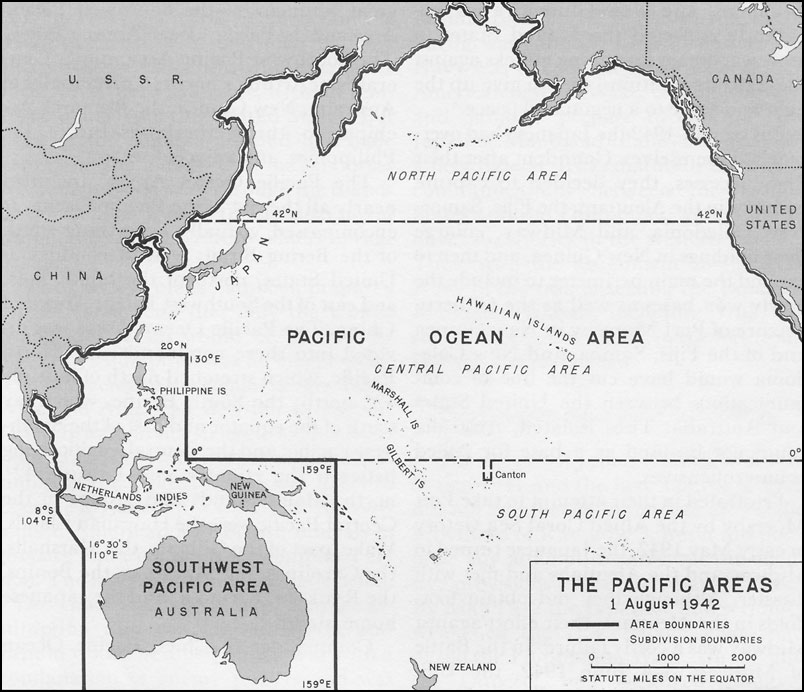
CenPac and otherPacific theaters
The Central Pacific After Pearl Harbor
After long diplomatic and economic conflict the shooting war in the Pacific began with the Japanese carrier based air attack on Hawaii in December 1941. The Japanese had military forces in the Marshall Islands. They attacked and occupied Wake Island farthest to the east, Guam and other U.S. positions. They also occupied Makin Island in the Gilbert Islands. This was a buffer against incursions of their Marshalls positions. They cut off U.S. trans-Pacific communications. More profoundly they established a defense line around their “southern resource area” which was consolidated in the early months of the war.
America struck back at Japan with aircraft carrier attacks on Japan’s Marshall Islands and other island positions in February-March 1942 followed by the Doolittle raid on Japan in April. During 1942 there were four major carrier versus carrier battles. Three – Coral Sea, Eastern Solomons, Santa Cruz – were in the southern Pacific. The fourth – Battle of Midway – was in the Central Pacific. During 1942 each side lost four fleet aircraft carriers. In the Pacific each side was left with just two big carriers. Japan had little prospect of fielding a new large carrier in the immediate future. However, by the end of 1942 the U.S. had already added the U.S.S. Essex, the first of a new class of large carriers, to its fleet. More large carriers as well as a new class of fast carriers were coming online during the first half of 1943. As it turned out there were no carrier versus carrier battles in 1943. The first carrier based air strikes against Japanese islands in the Central Pacific in 1943 did not occur until late in the year.
Early American Reconnaissance and Bombing Missions
After Pearl Harbor. U.S. Army aircraft suffered heavy losses in the Japanese attack on Hawaii. Including bombers that arrived during the attack only fifty bombers, about half of which were operational, were on hand. In the immediate aftermath of that event the first notion was to avoid a repeat. Army bombers were subordinated to the Navy’s Patrol Wing Two to provide long range (600 miles) searches seaward from Oahu. These included new and old models of the B-17 heavy bomber sometimes supplemented by B-18s or A-20s. The Army and Navy had not conducted such searches in response to the war warning in the week prior to the attack. Had such searches been ordered the disaster might have been mitigated or entirely avoided [see Pearl Harbor – a Tragedy Revisited – RLDunn]. The Army’s bomber mission evolved into providing a daily striking force of thirty-five heavy bombers ready to counter another attack. In mid-January an Army task force (six B-17s) was sent to Canton Island and Nandi in the Fiji Islands to conduct anti-submarine searches for two weeks. In February twelve B-17s were released to Admiral Nimitz control for operations from Nandi in the southern Pacific. These bombers never returned to Seventh Bomber Command control.[ii] After acquiring some new B-17Es the Army was still hard pressed to meet all its bomber commitments. Despite constraints on its limited bomber resources a B-17E was sent on a long range reconnaissance mission to Wake Island staging through Midway on 14 February. Theater commander Admiral Chester Nimitz found the photographs from the mission valuable. They were sent via a Navy PBY to the carrier task force then en route to attack Wake.[iii]
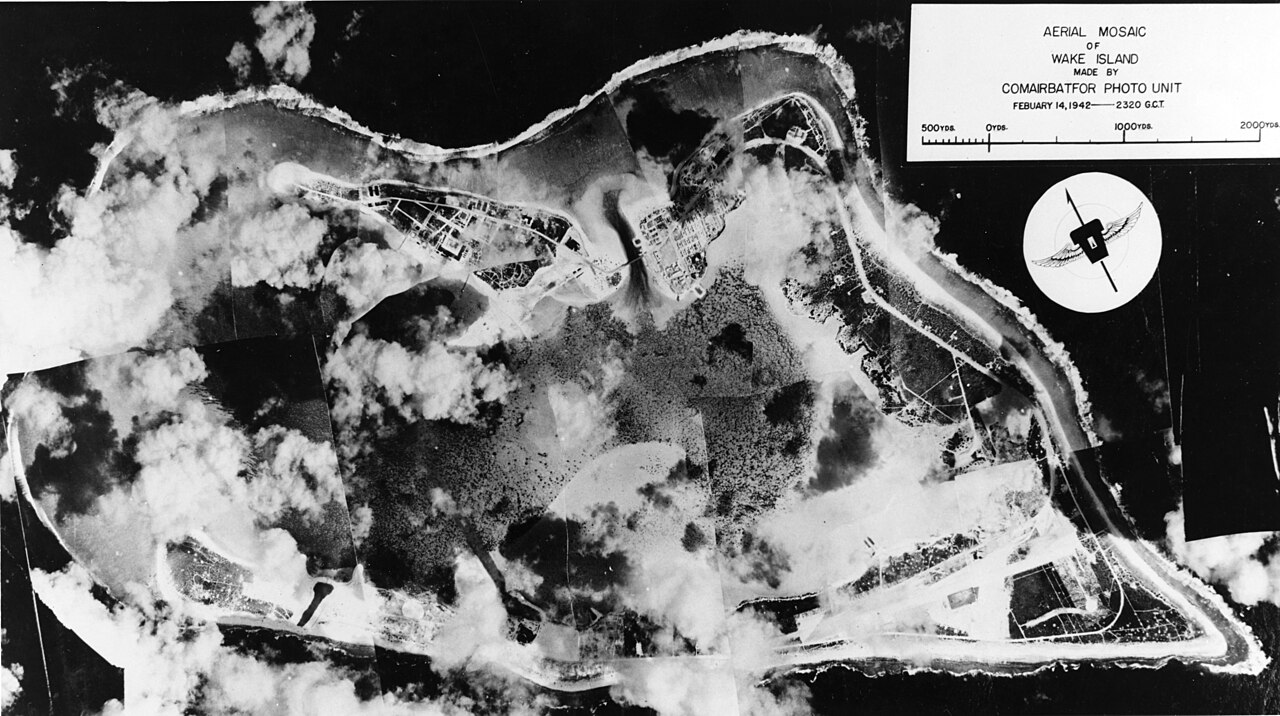
Wake Island composite from 14 February 1942 photo mission
In early 1942 there was an influx of heavy bombers to Hawaii, mainly B-17Es and LB-30s. Some B-18 crews retrained in B-17s. The only notable combat deployment and operations were associated with the Battle of Midway, May-June, in which B-17s flew 55 combat sorties and B-26s four with little impact on the outcome. With the Japanese in retreat after the battle an attempt was made to bomb Wake Island by four Army LB-30s. The mission was unsuccessful and one LB-30 carrying M/Gen. Clarence Tinker Seventh Air Force commander was lost.[iv] With Marine and Navy fighter squadrons pummeled during the Battle of Midway on 25 June carrier Saratoga flew off twenty-five P-40Es of the 73rd Fighter Squadron (FS) to bolster the island’s defenses. Three weeks after General Tinker’s loss three LB-30s carried out a night attack on Wake Island and returned safely to their staging base on Midway. On 31 July a B-17E carried out a successful photo reconnaissance mission over Wake and survived the attention of intercepting Japanese fighters with only a few bullet hits.
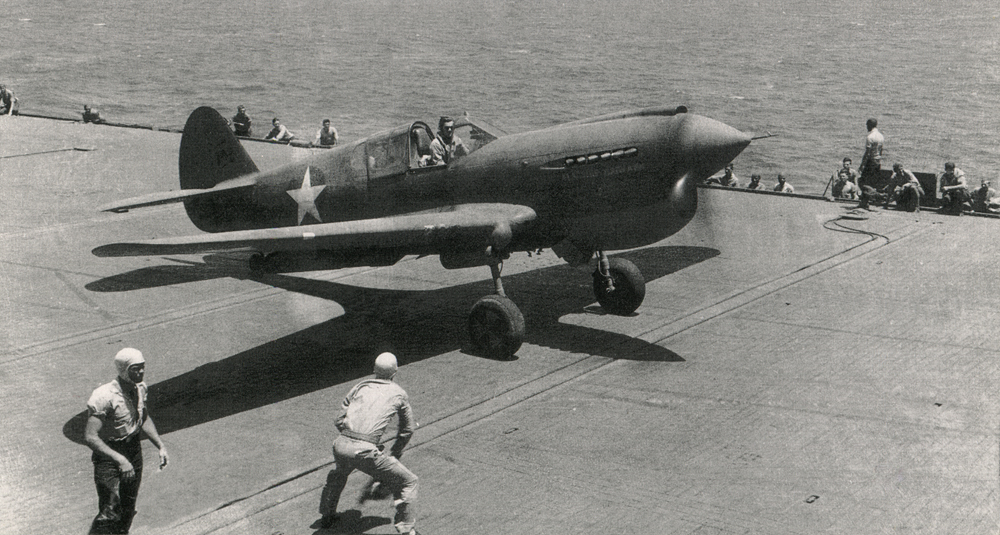
P-40E 73 FS on Saratoga
For much of the rest of 1942 the Army bomber force was in a state of flux. The 11th Bomb Group was designated a mobile air task force and left for the New Hebrides in July. It operated from South Pacific bases until the following spring. When it returned to Hawaii its squadrons were skeletal and their first job was converting from the B-17 to the B-24. The 72nd Bomb Squadron (BS) went south in September. The rest of the 5th Bomb Group (BG) followed by November. The 90th BG arrived in September but was in training status until transferring to the Southwest Pacific in November. Elements of the 307th BG arrived during October and November remaining through early 1943. The next heavy bomber unit, 30th BG did not arrive until autumn of 1943.
The December 1942 Wake Island Raid
The year 1942 wrapped up with a model mission. Assiduous planning began early December.[v] Several days before the mission the 307th BG was relieved of its search and standby strike force responsibilities. It trained in bombing and, with the help of Seventh Interceptor Command fighters, in defense. The plan included Navy navigation and rescue support provided by three submarines and a destroyer. Group commander Col. William Matheny led the mission. On 21 December twenty-four B-24Ds and two spares deployed to Midway on the first leg of their 4,000+ mile mission, a night raid on Wake Island. A detailed target map was available from the results of the 31 July photo mission. On 22 December despite miserable weather at Midway all twenty-six Liberators got off. Eighteen formed up in a single formation and the rest followed in small flights. As they neared Wake clouds began to thin out and the target was sighted in bright moonlight. The bombers descended to attack altitude of 4,000 feet. The first bombs were dropped before any search lights or AA fire was encountered. The plan called for a single bombing pass at nine pre-selected target areas. A few bombers found their assigned targets obscured by clouds and made a second run on the target. It was probably one of these that received a couple machine gun hits from one of the two Zeros that took off. Crewmen on one Liberator reported sighting a biplane and another Liberator reported being attacked by a Zero. Most crews saw no enemy aircraft. Back at Midway the following morning weather was still bad. It took over two hours for all the Liberators to get down but all did so safely. Distinguished Flying Cross (leaders) and Air Medal decorations were personally awarded by Admiral Nimitz.
The plan called for a follow up photo mission in daylight. However, weather over Wake turned bad and the photo Liberator never found the atoll. A Liberator on a second photo mission on December 29 was lost without a trace. Assessment of the raid thus was left at what the attacking bomber crews reported, many fires were started.
January to November 1943. According to the Air Force official history:
At no time between the summer of 1942 and the fall of 1943 did the Seventh Air Force have more than a single group of heavy bombardment, and this one was either an inexperienced unit destined for service elsewhere or a battle-worn outfit badly in need of rest.[vi]
Japanese Air Power in the Central Pacific
In December 1942 Japanese strength in the central Pacific came under the 22nd Air Flotilla at Kwajalein. Forty-three Type 96 land attack bombers (Nell) of Air Group 755 (former Genzan Air Group) were based at Kwajalein and Maloelap. Forty-nine Zero fighters (Zeke) were divided between Wake, Kwajalein, and Maloelap. Eight Type 97 large flying boats (Mavis) operated from Jaluit.[vii] Several observation and reconnaissance float planes were stationed at various bases including Makin Island in the Gilberts. In late summer 1942 after the Marine raid on Makin Island the Japanese began to increase their presence in the Gilbert Islands primarily on Tarawa. Defenses on Nauru and Ocean Islands were also beefed up. The Zeros were from Air Group 201 but in a few months, they would be withdrawn and replaced by Air Group 252.
The U.S. Navy had considerable air strength in Hawaii but only a single squadron of twelve long range bombers (PB4Y-1). Navy carrier based strength (two fleet carriers and six escort carriers) was standing by in the south Pacific in the final stages of the Guadalcanal campaign and was no immediate threat to Japanese positions in the central Pacific. Army heavy bombers of the Seventh Air Force if forward deployed and as well as those of the Thirteenth Air Force based on Guadalcanal were a potential threat.
The Seventh planned a strike against Wake on 22 January but it was foiled by bad weather. On the twenty-sixth (1/25 Oahu time) six B-24Ds of 371st BS of the 307th Group conducted a bomb/photo mission. They took vertical and oblique photos and dropped sixty 100lb. bombs from 14,000 feet. There was little AA fire and the interception by eight Zeros of Air Group 201 was rated as “tardy” by the Americans. American gunners claimed one fighter destroyed and four others as possibles. All the Japanese fighters survived. Two of the Liberators received single hits one by a 20mm round. The Liberator flown by Col. Matheny was hit ten times and landed with one engine out.
Long-Range Operations Against the Gilbert Islands and Nauru
The Liberators of the 307th extended their reach by deploying south to Canton Island and Funafuti in the Ellice Islands where Marines had landed in October 1942. By early 1943 Seabees constructed a forward airbase there. The total out and back distance to Gilbert targets was about 6,000 miles. On 26 January three Liberators conducted a photo/bombing mission over the northern Gilbert Islands and claimed a near miss on a cargo vessel near Tarawa. No damage is verified by Japanese records. Two days later a photo mission was flown over Nauru and Ocean Island where AA was reported as heavy. At the end of January 1943, a buntai of nine Zero fighters was dispatched to Nauru (6) and Tarawa (3). [viii] The Japanese probably gave preference to Nauru as in addition to being an advanced defense position it was also a valuable source of phosphate for Japan’s economy.
The Battle Over Nauru
The first clash over Nauru was not long in coming. On 7 February the 2nd Marine Aircraft Wing war diary recorded that a Guadalcanal B-17 on a photo mission to Nauru radioed it was intercepted by two Zeros. This was consistent with Air Group 201’s mission report (kodochosho). The Flying Fortress failed to return to base (details wanted). On 9 February a B-17F of the 72nd BS (formerly Seventh Air Force) operating from Guadalcanal flew a sea search in the vicinity of Nauru. It was not a reconnaissance of Nauru and the pilot Capt. Thomas Classen kept his distance from the island. Apparently, Nauru’s radar was operating efficiently. The B-17 was reportedly assailed by eight Zeros. There actually were five Zeros led by W.O. Sahei Yamashita. The combat went on for over an hour. Some of the B-17’s guns jammed but gunners claimed two Zeros destroyed, and six others probably destroyed or damaged. The returning Japanese pilots expended virtually all their ammunition. Yamashita was shot down. The battered B-17 lost one engine after another. All crew members were wounded. Despite heroic efforts by Capt. Classen the Flying Fortress ditched and sank within a minute. The crew survived after a grueling and lengthy experience including sixteen days in rubber rafts.[ix]
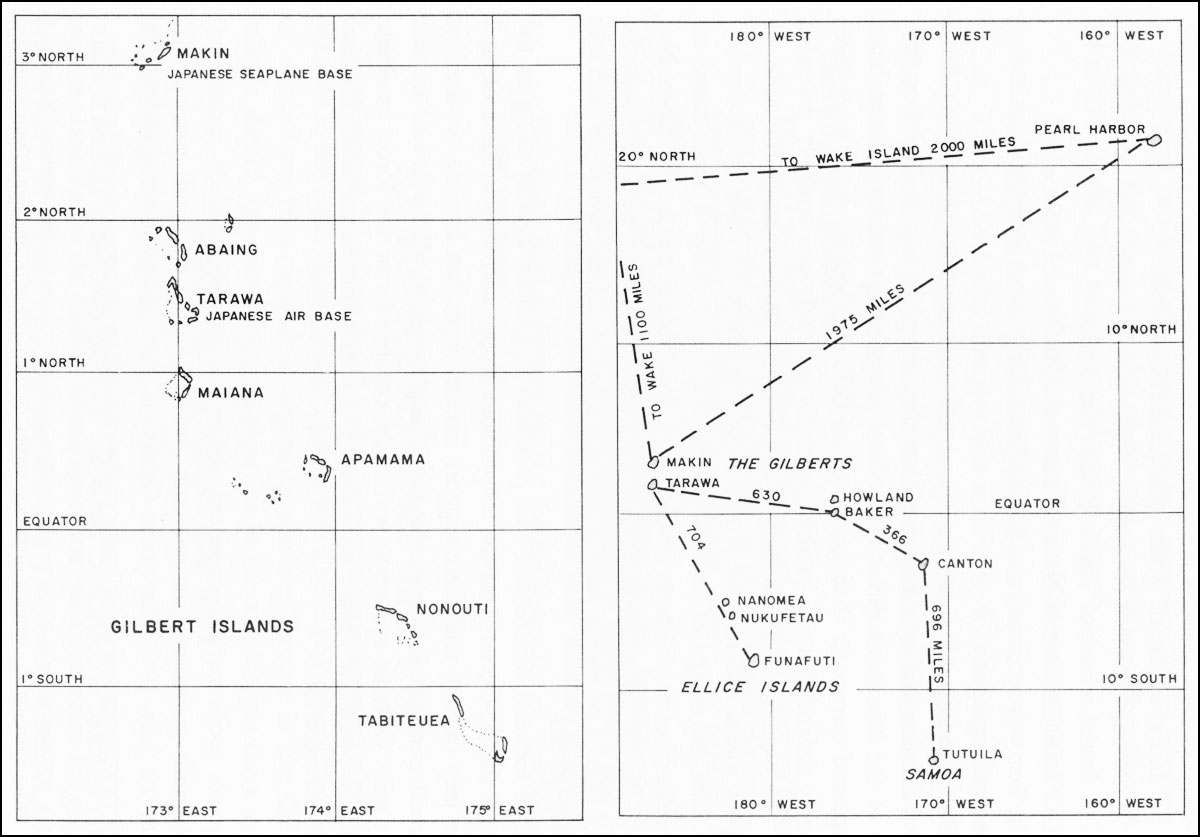
Central Pacific Distances
Three 307th BG B-24Ds staging through Canton I. conducted a photo/bombing mission to northern Gilberts on 20 February. They encountered AA fire at both Makin and Tarawa suffering no damage. They dropped nine 500lb. bombs causing no damage. Japanese Type 2 flying boats of Air Group 802 raided Canton Island three times in March first on the 19th when two aircraft were detected and only about eight of the thirty 60kg bombs dropped were near American positions. This and subsequent raids by one and two flying boats respectively caused little damage or inconvenience other than destruction of one transient PBY.
Task Force Twelve and the Nauru Bombing Campaign
Spring brought an interesting, combined mission on 25/26 March. Navy PBY Black Cats and Army B-24s headed to Nauru from their southern Pacific bases. The six PBYs carried bombs but also equipment to detect radar. On this occasion there was no indication of radar in use. The PBYs carried out their night glide bombing attack. At early daylight they were followed by five B-24s dropping 500lb. and 100lb. bombs from high altitude. There was no interception and only a single fighter and one twin-engine aircraft were sighted on the airfield. However, this raid was highly successful. There were twelve land attack bombers and eight Zeros present. Several were destroyed or damaged. Only six land attack bombers and four fighters remained operational after the raid.
Incorrectly assuming the attack came from Funafuti the Japanese planned a retaliatory strike. A detachment of VMF-441 F4F Wildcats had been deployed to Funafuti since 22 March. The Japanese staged six Air Group 755 Type 96 land attack bombers through Tarawa to make the attack. Two aborted and four approached the island early on 28 March. Two Marine F4Fs alerted by radar met the Japanese bombers twenty miles north of Funafuti. The Nells (Allied codename) jettisoned their bombs. Capt. William Boland shot down the bomber captained by Lt.(j.g.) Takashi Sumimoto and claimed another damaged. The guns on Boland’s wingman jammed or the Japanese loss might have been greater. The surviving Japanese bombers returned to their base Maloelap after resting and refueling at Tarawa. The closest Army fighters were at Canton Island where 46th FS had recently relieved 333rd FS. Fighters on Canton were not getting much business but patrol planes (PBYs) operating from there and other bases occasionally had combats with Japanese patrol planes (flying boats or land bombers) typically with inconclusive results.
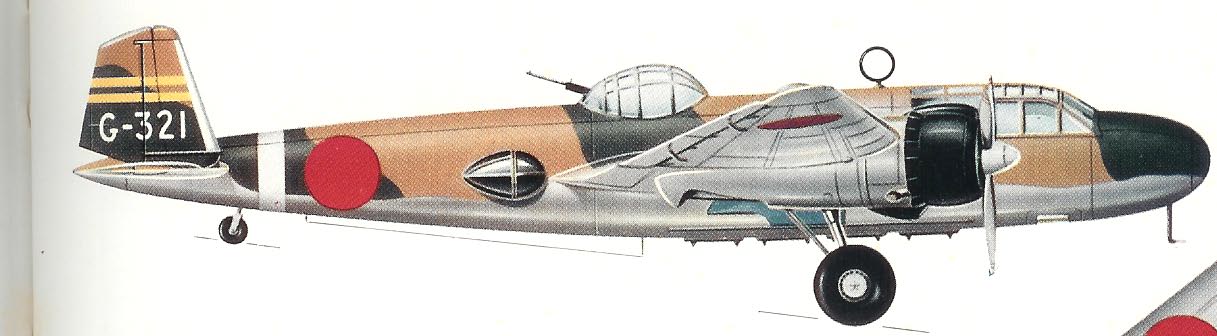
T 96 land attack bomber of Genzan (755) Kokutai
The Marine fighters at Funafuti on detached service found conditions there spartan to say the least. When CenPac command decided to conduct its own raids on Nauru and the Gilberts from Funafuti it created a task force for the purpose. Two cargo ships were dispatched from Hawaii two weeks before the planned 18 April arrival date of the bombers of Task Force Twelve. They brought supplies and equipment to support the mission. The task force included only two squadrons of the 307th Group because the other two squadrons were operating from Guadalcanal. The attack echelon of the task force personally headed by M/Gen. Willis Hale, Seventh Air Force commander, consisted of B-24Ds of the 371st and 372nd BS. These bombers had been modified at the Hawaiian Air Depot. The power operated tail turret was installed in the nose with a pair of free firing .50 caliber guns in the tail position. Weak forward firing armament had been a criticism of U.S. heavy bombers. The field modification was incorporated on the production line by Convair for later models of the B-24 which had power operated turrets in both nose and tail positions.
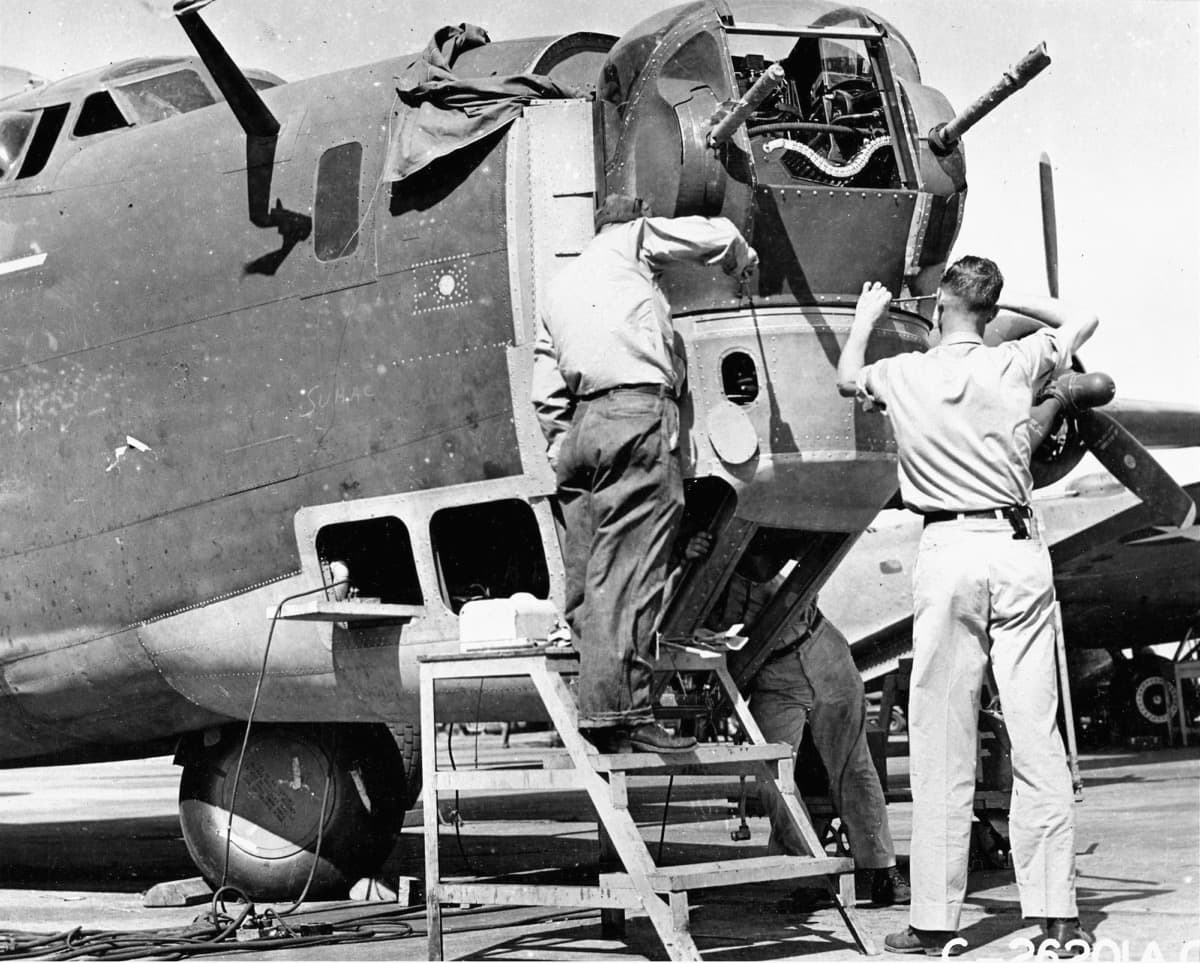
B-24D nose being modified at Tinker army airfield
Admiral Nimitz monthly summary described the attack:
TF 12…proceeded to Funafuti from Oahu and early on 20 April took off for Nauru armed with 500 and 1,000 lb. bombs and fragmentation clusters. Commencing…about mid-forenoon local time…22 B-24’s…flying at altitudes above 7,000 ft. dropped about 25 tons of bombs on Nauru industrial and military installations. The attack damaged buildings of 3 phosphate plants…Also destroyed was part of the fuel storage, some buildings in the barracks and airfield shop area, and probably two planes on the field…After the attack about 8 enemy fighters engaged our planes which drove them off, shooting down one without loss to themselves. All our planes returned to Funafuti, though 5 received some damage and 1 man was killed.[x]
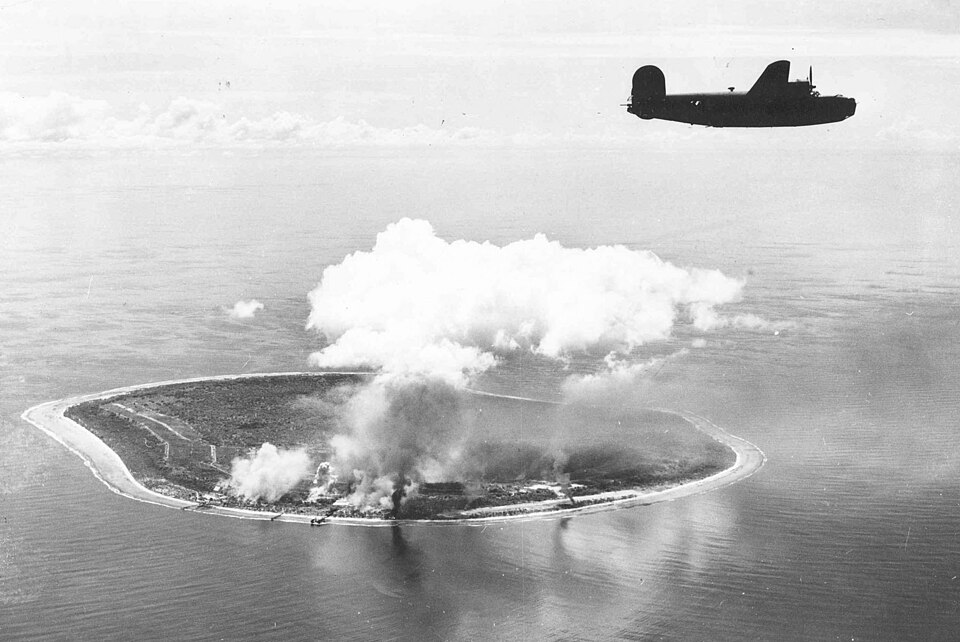
Nauru Island and modified B-24D Liberator
The bombers were met by a heavy fixed barrage of AA fire before the bomb run. A total eight fighters identified as 7 Zekes and a Hap were observed after the bombers cleared the AA area. Attacks were chiefly by individual aircraft attacking from 2, 5, 8 and 10 o’clock positions. After a few nose attacks encountered the fire power there, they were not repeated. Some attacks were slightly below level. Five Liberators were damaged including one which had its rudder cable shot out. This aircraft fell out of formation but later rejoined. This was the bomber in which Olympian and collegiate one-mile record holder Louis Zamperini spliced the cable using bomb arming-wires.[xi]
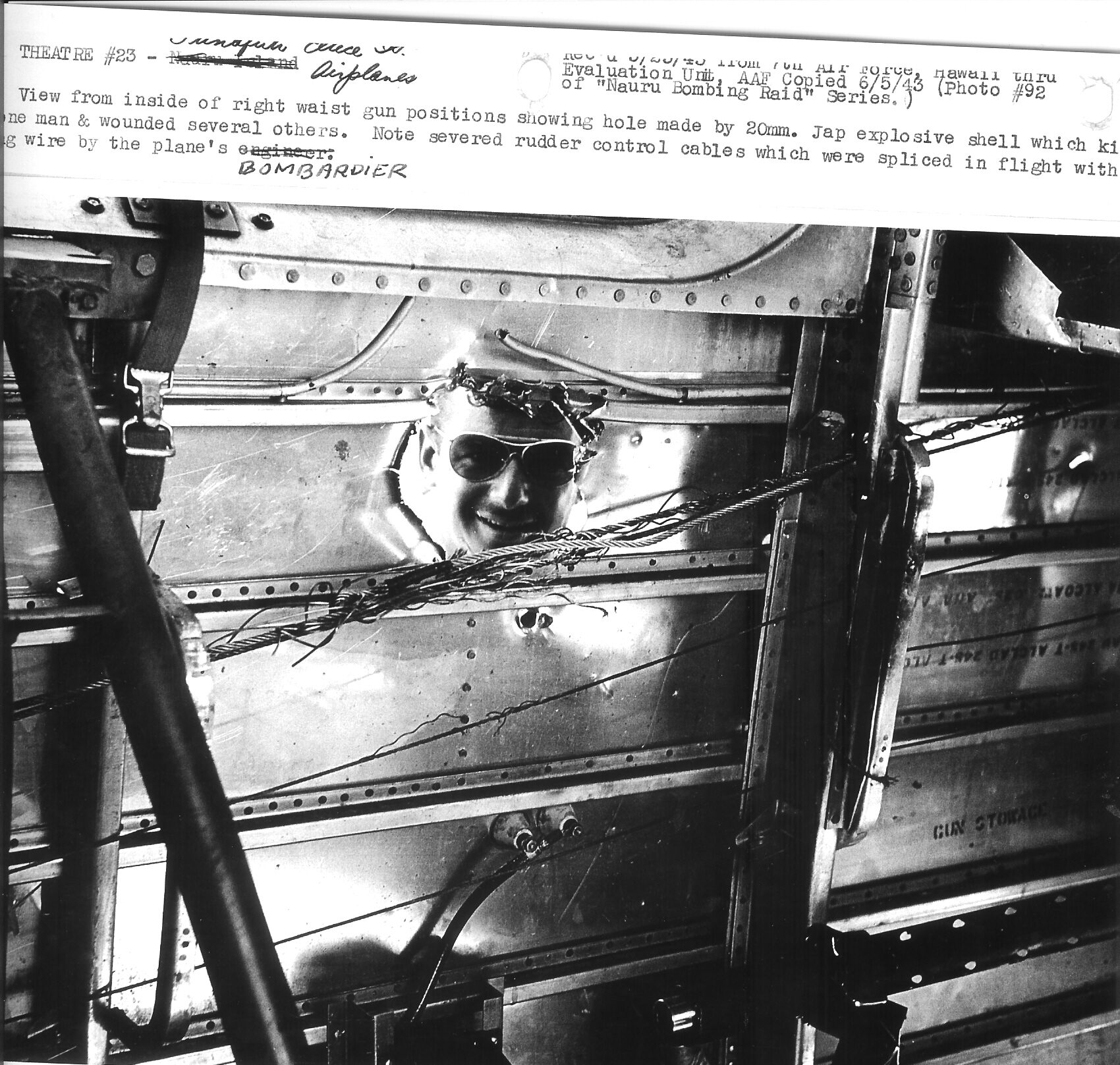
Rudder cable repaired with arming-wires
Only four Zeros of Air Group 252 intercepted and all returned safely to base. On the airfield, however, one land attack bomber was destroyed by fire and five land attack bombers and three Zeros were damaged.[xii]
Retaliation and Counterattacks
Air Group 755 sent seventeen Type 96 land attack bombers to Tarawa for a counter blow against Funafuti. The following night twelve of these were launched in four separate waves of three. One trio turned back due to weather, but three flights made it to Funafuti where the first flight’s bombs caused no significant damage. Bombs from the second flight destroyed the white stone church of the London Missionary Society. An armed Marine dispersed the crowd of natives who had gathered in the church for safety shortly before it was hit. Bombs from the third flight fell on the airfield area. One of the two B-24s which were destroyed was loaded with bombs and caused a huge explosion. Five other B-24s were damaged. One VMF-411 Wildcat was destroyed and eight others damaged. Personnel casualties included five dead and twenty-seven wounded.[xiii]
On April 23 twelve B-24s took off from Funafuti and shaped a course northward east of the Ellice and Gilbert Islands flying 800 miles to approach Bititu Island, Tarawa Atoll directly from the east. This route achieved surprise and no AA fired until after their load of about 15 tons of bombs had been dropped, the first from ships offshore. Heavy AA was then encountered. One bomber was hit. Four Zekes and a float biplane were seen but caused no damage. A B-24 ditched off Nui Island 135 miles northwest of Funafuti. The crew was rescued. A planned follow up photo mission was canceled to get out of Funafuti as rapidly as possible.
The May 1943 Wake Island Operation
Back on Oahu the 371st and 372nd BS rested and prepared for a raid on Wake Island. Admiral Nimitz recorded:
[T]he bombing mission against Wake Island, on 15 May, [was] by 18 B-24’s of the 7th Bomber Command, operating from Midway. 4 B-24’s were forced to return by excessive fuel consumption. 7 B-24’s reached the target and dropped their bombs, 65% of which were estimated to have fallen in the target area. Weather over the target was poor, being 9/10 overcast; clouds between 2000 – 13,000. The flight was intercepted by [12] VF, 4 were shot down; 4 B-24’s were damaged. On the return, 1 B-24 made a forced landing 120 miles to southwest of Midway. The crew was rescued by PC boat.[xiv]
Air Group 252 suffered one fighter ditched with pilot recovered and three others hit by shells. The Japanese had assembled twenty-one land attack bombers on Wake, but none was damaged in the attack. One wonders if U.S. communication intelligence of this concentration of bombers motivated this attack. The Japanese did suffer a damaging blow. The torpedo adjustment depot was destroyed. In future torpedoes would have to be sent to Wake from Kwajalein as replacements.[xv]
Why These Forgotten Operations Matter
Professor Morison’s assessment of land-based operations in the Central Pacific at the beginning of this article (few, slight importance) may appear correct to many readers for the period reviewed. However, it may be fair to ask: Compared to what? The Pacific Fleet had fleet and escort aircraft carriers available. The H.M.S. Victorious even joined them for a few months. There were no aircraft carrier strikes against any of Japan’s island bases in the central Pacific in the early months of 1943 as there had been in early 1942. For that matter there were none in the northern Pacific or southern Pacific theaters.
Although overshadowed by the major amphibious campaigns that followed, the Central Pacific air operations of early 1943 demonstrated the growing reach of American air power and exposed weaknesses in Japan’s island defenses. These missions forced both sides to commit aircraft, personnel, and resources across enormous distances while refining tactics that would later prove decisive in the Gilbert, Marshall, and Mariana campaigns. Far from being insignificant, these operations served as an important testing ground for the strategies, technologies, and leadership that would shape the remainder of the Pacific War.
Footnotes:
[i] Morison, Aleutians, Gilberts, and Marshalls June 1942-April 1944, Little, Brown & Company, Boston (1951), p. 96. Vol. VII of his naval history of World War II.
[ii] The Hawaiian Air Force was redesignated Seventh Air Force in February 1942; its subordinate commands were renamed accordingly. The B-17s (“Southern Bombers”) eventually ended up in Australia.
[iii] Combat Narratives, Early Raids in the Pacific 2/1 – 3/10 1942, Office of Naval Intelligence, p. 42.
[iv] M/Gen. Tinker’s LB-30 was observed to go out of control and disappear in murky weather not far from Midway. Tinker official U.S.A.F. biography.
[v] CinC, Pacific Fleet Operations Order No. 49-42 (17 Dec. 1942) memorialized the details.
[vi] Craven & Cate, The Pacific: Guadalcanal to Saipan, Univ. of Chicago Press, Chicago (1950/1983), p. 282.
[vii] Izawa, Rikko and Ginga, unpublished English language draft (1995), p. 145 (copy in possession of author).
[viii] Ibid. p.146. Twelve land attack bombers and eight Zeros were present on Nauru in March.
[ix] Salecker, Fortress Against the Sun, Combined Publishing, Conshohocken PA (2001), pp. 324-325. 201 Kokutai (Air Group), Kodoschosho, 9 Feb. 1943
[x] CinC Pacific, Operations in Pacific Ocean Areas, April 1943, para. 24 & 25 (29 June 1943).
[xi] Hillenbrand, Unbroken, Random House, New York (2010), p. 101.
[xii] Note vii, p. 147. Air Group 252 kodochosho, 21 Apr. 1943.
[xiii] Sherrod, History of Marine Corps Aviation in World War II, Combat Forces Press, Washington (1952), p. 221, Note vii, p. 148.
[xiv] CinC Pacific, Operations in Pacific Ocean Areas, May 1943, para. 13.
[xv] Note vii, p. 148.
Excellent research.