
What more could be said about the Japanese attack on Pearl Harbor in Hawaii in December 1941 that has not already been said? At first I thought about Lieutenant Kermit Tyler and his “Well, don’t worry about it” or “Forget it” comment in response to a telephone report of a strange return on the Opana Point radar scope. Contrary to all the cheap shot commentaries in print and film, Tyler was officially exonerated, and several publications point that out. The accusations against Admiral Kimmel and General Short as well as the voices of their defenders echo down the years. I certainly do not claim to be an expert on the Pearl Harbor operation. However, it seems to me there are some facts and possibilities that have not been highlighted or sufficiently connected to fully elucidate the story.
I have only visited the Hawaiian Islands once. The occasion was my son’s wedding. He had visited a friend in Hawaii and decided the perfect spot to get married was at Turtle Bay Resort on Oahu. The outdoor wedding pavilion was the northern most structure on the island. I appreciated that Turtle Bay also featured a plaque memorializing the Opana Point radar site location which could be seen on the heights above the resort. The failure of the radar warning to trigger a vigorous interception is, like absence of a long range search, just one of the questions to be more fully explored.
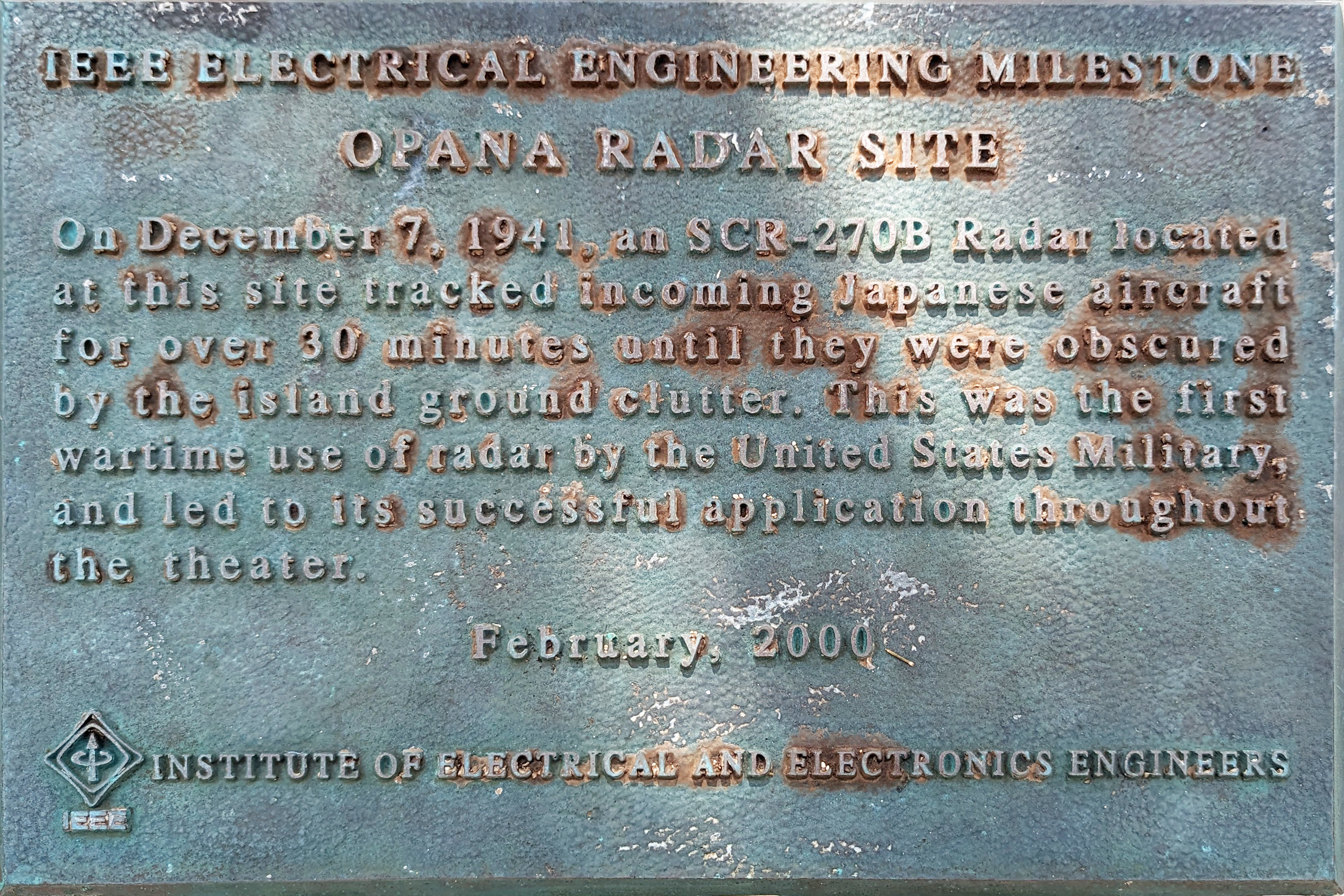
Opana plaque at Turtle Bay
Another preliminary comment harkens back to the U.S. Civil War. In the aftermath of the Battle of Gettysburg there was much hand wringing, finger-pointing and analysis on the part of Confederates. When General Pickett was asked who he thought was responsible for the South’s loss at Gettysburg his response was “I always thought the Yanks had something to do with it.” Japanese planning and execution were excellent. Amassing an attack force of six first-line aircraft carriers with well-trained aircrews and charting a course across the Pacific that avoided detection were key elements. Technical innovations included the use of torpedoes modified for shallow water use and training in extremely low approach runs. Likewise using Type 97 No. 80 Bombs (modified armor piercing shells) and training in level bombing attacks from 10,000 feet facilitated penetrating battleship armor.
Still questions linger. In late 1941, Pearl Harbor had been the base of the Pacific Fleet for over a year. During that period U.S. relations with Japan which were already strained deteriorated precipitously. In June 1941, Germany invaded Russia. Japan did not join the Axis attack. Suddenly Japan’s vulnerable northern flank was no longer at risk. It was free to address issues to the south. On 26 July 1941 the U.S. and Great Britain froze Japanese assets. Since the U.S. was Japan’s main supplier of petroleum this immediately created a deepened crisis. Two days later the crisis became an existential threat to Japan’s national existence when the Netherlands East Indies (Japan’s back-up plan source of oil) also froze Japanese assets. In diplomatic negotiations that followed the U.S. played hard ball. Prospects were that Japan would either capitulate, losing face in unprecedented fashion, or go to war. Only the timing was uncertain. This was the context when Washington issued a “war warning” on 27 November 1941.
In this article a key issue of defense, or more correctly failure, will be discussed. It is long range search. This was a potential enabler of effective defense of Pearl Harbor facilitating other elements such as advance warning of personnel, dispersal of assets, and disruption of enemy efforts. This issue is not new, but a somewhat different light will be shined on it.
Long Range Search
The vulnerability of Pearl Harbor to attack by carrier-borne aircraft and the counter to it was repeatedly articulated. At the end of December 1940 the commander of the Pearl Harbor naval district (RAdm. Claude Bloch) authored a memorandum sent via the Fleet commander to the Chief of Naval Operations (CNO). It pointed to the most likely means of attacking the fleet at Pearl was by aircraft carrier. Locating and sinking the enemy carriers before they launched their attack was the primary means of defense. According to Bloch:
The Navy component of the local defense forces has no planes for distant reconnaissance with which to locate enemy carriers and the only planes belonging to the local defense forces to attack the carriers when located would be the Army bombers. The Army has in the Hawaii area fifty-nine B-18 bombers…neither numbers or types are satisfactory for the purpose intended.
Bloch’s letter had an impact beyond the CNO. It was reviewed by the Secretary of the Navy, Frank Knox, who on 5 February 1941 sent a letter to his counterpart, the Secretary of War with an assessment and recommendation:
If war eventuates with Japan, it is believed easily possible that hostilities would be initiated by a surprise attack upon the Fleet or the Naval Base at Pearl Harbor. In my opinion, the inherent possibilities of a major disaster to the fleet or naval base warrant taking every step, as rapidly as can be done, that will increase the joint readiness of the Army and Navy to withstand a raid of the character mentioned.
The year 1941 brought two new top commanders to Hawaii. Admiral Husband Kimmel for the Navy and General Walter Short for the Army. Both had been urged to review the air defenses of Pearl Harbor. Staffs under their respective air commanders conducted a study and issued a report on 31 March 1941, the report was virtually prescient as to how the Japanese attack was to occur. The Martin-Bellinger report stated that an attack might precede a declaration of war. It went on:
In a dawn air attack there is a high probability that it could be delivered as a complete surprise in spite of any patrols we might be using and that it might find us in a condition of readiness under which pursuit would be slow to start…
The various analyses of potential attacks all mentioned several possibilities but the two of highest priority were air attack and submarine attack. Among all threats air attack from aircraft carriers provided the most significant challenge for the defense.
The solution would be to run daily patrols to seaward through 360 degrees to reduce the probabilities of surprise attack. The Martin-Bellinger report cautioned this “can only be effectively maintained with present personnel and material for a very short period and as a practicable measure cannot, therefore, be undertaken unless other intelligence indicates that a raid…is probable within rather narrow time limits.”
The alternative to “other intelligence” [presumably communications intelligence] and a practicable long range search capability required sufficient long range search aircraft, i.e. B-17s, to conduct a full 360 degree search in 5 degree sectors. The radius of search was 800 miles or more. This would require 72 B-17 searches per day, which in turn required 180 B-17s for a search flight per aircraft every other day and a standby strike force of 36 bombers. Even flying only search missions on alternating days without additional bombers for a striking force called for more B-17s (144) than the total number produced to that point.
Both Kimmell and Short were briefed on the Martin-Bellinger report. Despite the report’s discussion that specifically mentioned B-17s it should be noted that the Navy was primarily responsible for off-shore searches. Under the joint defense plan the Navy could ask the Army for assistance in carrying out searches. On August 20, 1941, Maj. Gen. Martin sent a letter with attachments to Lt. Gen. Short reiterating in detail the need for a 360 degree search and the B-17s needed to conduct such a search. If anyone was going to request B-17s for sea searches it presumably would have to start with Admiral Kimmel. However, Washington’s War Warning to Lt. Gen. Short on 27 November directed him to “undertake such reconnaissance…as you deem necessary…” If he decided to undertake reconnaissance it would have to be with resources at hand.
Two questions, (A) why weren’t there more B-17s? and (B) in December 1941 might a sea search covering all or most of 360 degrees from Oahu been extemporized with assets on hand?
For background on the development and early operations of the B-17 refer to XB-17 History – Reflections on Strategic Contracting & Bureaucracy – RLDunn.
After flight tests with the Boeing 299 the U.S. Army Air Corps was enthusiastic about the B-17 and contemplated a production contract for sixty-five bombers. This was not to be. With the retirement of Maj. Gen Benjamin Foulois as Air Corps chief at the end of 1935 the B-17 lost a champion. Gen. Douglas MacArthur forward thinking advocate of air power also retired as Army Chief of Staff and was replaced by Gen. Malin Craig in October 1935. The Army’s purchase was limited to thirteen aircraft for service testing designated Y1B-17. Twelve of these were accepted from Boeing, January to August 1937, and assigned to the 2nd Bomb Group as operational aircraft.
The B-17 became entangled in a roles and missions dispute between the Army and Navy and within the Army between the ground and air forces. The Navy and Army had agreed to an Army air role in coastal defense. This was an extension of the artillery’s traditional role exemplified by coastal forts. The agreement ostensibly limited the Army’s role to within 100 miles offshore. The Army higher command never established this limit as a formal policy. Within the Army there was no role for a strategic bomber. National policy was essentially defensive, and General Craig believed the only role for air was to support the ground forces. From a narrow perspective the only role or requirement for the B-17 was reconnaissance and attack on coastal threats. If the Air Corps could not demonstrate the B-17’s potential as a strategic bomber perhaps they could show it was a patrol bomber par excellence.
The small number of B-17s began to show their potential in 1937. President Roosevelt authorized a joint Army-Navy exercise off the west coast simulating a naval incursion by an enemy capital ship in August. In an operating area that stretched 300 miles out to sea B-17s flying from March Field found and “bombed” (water bombs) battleship Utah despite bad weather and faulty information provided by the Navy. Results of the exercise were supposed to be secret but leaked out. A few months later B-17s successfully “bombed” naval vessels off the Virginia Capes.
Three B-17s flying from Long Island in an Army exercise really made a splash in May 1938 by intercepting the Italian passenger liner S.S. Rex seven hundred miles out to sea. This event was not only recorded in the press but there was a reporter on board and live radio broadcast from the lead B-17. The Navy was furious. Publicly General Craig only accused the airmen of violating Army public relations policy, but the timing of the next B-17 purchase suggests interference in the procurement process.
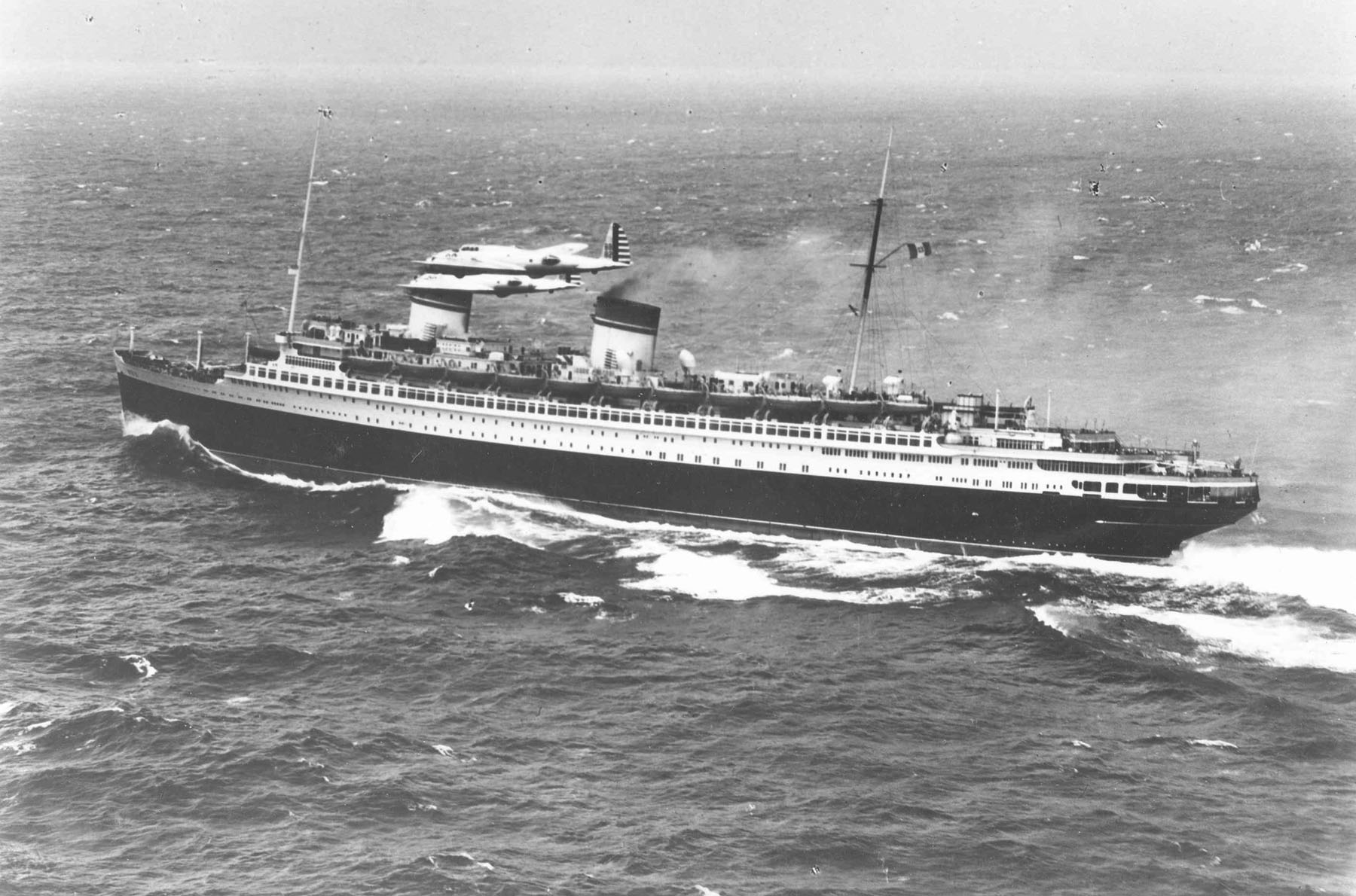
B-17s over S.S. Rex
In two batches in 1937 (August and November) the Air Corps ordered thirty-nine B-17Bs the first version equipped with turbo-superchargers. No B-17s were delivered to the Army during 1938. In January 1939 as war clouds darkened President Roosevelt directed an expansion of the Air Corps. This apparently had a positive effect on the delayed B-17B purchase. The first of the thirty-nine bombers was delivered at the end of July 1939 nearly two years after the initial order.
The last B-17B from the 1937 order was delivered at the end of March 1940. The Army had already ordered eighty additional B-17s which incorporated changes in line with lessons from the Spanish Civil War and trends among combatants in the European War. This order was split. The first thirty-eight, designated B-17Cs, were delivered from August to November 1940. A British purchasing commission sought to purchase B-17s for the Royal Air Force. General Craig authorized the sale of twenty of the B-17Cs to the British leaving just eighteen for the Air Corps. The balance of the order for eighty with additional changes were designated B-17Ds and delivered from February to April 1941. Air Corps B-17Cs were upgraded to B-17D standard.
The U.S. Army Air Forces (created June 1941) was in early 1941 ordering heavy bombers B-17s and B-24s by the hundreds. The first few B-17Es were delivered in September and by the end of the year over a hundred had been delivered. On 30 November 1941 just before the Pearl Harbor attack the Army Air Forces had on hand a total of 145 B-17s. Sixty-one of these were overseas including twelve in Hawaii and thirty-five in the Philippines. If leadership in Hawaii had taken the Martin-Bellinger report and similar analyses seriously how many B-17s might have been provided for long range search?
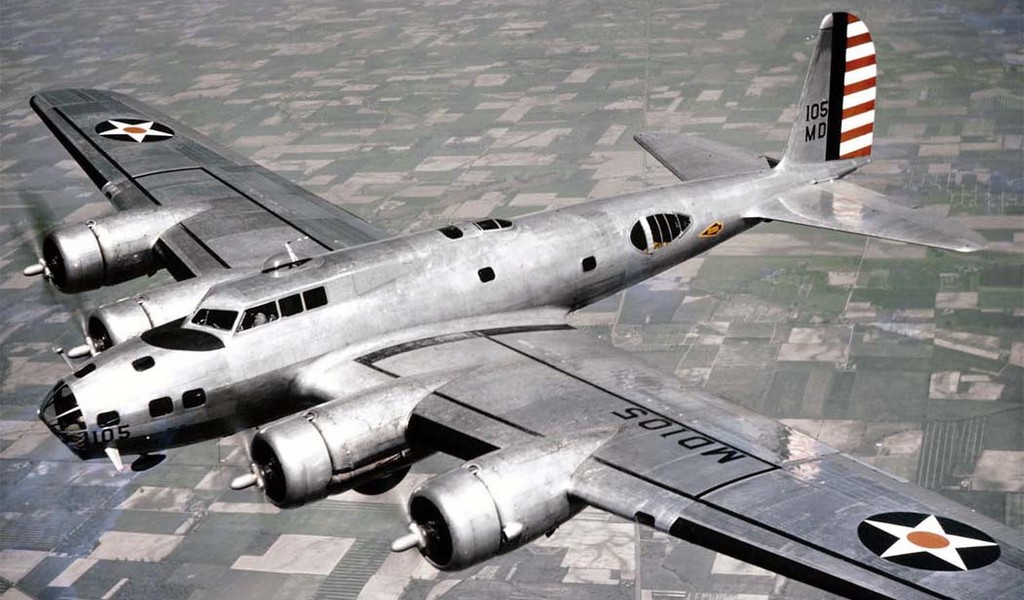
B-17B with flush gun ports
On 25 February 1941 just a month before the Martin-Bellinger report was presented to Kimmell and Short in Hawaii a conference was held in the office of the Army Chief-of-Staff General Marshall about the security of the fleet at Pearl Harbor. Attending were the chief of the Air Corps (Arnold) and other Air Corps luminaries (Generals Brett, Spatz, Emmons and McNarney). The meeting was occasioned by the 5 February 1941 letter from the Secretary of the Navy to the Secretary of War mentioned above. Maj. Gen. Delos Emmons head of the General Headquarters Air Force (stateside field command), who had previously served in Hawaii and who was selected to replace General Short after the attack had cogent comments. He asserted to close the meeting: “I would have long range bombers and not send pursuit, but bombers.”
On 19 May 1941 a conference was held in the office of the Secretary of War. There it was pointed out that fifty B-17s were available. These were aircraft not equipped with armor or self-sealing fuel tanks, that is, B-17s and B-17Bs. They were deemed suitable for high altitude bombing attacks but not general combat. They were clearly suitable for patrol missions. No request for these bombers came from Hawaii. By late summer 1941 eight B-17Bs were flying patrols over the Atlantic from Newfoundland. Eight were sent to Panama for use there and elsewhere in Latin America.
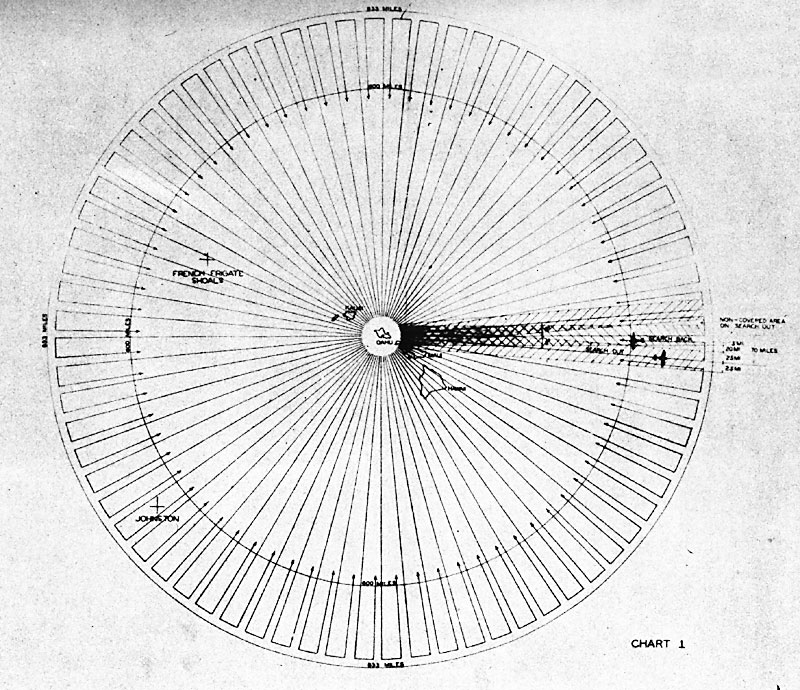
The search plan
Instead of its initial desire for sixty-five B-17s the Air Corps had been authorized only thirteen. These demonstrated superior capabilities. In the five years between the delivery of the first B-17 (Y1B-17) and Pearl Harbor no B-17s were delivered in 32 of the 60 months. While the Air Corps struggled to get support from Army leadership for as many as a hundred B-17s by 1941, the Navy had over four hundred PBY patrol bombers of various models by 1941.
What might be called the tragedy of the B-17 is connected to the tragedy of Pearl Harbor. September 1, 1939, is significant in this story for two reasons. That was the date Germany invaded Poland, and the date George C. Marshall became U.S. Army Chief of Staff replacing Malin Craig. As of that date the U.S. Army had approximately eight hundred combat aircraft. Of those seven hundred were A-17s, B-18s, or P-36s. By the time of Pearl Harbor all were considered obsolete. None saw significant use in combat during World War II. There were only twenty-three B-17s then on hand, yet it was the B-17 that served through out World War II and in December 1941 could arguably be considered the best bomber available to any of the combatants.
How might a long range search been mounted before the attack? Could an effective search covering all or most of 360 degrees have been mounted without 180 B-17s? The March 1941 Martin-Bellinger report indicated this was possible but “can only be effectively maintained with present personnel and material for a very short period…” The assertion that a full search could be maintained with resources available in early 1941 seems surprising, even if only for a few days. However, given the potential availability of fifty B-17s it seems more possible. It appears neither Kimmell nor Short took the threat of a raid as outlined by Martin-Bellinger or other officials seriously. Leadership in Hawaii did not request assignment of assets needed.
In any event misjudgments made in March need not have been repeated after the 27 November war warning. In the few days leading up to 7 December what resources were available that might have provided the warning to mount an adequate defense. The Navy had sixty-nine PBYs (PBY-3 and PBY-5 models) based on Oahu. Only seven PBYs were airborne at the time of the attack (three on local patrols and four in a tactical exercise). The Army had thirty-three B-18s and a dozen B-17Ds. Neither the PBYs nor B-18s were perfectly suited for the mission but could play their part. The PBYs and B-17s could cover an 800-mile search. In Hawaii the B-18s were credited with a combat range of 300 miles but without bombs could easily cover 500 miles or more. Given flights every other day available aircraft (34 PBYs, 16 B-18s, 6 B-17s) could cover 280 degrees in 5 degree sectors of which 200 degree coverage was out to 800 miles and the other 80 degrees to 500 miles. If the search wedge was broadened to 6 degrees, they could cover 336 degrees. Though not optimum this provided substantial coverage. What about the uncovered 80 degrees or 24 degrees as the case may be?
The obvious solution was transmitted in a CNO message (10 Dec 2209) to the Pacific Fleet and other fleets after the attack:
Desire assist Army aircraft warning service by providing suitable small vessels stationed 50 or more miles off shore to report approaching enemy aircraft and enemy surface craft and submarines. Such vessels to be equipped with radio for transmitting voice or telegraph as required for reception by Army warning net.
A search approach that would cover nearly 360 degrees was practical. Any uncovered or poorly covered sector could be backed up by radar and radio equipped small vessels. Late in December after the Japanese attack, with 78 PBYs available thirty were being used for daily searches out to 700 miles covering 240 degrees from Oahu. The remaining 120 degrees was covered by 16 B-17s. If fewer aircraft were available shorter range observation aircraft filled in. Newly arrived commander of the Pacific Fleet Chester Nimitz advised the CNO in early January 1942 in good visibility “that about 50 planes (the number varying slightly by type) are needed daily for search.” If leadership had understood the threat and applied the available resources a system to detect the most likely and dangerous form of attack was possible. And…if leadership had understood the problem earlier thirty or forty early model B-17s could have contributed to the solution.
Part II will address failures in radar command and control and interception operations.