
This article focuses on one pilot’s story—Lt. Noriyuki Saito, a Japanese fighter pilot who flew missions over Burma during WWII. Through his experience, we gain rare perspective and insight into the other side of the Burma air war. His story sheds light on the personal challenges faced by Japanese aviators, the logistical complexities of the region, and dispels myths—such as the idea that American bombers were used as bait to trap Japanese fighters. Much of what is shared here cannot be found in other historical accounts.
Burma, October 1943
The Monsoon season ended early in the month. Japanese army air units that deployed most of their strength to fallback bases during the rainy season returned to Burma by the beginning of the month. The 50th Hikosentai (Flying Regiment, FR) with its main strength at Singapore and a detachment at Bandoeng, Java transferred to Mingaladon near Rangoon. While deployed in the south it had replaced its last few Type 1, model I fighters (Ki 43; Hayabusa) with model II’s. Replacement pilots were also integrated into its three chutais.
The Japanese had occupied southern and central Burma since May 1942. In early 1943 the Japanese successfully rebuffed a British-Indian offensive in the Arakan west of Akyab. In October 1943 they were confronted by threats on four fronts. British-Indian forces in the Arakan (XV Corps) and along the line of the Chindwin River (IV Corps) provided threats from the west. In the north the Chinese Army in India had been built up with training and equipment supplied by the Americans. In Yunnan to the east a Chinese expeditionary army (Y-Force) trained and equipped to Chinese standards also relied on American supplies to some extent.
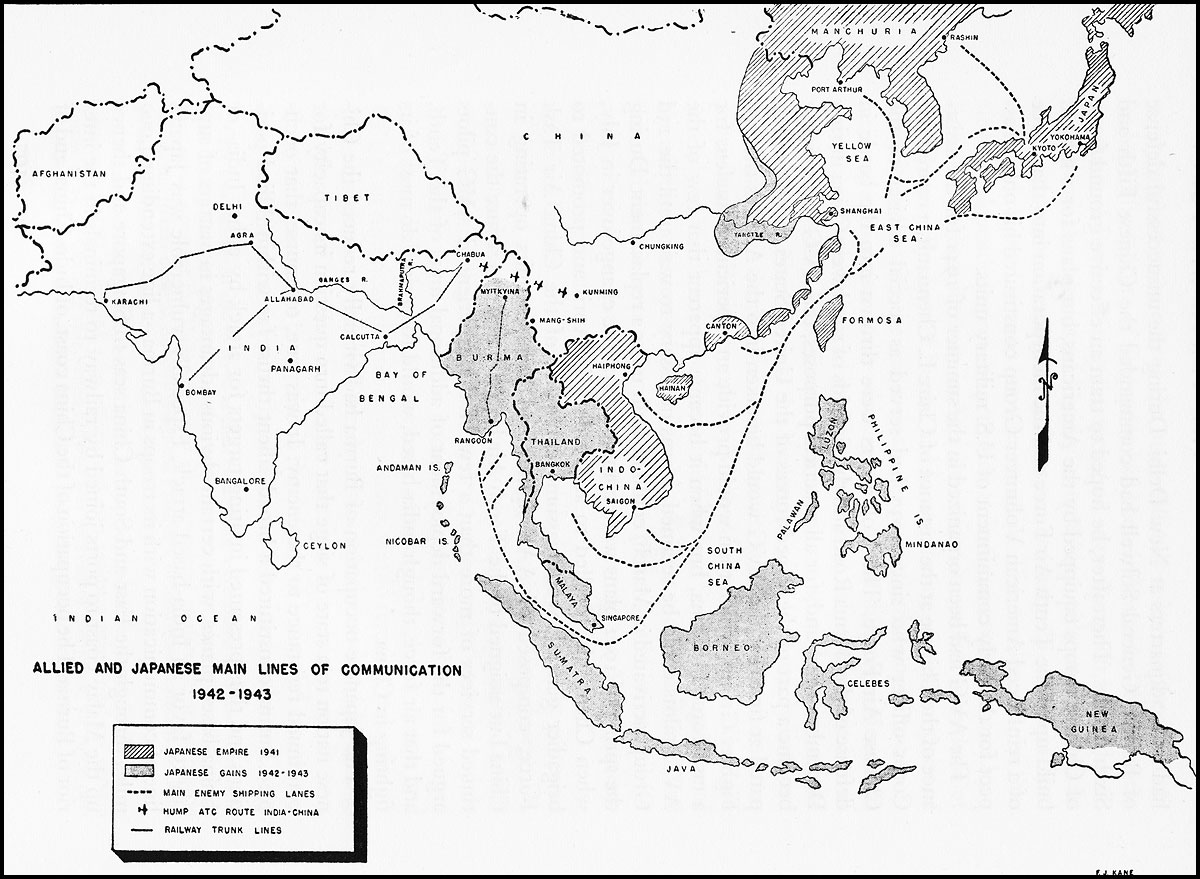
Lines of communication showing Hump air route.
Burma involved severe logistical challenges for both sides. Mountain ranges and jungles dominated much of the land. The Irrawaddy River provided a useful north south line of communication between Rangoon and central Burma for the Japanese. Overland travel was handicapped by a dearth of railroads and motor roads. To supply forward areas animal drawn carts gave way to trails for pack animals. In some cases supply was limited to whatever troops and native helpers, if available, could carry. The Allies had a useful adjunct to ground communication via air drops (free fall or by parachute) from cargo planes to supply forward deployed troops. The Japanese lacked a similar capability. Aerial supply from India to China passing over northern Burma was essential to keep the U.S. Fourteenth Air Force operational in China. It also provided some support to Chinese ground forces.
With the end of the monsoon and return of Japanese air units, air combat over Burma began to pick up. On October seventh an RAF No. 31 Squadron Dakota (C-47) was shot down by a Type 1 fighter near Tiddim over the Arakan. Japanese fighters rose to intercept U.S. B-24 missions over Rangoon including the mission on October 8 made famous when Sgt. Anabuki of 50th FR registered outrageous and baseless claims. The 50th FR also engaged in missions to disrupt the India to China “aerial bridge”. Flying over mountainous terrain – these were known as “Hump” operations. On 13 October eight 50th FR Hayabusas staging through Myitkyina claimed six victories. A Chinese (CNAC) contract C-47, an Air Transport Command (ATC) C-46 and an ATC C-87 were shot down. A B-24D of the 308th Bomb Group and two C-47s of the 2nd Troop Carrier Squadron were damaged. The three damaged aircraft were not part of China’s aerial bridge supply system. B-24’s of the 14th Air Force flew “routine ferry missions” carrying materials (primarily aviation gasoline) for their own missions in China. They typically dropped bombs on Japanese objectives on their return flight to India. The 2nd TCS was involved in air drops to supply troops in Burma. Immediately after refueling at Myitkyina the Japanese fighters returned to Mingaladon. P-40N’s of the 80th Fighter Group holed the runway at Myitkyina with 1,000 pound bombs and strafed airfield facilities. They also increased their patrols supporting air bridge operations from four-plane to eight-plane flights. Bombing and strafing missions against Myitkyina airfield continued several times per month over the next few months. Japanese fighters switched to other forward airfields.
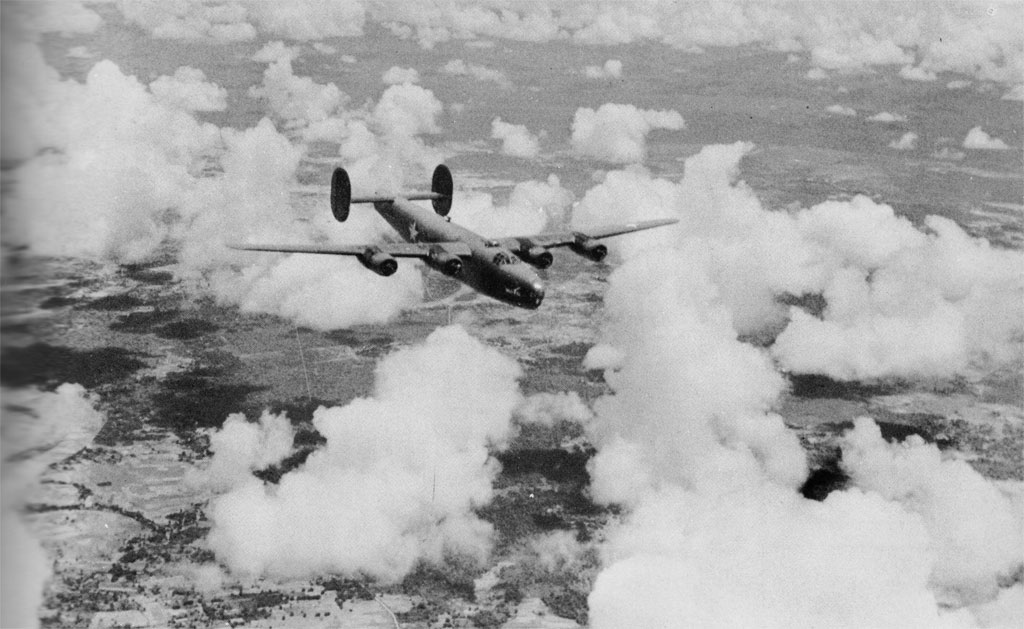
C-87 flying the Hump route.
NOTE:
CNAC (China National Aviation Corp.) played a small but efficient and important role in the Hump supply runs. In five and half months from April to mid-September 1943 India China Air Transport Command (ATC) averaged over 185 transports (C-47, C-46, C-87) on hand and delivered 18,261 tons (17.9 tons per aircraft on hand). CNAC (C-47) averaged 25 aircraft on hand and delivered 5,496 tons (39.2 tons per aircraft on hand). This was below the projected tonnage of which ¾ was allocated to the 14th Air Force and the remainder to Chinese ground forces and other uses.
The India-China transport route started from airfields in the Dinjan area of Assam and terminated at Kunming or other nearby airfields in Yunnan. Flights typically passed north or south (not directly over) Japanese occupied Sumprabum about 125 miles north of Myitkyina. Although both the Allies and Japanese had lookout stations along parts of the China air transport route, communication was poor, and little useful information was supplied to either attackers or defenders. Japanese fighters scored a success on October 20, shooting down a C-46. Three days later they shot down three C-46s.
October also saw the beginning of preliminary ground action. The Allies wanted to secure their line of communications and position themselves for future offensives. The Japanese wanted to spoil Allied preparations. Elements of three American trained battalions of the Chinese 112th Regiment began moving south into the Hukawng Valley probing for outposts of the Japanese 18th Division and their forward line. A substantial force from the Japanese 56th Division supported on its northern flank by elements of the 18th Division began a serious effort to dislodge Chinese nationalist forces from along the Salween River and drive them back to Yunnan. The Japanese press reported the Chinese suffered over 6,000 casualties. Abandoned equipment and billets were captured. However, the Chinese retreated so rapidly the Japanese were unable to surround and annihilate a substantial force as they had hoped.
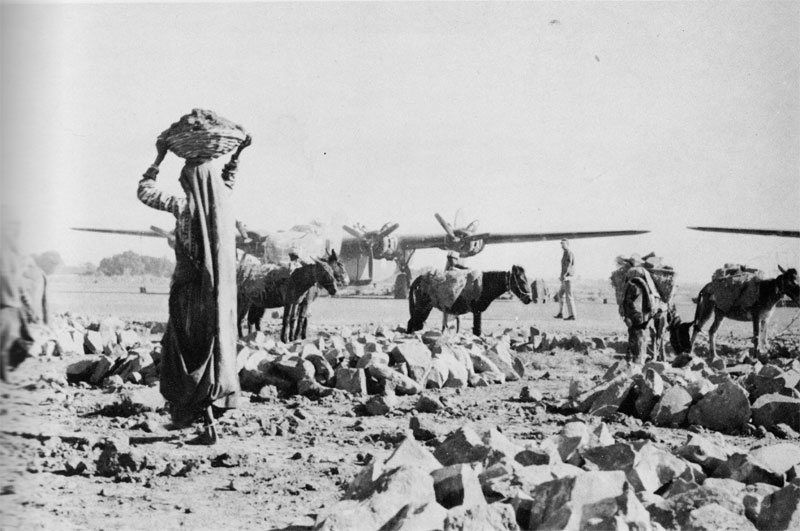
Airfield construction in India.
Lieutenant Saito’s Road to Burma
Noriyuki Saito was born in Futabacho not far from present day Misawa Air Force Base near Tokyo in 1921. He completed eleven years of elementary and middle school as well as a year of higher school before joining the Japanese army air force in January 1940. His initial training at Kashiwa Kyoikutai involved basic military drill and infantry training. In March 1940 he entered Kumagaya Hiko Gakko for ground school and initial flight training in basic trainers. In January 1941 having completed about 100 hours flying time he transferred to 12 Kyoiku Hiko Rentai, Chofu for training on Type 95 biplane fighters and Type 97 fighters. As an officer candidate he received officer training as well as more flying time than enlisted personnel. He completed an additional 300 hours flying time at Chofu and was commissioned before moving on to Akeno Hiko Gakko in June 1942 for advanced training on Type 97 and Type 1 fighters. He completed another 150 hours of flying time by April 1943. He was assigned to the 50th FR and proceeded overseas via Taiwan, Singapore and Bangkok before joining his unit at Meiktila, Burma at the beginning of May 1943.
Lt. Saito had few opportunities to fly on operations before the 50th FR withdrew to Singapore with the onset of the Monsoon season. However, on 15 May he witnessed action up close. Most of the Sentai was away on a mission escorting bombers to Kunming, China. Only a few older Type 1 fighters remained at Meiktila (Kangaung). With little warning eight Hurricanes swept in to strafe the airfield. With Saito present to watch, Sgt. Jukichi Sugawara attempted to take-off. He was caught during his take-off run, shot down and killed. This was one of four aircraft lost while Saito was with the 50th in May.
Saito spent most of the time from June to late September with his unit at Singapore. The pleasant stay at Singapore was interrupted only by a trip to Java with two other pilots to ferry fighters back to Singapore. Upon returning to Burma the 50th FR operated from Mingaladon before moving up country to Heho on 14 October. Saito’s operational missions included escorting convoys into Rangoon harbor, a few attempted interceptions of B-24s and a bomber escort mission.
The Last Mission
On 26 October the commander of the 50th FR ordered ten Type 1 fighters of Nos. 1 and 3 Chutais to deploy to Loiwing to patrol the India-China air route the next day. Loiwing was in China close to the Burma border. Until 1942 it had been the home of the Central Aircraft Manufacturing Company (CAMCO) which assembled aircraft for the Chinese Air Force and later repaired aircraft of the American Volunteer Group (Flying Tigers). In Japanese hands in 1943 it featured a relatively short runway, a small Japanese servicing detachment and austere airfield facilities and billets for personnel.
The mission to interdict the Hump air route was reputedly termed Tsuzigiri (street murder) by the Japanese. This implies a serendipitous violent encounter. The Type 1 fighters were each equipped with two external long-range fuel tanks. This permitted them to patrol for hours. Their patrol area ran north from Myitkyina to the vicinity of Sumprabum. There was little in the way of a briefing before take-off. Saito had heard these missions discussed among the pilots and knew pretty much what to expect.
On the morning of the 27th eight Hayabusas took off from Loiwing. There were two flights of four each. Each flight flew in a two element “finger-four” formation that the Japanese army called a rotte formation based on German practice. Saito was not included in this mission. According to a 10th Air Force intelligence summary: “At approximately 0800 hrs, 3 enemy aircraft attacked a transport just NE of Sumprabum. The transport is overdue and believed shot down.” The victim was C-46A No. 41-12307. The pilot Flight Officer Marion Thomas was badly injured but survived and eventually returned. The other three members of the crew died. The same intelligence summary based on information from the 14th Air Force reported: “Six B-24s…were intercepted by 8 camouflaged fighters at 0930. Attacks were made from 11 and 1 o’clock positions for a period of 15 minutes. 3 fighters were reported destroyed and 1 probably destroyed.” Seven Japanese fighters returned to Loiwing. Warrant Officer Oshima was reported missing but survived a crash landing and returned a few days later.
Saito joined the afternoon mission. He flew as wingman to chutai CO Capt. Shigeharu Hashimoto in a three-plane flight. There were only seven planes in the formation, one having been lost in the morning mission with two others unserviceable. After the mission the fighters were to return directly to Heho rather than Loiwing.
The formation flew a direct course for Sumprabum then on toward Myitkyina flying at around 4,000 meters (about 13,000 ft.) at 190 m.p.h. Shortly before arriving five B-24s were sighted slightly below the Japanese fighters. The Hashimoto flight pressed ahead of the second flight. They caught up with the bombers from behind and then took position for a frontal attack. Saito made his first pass from a 10 o’clock position. He positioned himself for a second pass from head on. During this pass his aircraft was hit and lost power.
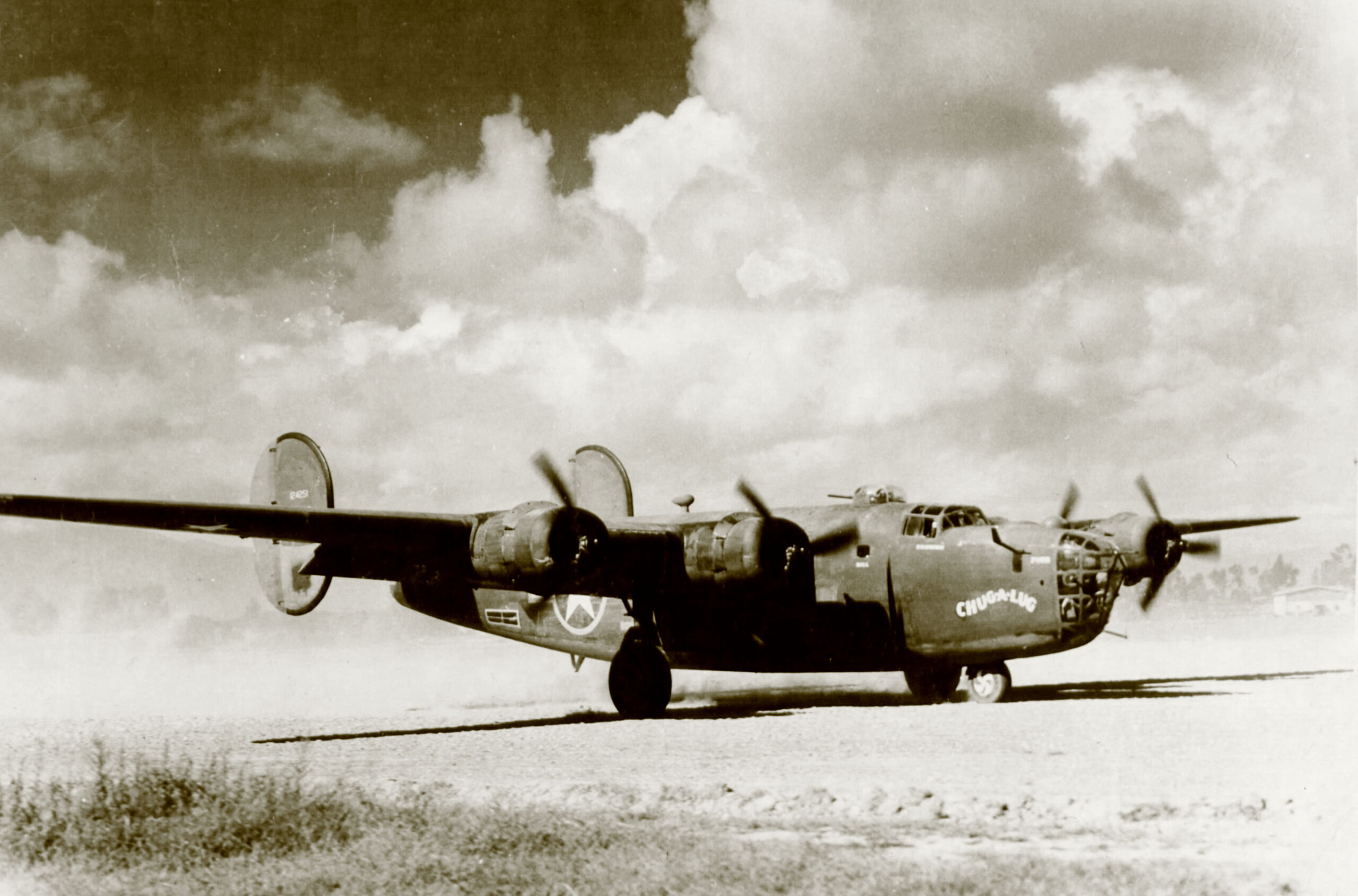
B-24D Liberator 41-24251 425th BS Nov. 1943.
The 10th Air Force intelligence summary related the afternoon encounter. “At 1505 the same day, a return flight of 5 B-24s was intercepted by 8 silver fighters 25 miles SSE of Sumprabum. These were reported to be a different type of fighter than those of the morning and were more aggressive. 5 fighters were reported destroyed and 1 probably destroyed. All B-24s landed safely with minor damage.” A 14th Air Force intelligence summary noted that the bombing target on the return flight was Lungling. It further commented: “On the return trip, eight Zeros, long slender, all silver attacked for 30 minutes…at altitude of 13,500 feet…more efficiently and aggressively. Five confirmed, one probable shot down and one or more damaged. All B-24s landed safely with minor injuries to two crew members.”
Defensive fire from the Liberators against these “more aggressive” attacks resulted in two Japanese fighters falling out of the fight in trouble. One was Saito’s and the other was Type 1 fighter No. 5072 flown by Corp. Masaharu (possibly Seiji) Tabuchi. The crash report on No. 5072 stated that the pilot had been wounded. He attempted a belly landing in a rice paddy located in a valley surrounded by steep cliffs. Failing to use flaps, he overshot, hit a tree tearing off the left wing. The aircraft broke up in three parts. Tabuchi died of a broken neck. The crash report noted that this early production model II had makeshift armor behind the pilot seat. A padded bag the shape of a baseball umpire’s chest protector contained many half-inch steel plates about 5-inches square mounted by leather straps about two feet behind the pilot’s seat. The armor had not been hit. The wreck also displayed signs of poor maintenance.
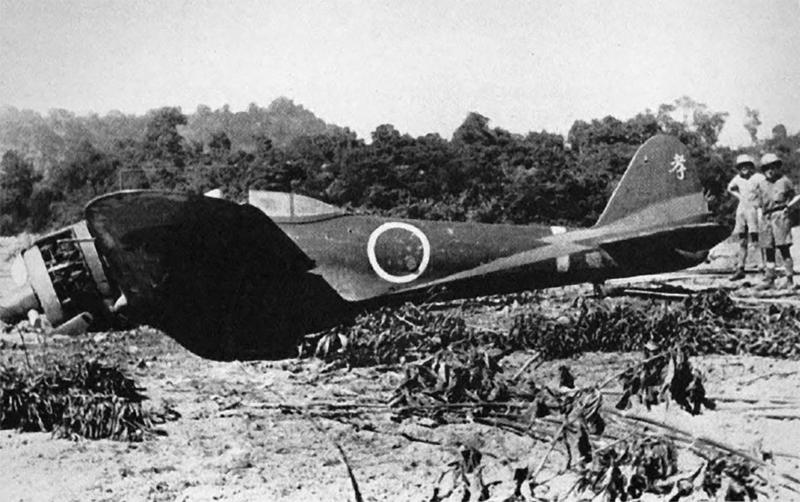
Type 1 fighter 50th showing Sentai markings.
Saito’s fighter lost power after being hit. Like Tabuchi he opted for a belly-landing in a rice field. The crash caused him to lose consciousness. When he came to he found about ten Burmese standing nearby. He got out of the aircraft. The natives ran away but came back when he called to them. They helped clean up his bloody face and took him to their village. The natives gave him directions to Sumprabum but convinced him to stay in their village as it was late in the day. Saito was awakened during the night by being attacked by the same natives. They hit him with sticks. They bound him hand and foot. In the morning they untied his feet so he could walk. Then began a long trek of perhaps two weeks where he was handed off from village to village in most cases with harsh treatment including near starvation. The headman from the first village came along for the entire trip. Finally he was handed over to an American officer accompanied by another American. There he was treated kindly. He was carried on a stretcher for a day’s journey before being placed in a small airplane and flown to a larger airfield from which he was taken to hospital. Finally he was transported to Delhi, India. Saito was extremely appreciative of the kind treatment received from the Americans which probably accounts for his cooperation with Allied intelligence during P.O.W. interrogations. Saito’s interrogation reports provide much grist for this account.
The “Rest of the Story”?
The great storyteller, Paul Harvey, would capture the interest of his audience with an interesting tale and then regale them with “the rest of the story.” Unfortunately, I have no similar satisfying end to Lt. Saito’s story. He told his captors he did not wish to return to Japan after the war. This was a common theme among Japanese prisoners. They felt they had disgraced themselves by being captured. He said he might want to settle in Java or Malaya. However, our story does offer some opportunity for reflection and further reading.
Sgt. Satoshi Anabuki was briefly mentioned. Anabuki became a Japanese national hero. Among his exploits, on 8 October 1943, he claimed to have shot down two B-24s, two P-38s and then rammed and destroyed a third B-24 before crashing and injuring his hand. There were no witnesses to these events. Saito’s interrogators questioned him about Anabuki, and he responded it was beneath the dignity of a Japanese warrior to make false claims. See Anabuki Document
Another issue tangentially related to Anabuki is the issue of overclaiming more generally. Some folks seem to write this off with the idea that everybody overclaimed. Roughly true but in fact there were vast differences in the accuracy of claims in various theaters by various combatants at various times. Work has been done on this issue, and it is possible to parse whose claims are more accurate than others. Japanese claims were not always more inflated than Allied claims for example. Preconceived notions on this issue tend to be wrong.
Finally, published sources have suggested that B-24s were sent over the Hump route as a trap to confront unwary Japanese fighters who would think the B-24s were unarmed C-87 transports. Not so. 308th Bomb Group B-24s regularly flew the Hump route to restock their own supplies so that they could conduct bombing missions over China. The missions described in this article are an example of that. For more insight see: The B-24 Liberator in Chinese Skies – Summer 1943 – RLDunn
“Turlock Flier was Sole Survivor of Crash in Burma”
Turlock Daily Journal (Turlock, California)
Saturday, December 09, 1944
page 3
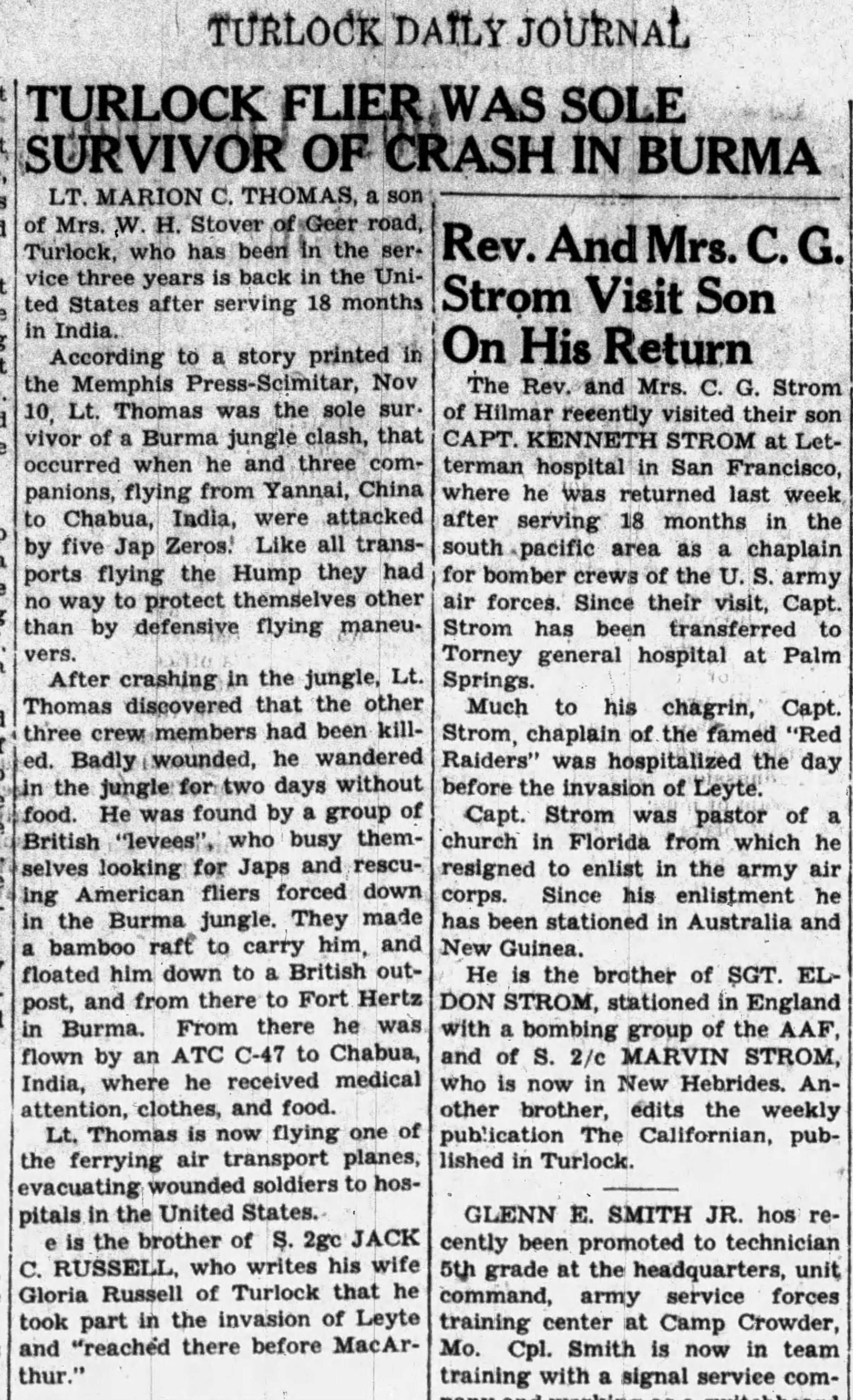
“Lt Marion C. Thomas, a son of Mrs. W.H. Stover of Geer road, Turlock, who has been in the service three years is back in the United States after serving 18 months in India.
According to a story printed in the Memphis Press-Scimitar, Nov. 10, Lt. Thomas was the sole survivor of a Burma jungle crash, that occurred when he and three companions, flying from Yannai, China to Chabua, India, were attacked by five Jap Zeros. Like all transports flying the Hump they had no way to protect themselves other than by defensive flying maneuvers.
After crashing in the jungle, Lt. Thomas discovered that the other three crew members had been killed. Badly wounded, he wandered in the jungle for two days without food. He was found by a group of British “levees”, who busy themselves looking for Japs and rescuing American fliers forced down in the Burma jungle. They made a bamboo raft to carry him, and floated him down to a British outpost, and from there to Fort Hertz in Burma. From there he was flown by an ATC C-47 to Chabua, India, where he received medical attention, clothes, and food.
Lt. Thomas is now flying one of the ferrying air transport planes, evacuating wounded soldiers to hospitals in the United States.
He is the brother of S.2gc Jack C. Russell, who writes his wife Gloria Russell of Turlock that he took part in the invasions of Leyte and “reached there before MacArthur.”