
The story of early operations of the elegant looking Japanese Army Type 3 Fighter is one that should be told. Despite having great potential, the fighter was initially a disappointment to the Japanese command at a critical period. This attempt to tell the story is hardly perfect but will provide some insights and hopefully advance the cause of getting the story right.
Working up in Japan
Twelve experimental and pre-production Ki 61’s were produced by manufacturer Kawasaki Aircraft Industries between December 1941 and July 1942. Unique among Japanese army World War Two fighters it was equipped with an in-line engine, a twelve-cylinder inverted-V liquid cooled engine. This was a licensed built version of the German Daimler Benz DB 601A. When officially adopted the engine was designated the Type 2 1,100 HP Liquid-Cooled engine. The nomenclature Ha 40 was also applied to the engine. The Ki 61 was selected for production after tests proved it generally superior to the Ki 60 prototype and Messerschmitt Bf 109E (which influenced the design of the Ki 61) both of which were equipped with the DB 601A engine. Licensing of the DB 601 grew out of Germany transferring five Bf 109’s to Japan for evaluation.
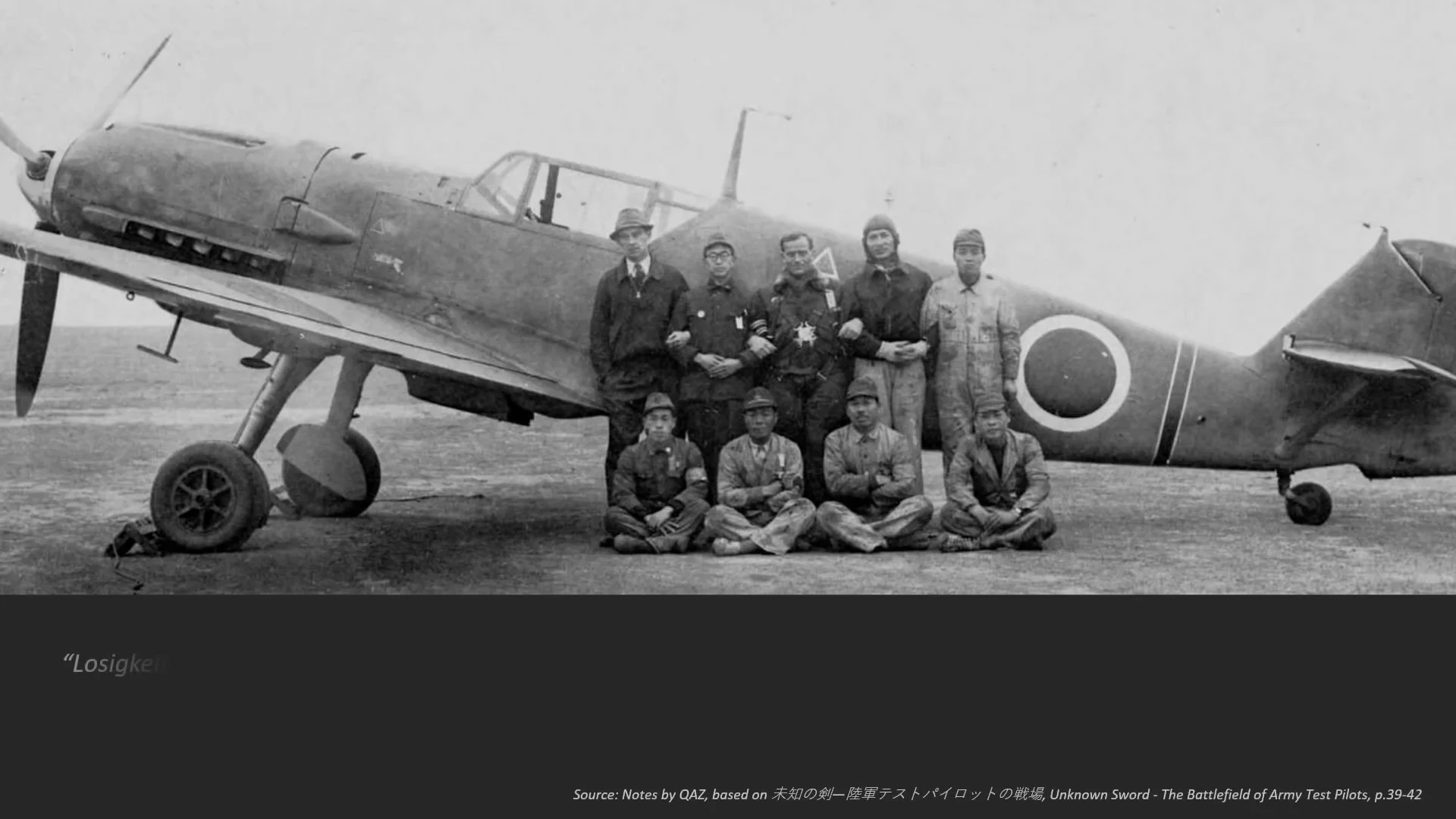
Japanese Messerschmitt Bf 109E
By the beginning of April 1942 five pre-production examples of the Ki 61 were flying. A year before the production Type 3 fighter reached the combat zone an early Ki 61 had a brush with combat. This occurred on 18 April 1942 when B-25’s of the Doolittle mission attacked Japan. Lt. Ryozaburo Umekawa was up in his Ki 61 for firing tests when B-25’s appeared over Tokyo Bay. Umekawa gave chase and fired a burst from long range but gave up pursuit due to fuel shortage. A B-25 gunner later reported sighting a Messerschmitt 109 over Tokyo Bay. Interestingly, Umekawa had claimed two victories in China in 1938 while flying a Kawasaki Type 95 fighter, a biplane equipped with an in-line engine.
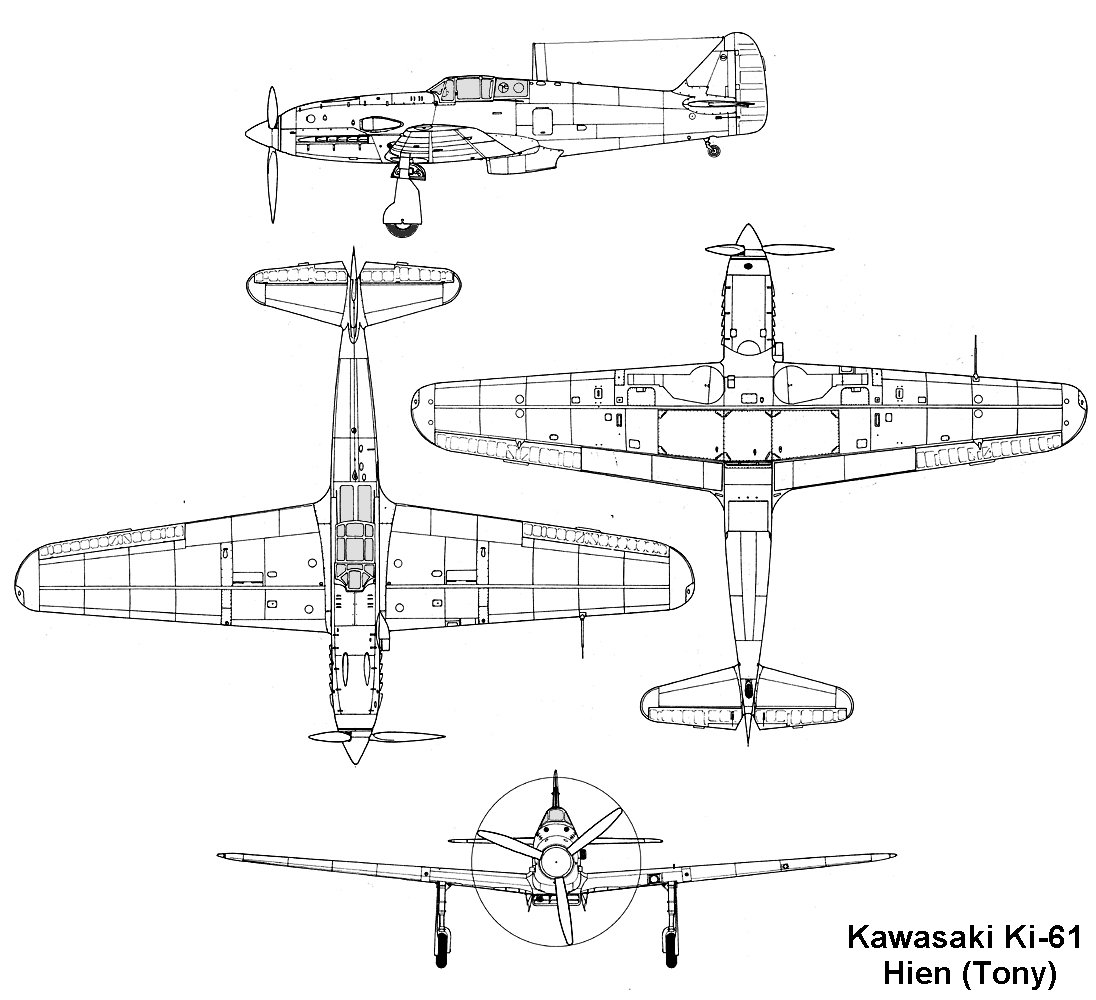
Type 3 fighter three view
The Ki 61 test program did not go smoothly. Glitches in the aircraft mainly the engine cropped up. The Ha 40 had direct fuel injection instead of a carburetor. This had significant advantages primarily operation under negative-g, but the direct injection system was complicated. Reputedly it had as many parts as all the rest of the airplane. The engine required specialty metals that were in short supply in Japan. It also required manufacturing tolerances that challenged Japanese production techniques. Problems appeared, were fixed and then additional problems appeared. During a speed test in bad weather a Ki 61 flew into a mountain killing the pilot. Kawasaki chief test pilot Kataoka was killed by an in-flight explosion suspected of being in the fuel tank. Accidents sometimes took place on a weekly basis. One by one the problems were worked out.
Delivery of production aircraft began in August 1942, and a squadron was formed at Chofu Airfield to begin combat training. By December 1942 after the Ki 61 had been officially adopted for service as the Type 3 fighter it was time to equip the first operational unit. The 68th Hiko Sentai (Flying Regiment, FR) was transferred from Manchuria to Akeno Airfield under its commander Maj. Noboru Shimoyana as the first combat unit to be equipped with the new aircraft. Initially about thirty production aircraft were available. The aircraft was given the name Hien (Swallow). Pilots familiarized themselves with flying the aircraft and trained for combat. Ground crews worked to master its engine, airframe and equipment. Problems arose and accidents occurred. Many of the problems were associated with engine cooling and the fuel injection system. Despite the problems after more than three months the regiment was slated to advance to the combat zone.
Truk-Rabaul Transfer Flight
At the end March 1943 the 68th FR began the process of transfer to Japan’s Southeast Area and its main base at Rabaul, New Britain. Personnel, supplies and aircraft were transported to Yokosuka. Fifty-four Type 3 fighters were among the resources that boarded auxiliary aircraft carrier Taiyo (formerly Kasuga Maru). Fifty-four fighters amounted to half the total production to that point. On 4 April in company with another aircraft carrier and escort vessels Taiyo departed Yokosuka. The day before arriving at Truk Atoll Taiyo was attacked by a U.S. submarine but due to faulty American torpedoes no reported damage was suffered. On 10 April the ship arrived at Truk. Aircraft and personnel were offloaded at Harushima (Moen) Island. The offloading, preparing and test flying the aircraft took a couple weeks. Maintenance was apparently mainly conducted by personnel unfamiliar with the aircraft.
Also on Truk during April were five early production versions of the Navy’s Type 2 carrier reconnaissance plane (D4Y). They were there to test the Navy’s version of the Daimler Benz engine (Atsuta) in tropical conditions. Evaluations showed only minor adjustments were needed.
On 25 April a mass transfer of Type 3 fighters with reconnaissance planes as navigational guides departed Truk for the nearly 800-mile flight. The guide planes may have been among five Type 100 Headquarters reconnaissance planes (Ki 46) transported to Truk on auxiliary carrier Chuyo in the same convoy as Taiyo. That flight was aborted en route due to mechanical problems and bad weather. The planes returned to Harushima.
A second attempt was made on 27 April. Orders called for two formations taking off in the morning an hour apart. Each flight was to be accompanied by a reconnaissance plane. Each flight consisted of fewer aircraft than originally ordered possibly due to last minute mechanical problems. The first flight of thirteen was led by Regimental commander Maj. Shimoyana. The second flight consisted of fourteen fighters.
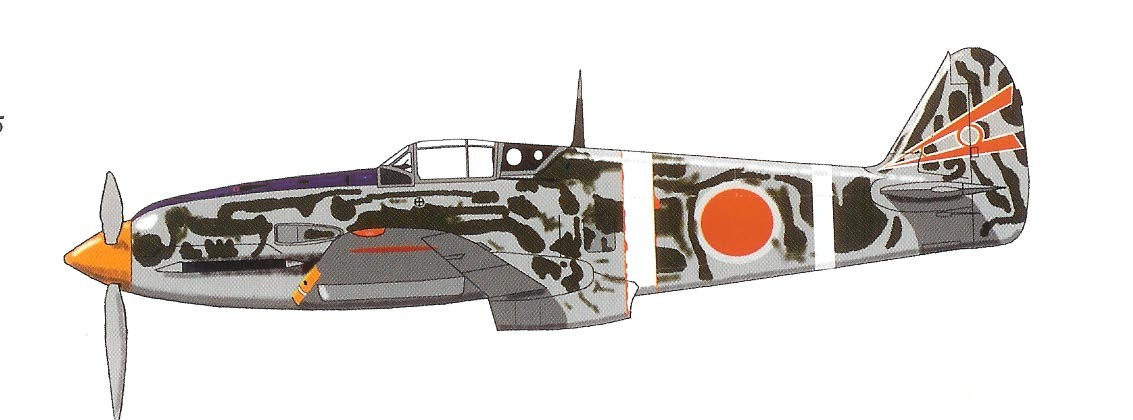
68th Hiko Sentai Type 3 fighter
Now the story gets murky. There are at least three different versions of the transfer flight all of which, however, are consistent in painting a picture of disaster. A cryptic account in the small English language book “Kawasaki Ki-61 (Tony)”, editors of Koku-Fun (1967) states regarding the flight to Rabaul:
One by one several of the planes became disabled, necessitating ditching in the Southern Sea. The disablement was attributed to a counter-flow valve which caused…oil to be pumped out of an air outlet slot during flight.
Loss of lubricating oil would cause an engine to overheat. Substantial or total loss of engine oil would result in engine seizure. The account continues:
[P]ilots orbited the downed planes and saw distressed crewmen crawling out of the planes and floating for a time but soon slipping under water. Many of them became victims of sharks.
In another version eight of the aircraft that were lost went down near Nuguria Atoll. Details were provided by John V. Douglas a well know researcher of New Guinea World War 2 aviation wrecks. Douglas related:
Kevin Baldwin has a dive boat and went to Nuguria to find them [in the 1990’s]. He said that the planes seem to have landed outside the atoll in deep water. They couldn’t find any trace of them. The locals remembered the incident. When I told him about one survivor, he agreed with me, but said the locals had killed the rest, leaving one survivor who was also beaten by the locals.
A corollary to that story is an unverified account that the Japanese navy sent a boat to the atoll during the war but found only one survivor in bloody clothing. A year earlier a Navy Type 1 land attack bomber ditched in Nuguria lagoon with the crew of seven surviving unharmed.
As garish and interesting as these accounts are they apparently contain only tidbits of fact. The book “Japanese Army Air Force Units and Their Aces”, Hata, Izawa and Shores, Grub Street (2002), lists only three pilots lost. I have a copy of the loss list from the Japanese language edition, and it has the same three names. I have a translated paraphrase of the Japanese language version which seems most plausible. Twenty-seven aircraft in two groups of 13 and 14 left Truk. The first group was led by Maj. Shimoyama the regimental CO. Shimoyama lost sight of the navigational aircraft. I suspect this might have been caused by some aircraft suffering mechanical faults and the formation becoming disorganized but that’s merely a surmise. Lacking navigational aid Shimoyama also found his compass was malfunctioning. Over the open ocean he had no way of finding New Britain. Nuguria is west of the direct route from Truk to Rabaul. Nearest land was about a hundred miles from there. Shimoyama and seven other pilots ditched near Nuguria. Two pilots turned back and made it to Truk. Two were never accounted for. One pilot made it to Kavieng airfield on New Ireland. The fourteen in the second flight all made it to Rabaul safely. This version does not expressly account for the third pilot that appears in the Hata/Izawa loss list. Possibly he was one of the pilots that ditched off Nuguria.
In addition to the failure of the engine oil counter-flow valve the Koku-Fun book also states “Insufficient tests and design error were also said to have accounted for the failure.” A translation of a captured “Ki 61 Handling Reference” states regarding the oil tank: “A drain fitting is located at the bottom center of the oil cooler through which oil can be drained from the lines and tank.” Possible support for identifying the oil valve as contributing to the failure may be found in the U.S. Strategic Bombing Survey report on the Kawasaki plant. A chart on critical shortages of accessories states that the subcontractor responsible for the “Ki 61, oil system selecting cock” delivered only about half the needed components to support production in February and March 1943. How this might have impacted events is unclear, but it seems to relate to the oil valve. It also seems worth pointing out that the losses from mechanical or equipment problems occurred among planes of one flight while all the planes of the second formation arrived safely. This might suggest maintenance or training was also part of the problem. Rather than just three stories there actually is a fourth story. Allied intelligence misread an intercepted message that was obviously garbled. According to the translation one aircraft of twenty-seven reached Rabaul, eight made emergency landings, and eighteen plunged into the sea.
The loss of ten aircraft on a transfer flight was bad enough. This incident shocked senior Army air officers who were expecting great things from this new aircraft. The functionality of the Type 3 fighter was questioned. This came at a time when the Japanese army was engaged in a buildup of air power in its Southeast Area. The Type 3 fighters of the 68th FR were the first increment of that planned build up. With reinforcements it was intended to support ground operations in the Lae-Salamaua region, secure friendly lines of communications along the New Guinea coast while disrupting Allied supply lines and ground advances in the area.
Combat Operation May – July 1943
Two fighter regiments (1st and 11th FR’s) and a light bomber regiment (45th FR) of the Japanese Army Air Force were sent to Rabaul to help regain air superiority in the recapture of Guadalcanal. Instead, they participated in the operation to withdraw Japanese forces from the island. The operation (Ke-Go) and their participation was considered successful. The fighter units also participated in Operation 18 providing air cover for a reinforcement convoy to Lae, deemed a success. Then in early March 1943 came Operation 81 known to Americans as the Battle of the Bismarck Sea, a military disaster for the Japanese. The Japanese army decided additional air resources were needed to maintain their position in New Guinea and eventually regain the initiative.
In the second half of March 1943 about the time the 68th FR was preparing to ship out to Truk JAAF air strength in the Southeast Area was low. Two fighter regiments (1st and 11th FR’s) fielded only about fifty operational Type 1 model I fighters. Operational light (45th FR) and heavy (14th FR) bombers totaled only thirty-five. There were also three reconnaissance planes available and an ad hoc “special attack unit” of several twin-engine fighters. Soon thereafter orders went out to transfer units from several different fronts (Japan, China, Java, central Pacific) to New Guinea as well as sending replacement aircraft to the units already there.
By the first week in May the only new unit added was the 68th FR. Unit strengths (shown as operational/under repair) according to an inventory of the 14th Air Repair Depot at Rabaul was then:
Type 1 fighters, 1st FR 36/2 and 11th FR 38/4; Type 99 twin-engine light bombers, 45th FR 16/1; Type 97 heavy bombers, 14th FR 28/1; Type 100 HQ reconnaissance planes, 76th independent chutai (squadron), 6/3; Special attack unit Type 2 two-seat fighters and Type 100 HQ reconnaissance planes, 7/-; Type 3 fighters, 68th FR, 15/1. Aircraft of the 11th and 45th FR’s were then on their way to Wewak. Numbers for the 68th included only those at Rabaul and not others still at Truk.
A parade of newcomers began arriving at Rabaul or Japanese bases near Wewak on New Guinea’s north coast. Among the first to arrive at Rabaul was 13th FR with twin engine fighters. The 13th incorporated airplanes and crews of the special attack unit. The 24th FR flew the model II version of the Type 1 fighter. The 208th FR was a twin-engine light bomber unit. The 83rd independent chutai flew Type 99 army reconnaissance/assault planes. A chutai of the 81st FR flew the Type 100 HQ reconnaissance plane. It later combined with the 76th to form the 10th FR.
Meanwhile activities of Australian troops south of the Japanese Salamaua outpost positions had increased. The Eighth Area Army ordered the Sixth Flying Division (senior JAAF command in the area) to cooperate with the ground forces of the 51st Division in the vicinity of Mubo and Bobdubi; and provide air cover to aid expeditious movement of 51st Division assets from Tuluvu (western New Britain) to Lae. Newcomers and resident units were soon in action.
On 14 May Australian observers keeping an eye on Lae airfield noted activity there mainly by aircraft identified as type 97 single seat fighters. They were the recently arrived army Type 99 (Ki 51) reconnaissance/assault planes. The following day the Japanese mounted three attacks on Australian positions. In the morning nine assault planes accompanied by twenty fighters attacked Bobdubi and twenty-two heavy bombers escorted by seventeen fighters from Rabaul bombed Wau airfield. An afternoon attack was mounted by ten light bombers escorted by eight fighters. Allied photo reconnaissance detected thirty fighters at Wewak. Fourteen fighters and six medium bombers were detected at nearby Boram. At Dagua and But farther west thirty twin-engine aircraft, assessed as either bombers or twin-engine fighters were seen. Additional attacks occurred on the sixteenth.
On 17 May Type 3 fighters of the 68th FR made up part of the escort of forty-two fighters covering twenty-two heavy bombers attacking Wau. The bombing caused some damage and a few casualties. There was no interception and only light anti-aircraft fire was encountered. One Type 3 fighter landed at Lae. It refueled before continuing its return trip. A Hien crashed landed at Tuluvu killing the pilot Sgt. Maj. Ginzo Shirogane. This inauspicious debut apparently dampened the ardor to feature the Hien in additional offensive operations.
Meanwhile the 68th FR’s place at Akeno had been taken by the 78th FR which became the second Hikosentai equipped with the Hien. Plans were for the 6th Flying Division to base the bulk of its forces in the Wewak area. As a result, part of the 68th FR was sent there during June. Operating in Wewak’s dusty airfield conditions, the Type 3 fighter encountered additional problems. Dust clogged the supercharger air intake. Maintenance men extemporized by placing sponge gourds (luffa aegyptiaca) in the air intake to act as a filter. This apparently had a positive effect and sponge gourds being a native New Guinea plant a collection campaign took place. Despite this, engine failures of various kinds continue to plague the aircraft in succeeding months.
On the last day of June, the Allies began major offensive operations in their South Pacific and Southwest Pacific Areas (Japan’s Southeast Area). In the South Pacific landings took place in the central Solomons in the New Georgia group of islands. In the SWPA landings took place on Kiriwina and Woodlark Islands in the Solomon Sea. The Japanese were initially unaware of those operations. An additional landing took place at Nassau Bay on the New Guinea coast southwest of Salamaua. The Japanese navy responded with vigorous air attacks against the Solomons landings suffering heavy losses in the process. They requested air help from the Japanese army.
On 2 July a joint army-navy mission in the central Solomons was planned. The army would provide twenty-four heavy bombers and twenty-four fighters flying from Rabaul. The navy would add twenty additional fighters when the army formation flew over southern Bougainville. The army fighters included Type 1 model I fighters of the 1st FR and six Type 3 fighters of the 68th FR’s Rabaul detachment. The weather in the vicinity of Rendova Island was good but troubled both north and south of that area. Allied air patrols were recalled to their bases. The Japanese apparently flew a circuitous route in trying to avoid the worst of the weather. The bombers kept together but not all the fighters stayed with them. According to Allied reports, twenty or fewer fighters, thirteen in one report, accompanied the bombers over the target. The Japanese achieved surprise. In addition to the absence of fighter cover Rendova’s search radar was out of commission. The bombing attack was the most destructive of the entire central Solomons campaign including over two hundred personnel casualties.
For the 68th FR the vagaries of weather, navigational error, extra fuel consumption and possible mechanical trouble took a toll. Three Type 3 fighters failed to make it back to Rabaul; one pilot Lt. Toshio Abe was killed.
The mission order two days later called for eighteen bombers and twenty-five army fighters. Of the three Type 3 fighters that returned to Rabaul only two flew the mission. An even larger force of navy fighters was to join in. However, only seventeen bombers and seventeen close escort fighters carried out the attack. The briefed target was on Roviana Island but due to weather conditions Rendova was attacked. Two LCI’s were seriously damaged and some other damage and casualties were inflicted. The bombers flying at 4,000 meters, assailed by fighters and highly accurate anti-aircraft fire, suffered heavy losses. Available Allied fighter reports do not indicate combats with any in-line engine fighters. After this the Japanese army decided not to engage in other joint missions. Later once the existence of the Type 3 fighter, codenamed Tony, was known and intelligence officers briefed Allied pilots in the South Pacific, pilots there not only erroneously reported “seeing” Tonys but shooting them down.
The fifth of July proved to be an auspicious day. Lt. Mitsuyoshi Tarui who was reported missing over the Solomons returned safely to Rabaul. Tarui was a distinguished pilot credited with more than twenty victories over Nomonhan in 1939 and continued service with the 1st FR early in the Pacific War and at Rabaul. He transferred to the 68th FR after it arrived in April. He was later credited with ten victories flying the Type 3 fighter including the first victory over a P-47. He also survived three engine failures while flying the Hien.
Another noteworthy event of 5 July was the arrival of the 78th FR. The unit transferred from Manchuria to Akeno in April under its newly appointed CO Maj. Akira Takatsuki. It became the second Type 3 fighter regiment. Instead of traveling to Truk via aircraft carrier, the 78th came south over an air route that was just being developed. This involved numerous stops in the Philippines, Netherlands East Indies and western New Guinea along the way of the 5,000-mile route. They left Japan on 16 June with forty-five aircraft and arrived with thirty-three. Transferring from Japan at the same time was the headquarters of the 14th Hikodan (Flying Brigade, FB) to which both Type 3 fighter regiments were subordinated.
Up to this point the Type 3 fighter had engaged in limited combat operations. Losses had been incurred and no aerial victories claimed indeed apparently no aerial combat had taken place. Losses continued. The 68th lost a pilot at Truk on 8 July and another flying from Rabaul on the following day. In neither case was combat involved. On 11 July the Japanese mounted a mission of nine heavy bombers and twenty-five fighters from Rabaul against U.S. positions at Nassau Bay. Two Type 3 fighters of the 78th FR and their pilots were lost over Cape Cretin probably in a collision. The Japanese reported their attack started two fires, but Allied accounts fail to mention the attack. Two days later on the thirteenth Lt. Shoichi Ideta of the 78th was lost in an accident at Rabaul. Interesting although Ideta is not a common Japanese name the 68th pilot lost on the eighth was also named Ideta and the two were just a year apart in flying training.
Soon after this both Hien regiments and the 14th Flying Brigade HQ were united with all being based at Wewak airfields. Wewak was Wewak-Central to the Japanese, Boram was called Wewak-East. Allied photo reconnaissance noted an increase from fourteen to about fifty single-seat fighters at these fields between the second and third week of July.
Aerial Combat July 1943
Early in the afternoon of 18 July Australian observers sighted up to fifty Japanese planes over Lae headed toward Salamaua. The formation apparently split as minutes later twenty-five fighters were sighted over Salamaua. Subsequently ten bombers and six fighters were sighted over Bulolo. Eighteen P-38s of the 39th Fighter Squadron on an escort mission sighted the Japanese. Ground observers reported an attack by six P-38s on twenty-five fighters with eighteen Japanese fighters departing the area while seven engaged the P-38s. No casualties on either side were observed.
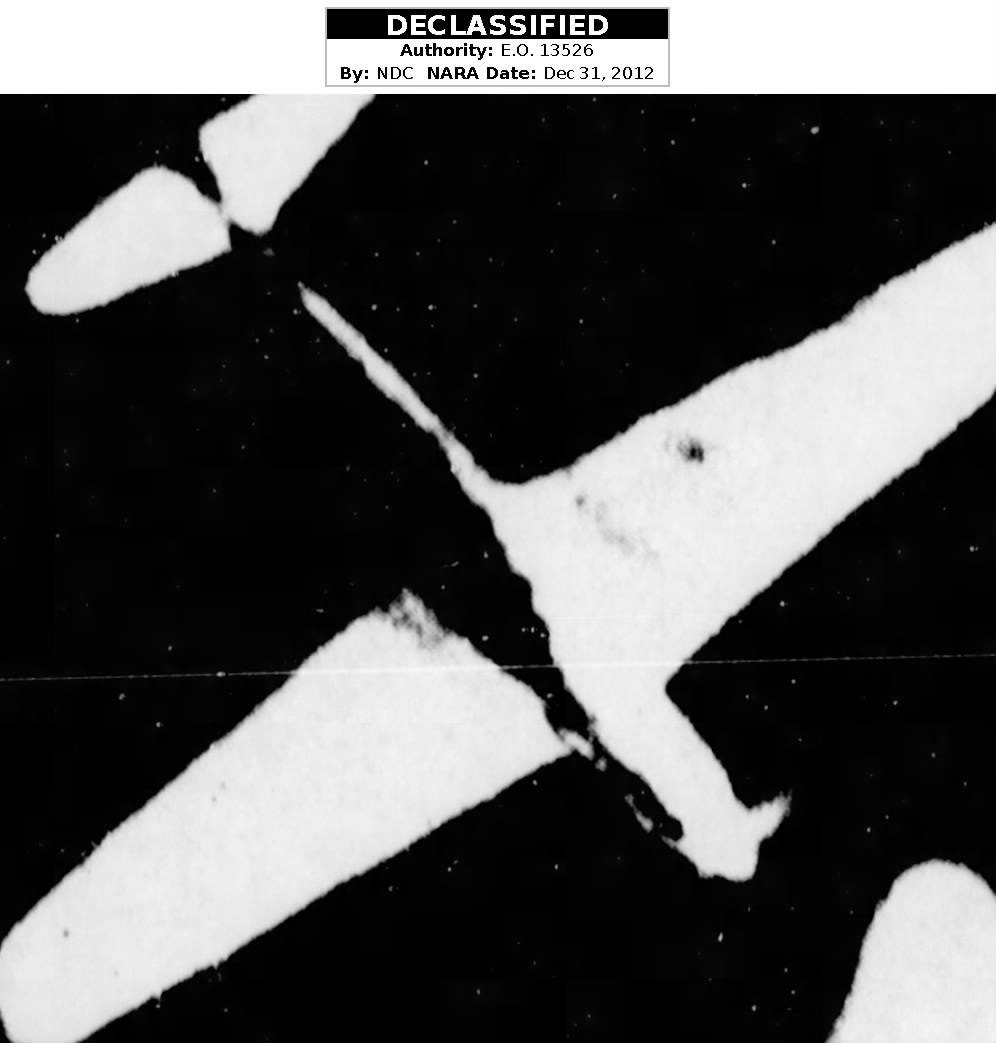
Early gun camera photo of Hien
1/Lt. John Lane claimed a Zero destroyed and a twin-engine fighter probably destroyed. 1Lt. Kenneth Sparks claimed an Oscar destroyed. He and other pilots made additional probable and damage claims, one of which by 1Lt. Gene Duncan was for a fighter that resembled an Me 109. Type 3 fighters were involved. Lt. Takashi Tomishima of the 78th FR claimed a P-38 for the first Type 3 fighter victory. Aircraft from both sides all returned to base.
The first verified victory by a Type 3 fighter came on the twentieth. Nine Japanese light bombers destroyed thirty-two huts of a staging camp at Bena Bena in the New Guinea highlands. Upon return part of the escort, five Type 3 fighters of the 2nd Chutai, 68th FR, encountered a B-24. After several attacks B-24D No. 42-40327 exploded and crashed. Only one member of the crew survived. The victory was credited to chutaicho Capt. Shogo Takeuchi. There was no Allied report of a new fighter involved.
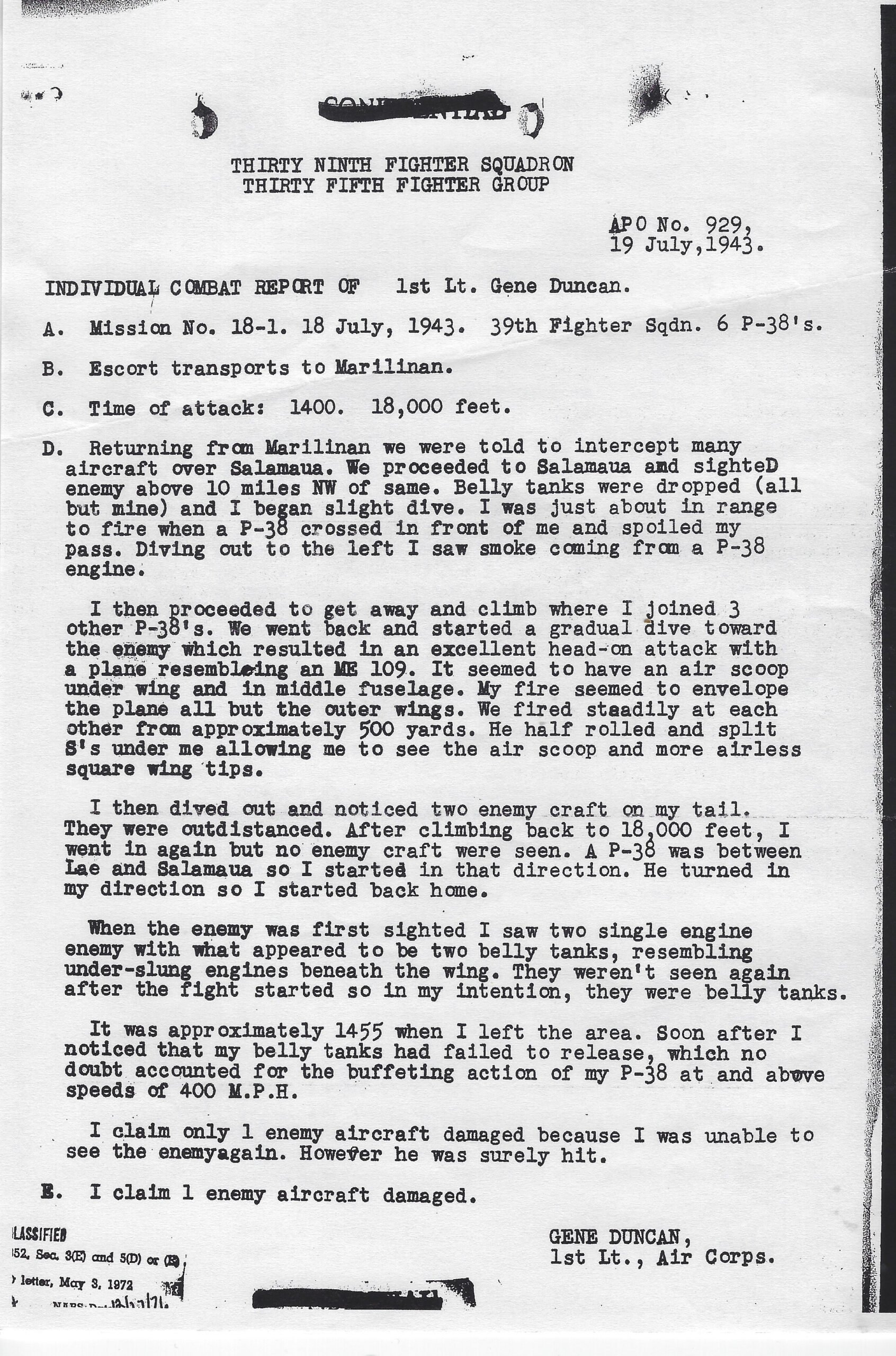
Combat Report
On the twenty-first eight light bombers escorted by Type 3 fighters of the 14th FB and Type 1 fighters of the 1st and 24th FR’s were engaged in a mission to attack Allied positions at Nassau Bay. At the same time dozens of B-25s escorted by P-38’s of the 39th and 80th fighter squadrons were attacking Japanese troops and construction efforts in the Bogadjim region. The two forces came into contact. After being menaced by several P-38’s the Japanese light bombers cleared the area unscathed as dogfights swirled around them. Meanwhile, the Type 3 fighters and some of the Type 1 fighters engaged in protracted combat with the twenty-eight Lightnings. Pilots of the 80th FS registered ten victory claims all for Zekes or Zeros and suffered its first pilot loss in 1943. The 39th claimed eleven kills of which five were for Oscars or Zeros and six for “fighters” later considered to be Type 3 Tony fighters. There were other probable and damage claims. Each squadron lost one P-38 in the combat. One P-38 pilot tried to elude the new fighter in a shallow dive. Speed built up to an indicated airspeed of 400 m.p.h., but the Japanese fighter stayed with the Lightning. The Hien was driven off when another P-38 came down in a steep dive and fired at long range. A Japanese intelligence report gave collective results for the 14th FB. Two Type 3 fighters were lost. They registered claims for four P-38s “almost certain”, two which emitted flames, and five which emitted smoke. Lieutenants Fujita and Suzuki of the 78th FR were killed. Two other Type 3 fighters landed away from their home airfield but returned the next day. One source suggests two Type 1 fighters were also lost. It appears American claims for twenty-one fighters destroyed netted just four fighters.
On the twenty-third the Japanese sent a raid of over forty fighters and bombers against Salamaua. On the return trip twenty-five P-38s from the 9th and 39th squadrons intercepted and claimed seven fighters including one Type 3 by 1Lt. Andrew Kish. A fighter from the 78th FR flown by Lt. Hiroshi Suemitsu failed to return. Later that morning fourteen P-38s of the 80th FS intercepted several Japanese planes reportedly ten Oscars and five Type 3 fighters while providing top cover for heavy bombers. Among seven victory claims was one for an in-line fighter and another just for a “fighter.” A Type 3 fighter flown by Sgt. Maj. Hideji Sekiya of the 68th FR was lost. One P-38 went down.
The twenty-fourth saw the Japanese mount one of their frequent raids on Australian positions in the highlands. Seven bombers and six fighters attacked Bena Bena. One of the aircraft involved found something interesting to strafe. It crashed after being hit by small arms fire. The crash of Sgt. Kurajiro Umezawa’s 78th FR aircraft several miles from Asaloka gave the Allies their first close look at a Type 3 fighter. According to Air Information Bulletin No. 2-43 it was originally thought to be an Italian design. The Hien bears some resemblance to the Macchi 202 which is powered by the DB 601 engine. This apparently engendered a connection to Antonio and thus Tony as its codename. More on this and other early examples of Hiens in Allied hands is discussed below.
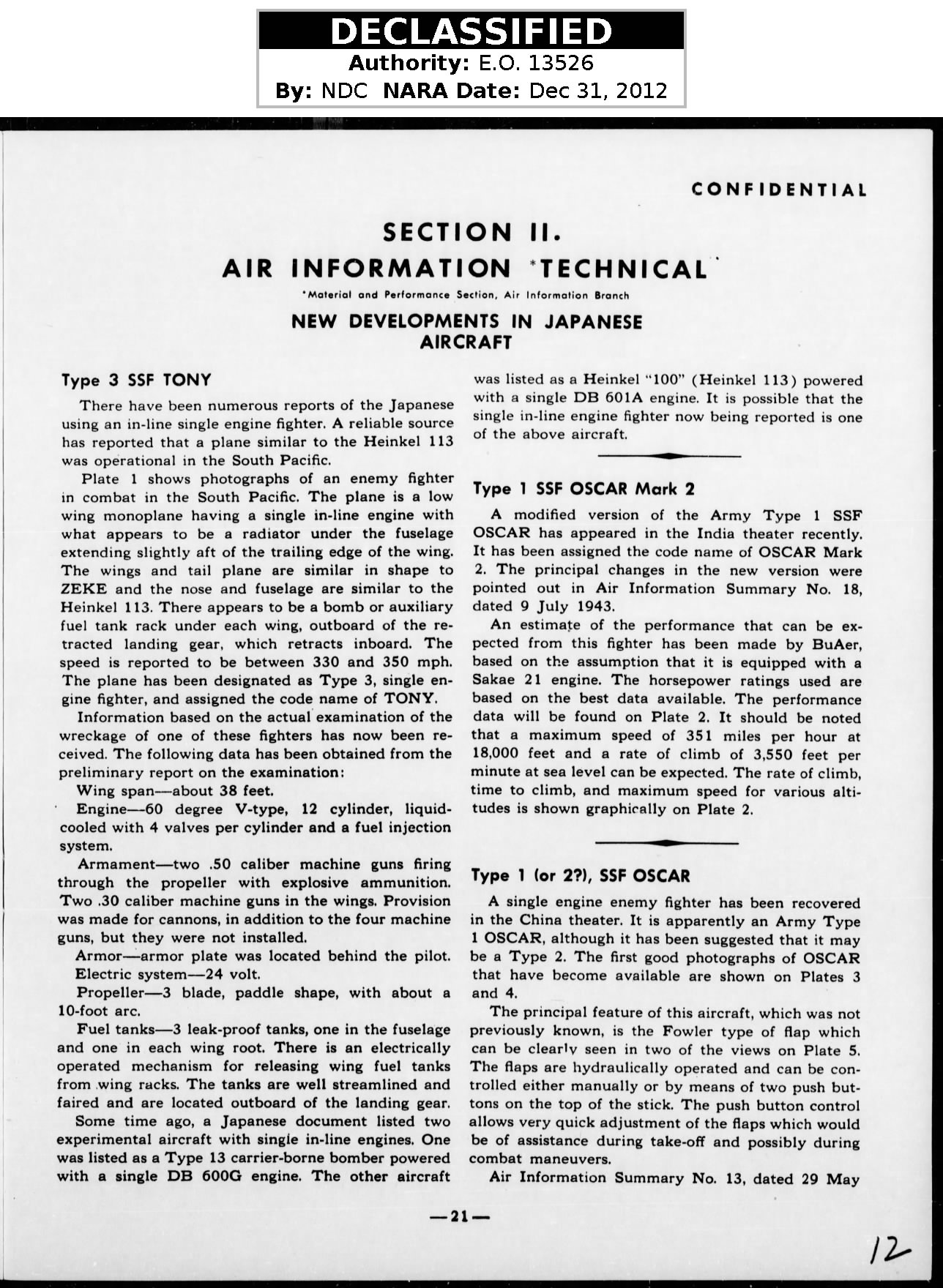
Page from information summary 2-43
Finally came 26 July a day when Fifth Air Force aces padded their scores with “kills” that included several Type 3 fighters. The Japanese sent another mission of light bombers to support their ground troops in the Salamaua area. Seven light bombers had a close escort of fourteen Type 1 fighters of the 1st FR. Indirect support was provided by about twenty Type 3 fighters and handful of 24th FR Type 1 fighters under Capt. Shoji Miura, who led because all the senior leaders of the 14th FB units were ill. The Japanese side of this episode is based on a summarized version of Miura’s account. Over the Markham Valley west of Lae the Japanese were met by twenty-five P-38s of the 9th and 39th squadrons. Despite other squadrons being in the area the air combat essentially took place between Miura’s supporting force and the two Lightning squadrons.
As the opposing forces closed on each other Miura led his fighters in a climb and thought he gained at least some altitude advantage before combat broke out. After the first pass a kaleidoscope of combat took place. The Japanese reported only one victory. No P-38s were shot down but one damaged Lightning was scrapped after combat and another belly landed with hydraulics shot out. Japanese fighters suffered damage, a couple of pilots were wounded, and several landed away from their home base. In a matter of days all had returned to Wewak. The wear and tear from a week of operations had its effect. Photo reconnaissance showed about forty fighters at Boram but operational numbers for the 68th and 78th FR’s sank to eleven and twelve Type 3 fighters, respectively.
From this confused encounter came an amazing array of American claims. Researcher Frank Olynyk’s assessment of American claims shows Ace of Aces Richard Bong claiming two Tonys and two Oscars. James Watkins also claimed four victories including three Tonys. Ace Gerald Johnson claimed a Tony and an Oscar. Seven Type 3 fighters were claimed among eleven victories with additional claims for fighters probably destroyed or damaged. Other sources differ slightly on identification of the claimed victims.
A less than perfect accounting of these early combats (Type 1 fighters were involved in some actions) shows U.S. losses: one B-24D and three P-38s shot down with one P-38 written off due to combat damage. Five Type 3 fighters were shot down, one by ground fire.
Getting to Know Tony
In these early encounters American pilots were not always aware they were confronting a new enemy fighter despite its distinct difference in appearance compared to the Navy’s Mitsubishi Zero or Army’s Nakajima Type 1 fighter. For example, Charles W. King of the 39th FS was involved in the 21 July combat. Upon returning from the combat, he heard other pilots talking about an in-line engine Japanese fighter. Initially King did not recall seeing any of the new fighters. In a mental rerun of the mission some impressions popped up. He then distinctly recalled seeing the underside air scoop. Its location came back to him vividly.
Fragments of information about the new fighter had reached American intelligence officers before the first combats. A Navy aerial gunner POW captured in June mentioned a fighter that differed from the Hayabusa (Type 1 fighter). He had seen about ten of these aircraft which he referred to as San Shiki (Type 3) at Vunakanau. He offered that they had three bladed propellers, a pronouncedly longer engine than other types. They had in-line engines and used a special cooling fluid. He did not know their armament but had seen an aperture in each wing and two in the nose. This information contained in an interrogation spot report was circulated just before the 18 July encounter mentioned above.
Reconstructing the appearance and performance characteristics of the new fighter became an important intelligence quest. The first break came with the inspection of the Tony that crashed near Asaloka on 24 July 1943. Basic information was gleaned from Type 3 fighter No. 239. For a couple months it was a primary source of information. An Air Intelligence Summary published 1 September 1943 (No. 2-43) relied heavily on information gleaned from that wreck in describing the new fighter. The report contains a reference to leak proof fuel tanks. The information provided could be easily misinterpreted. It mentioned armament of two .30 caliber and two .50 caliber machine guns. It noted that provision had been made for mounting cannons, but they were not installed. It gave other basic information.
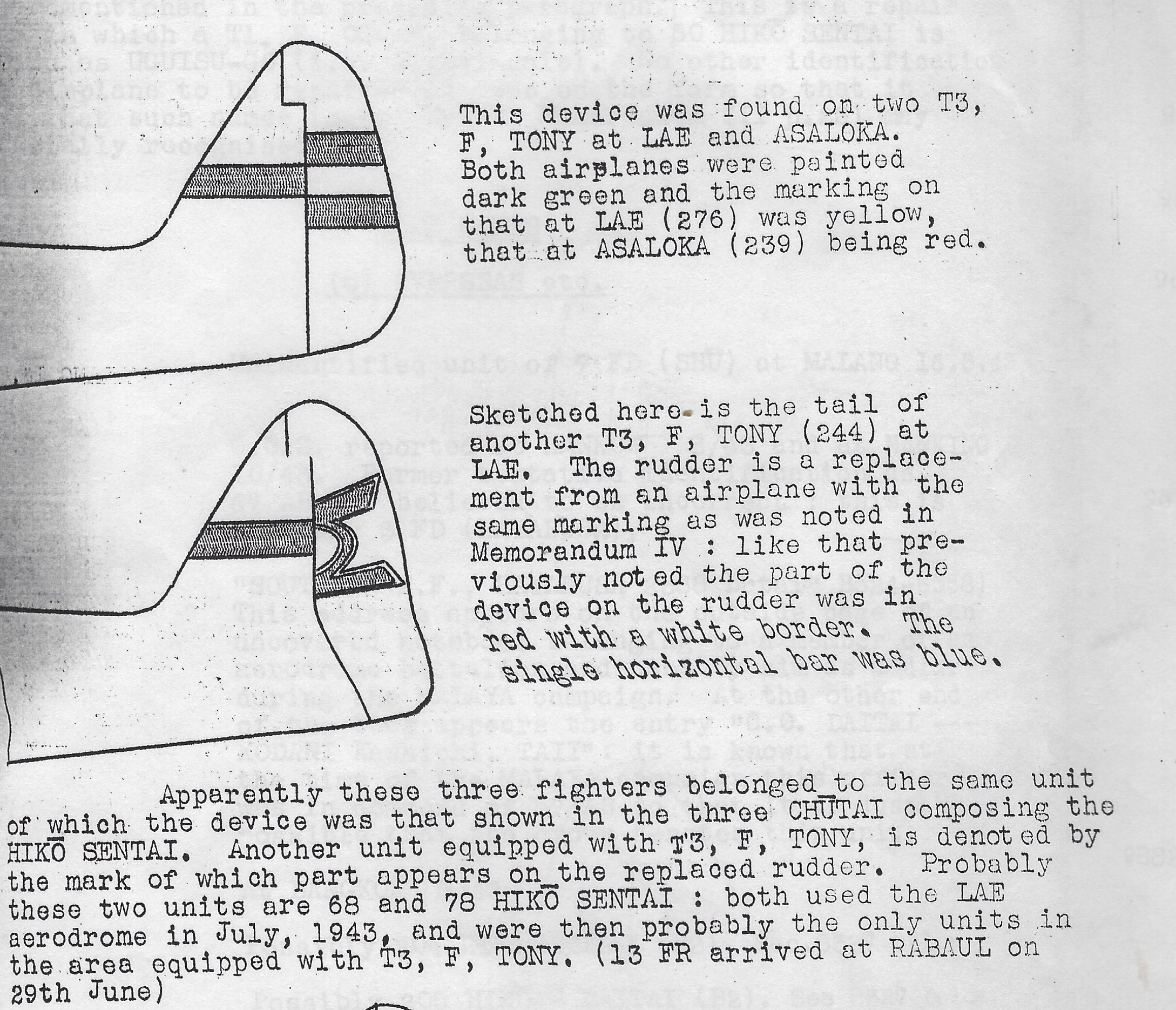
Lae Wrecks
In mid-September three Hien wrecks were inspected at recently captured Lae airfield. Camouflage was described as oil green or brown green on top, unpainted aluminum underneath. Among occasions Hiens landed at Lae during July translated records show Type 3 fighters of the 68th FR had refueled there on 3 July as had fighters of the 78th on the eleventh. Inspected at Lae were Type 3 fighters Nos. 183, 244 and 276. Production dates varied from February to May 1943. Two of these were very badly damaged by bomb blasts but they all provided some useful information. These revealed that the bottoms of the wing fuel tanks had no protective covering. Only the tops and sides did. Moreover, the tank covers were described as a “crude attempt” at leak proofing and “similar to Oscar”. The reference was to first generation tank covers with a thin absorbent layer of rubber 3mm thick between inner and outer fabric layers. They were roughly similar to tank protection on Spitfires and Hurricanes in 1940-1941 and on the U.S. P-40B. They might provide some protection against rifle caliber fire but virtually none against .50 caliber fire.
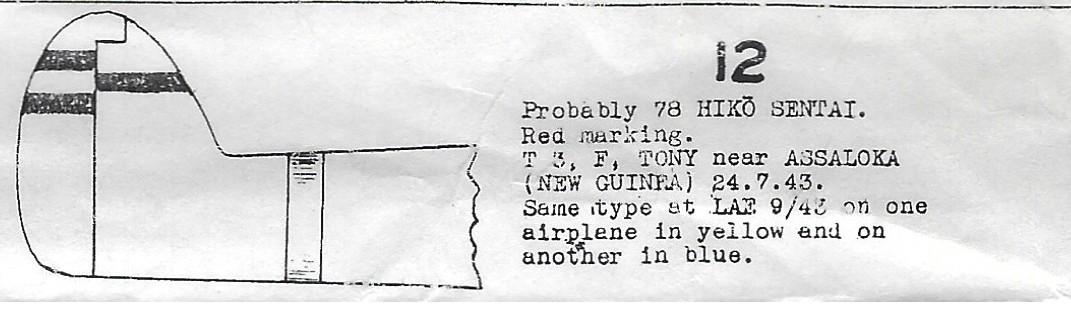
Lae Wreck
Recognition of the Tony improved when gun camera images and airfield photographs taken at low level became available to U.S. pilots. Despite its limited fuel tank protection, the Type 3 fighter seemed less vulnerable than the Type 1 Oscar probably because most of its fuel plumbing was located within the fuselage rather than the wing. It was considerably faster than the Oscar. The Kawasaki fighter was also found to have two pieces of armor plate 10.3mm thick protecting the pilot. The performance of the new Japanese fighter proved to be generally superior to the U.S. single-engine fighters then in use, P-39N and earlier models, P-40N and earlier models. The P-38 Lightning had a higher speed in level flight and in a steep dive. Its performance at altitudes above 20,000 feet was generally superior.
Upgrades in armament, pilot and aircraft protection would come but that was in the future. Despite improvements mechanical glitches continued to plague the Hien. After the early engagements American pilots gradually came to know the strengths and weakness of their new opponent. The Type 3 fighter was an aircraft to be respected but not necessarily feared. Japanese pilots appreciated the performance and increased fire power of the Type 3 fighter but remained skeptical concerning its mechanical reliability.