
I have written about the Zero 21’s maximum speed previously in this article. Published sources list Zero 21 performance across a surprisingly wide range. In addition to older references, the Pearl Harbor Aviation Museum currently has an article on its website stating that the Zero 21’s maximum speed was “about 317 mph to 332 mph at a critical altitude of about 16,000 feet.” These are not very specific figures. Several other numbers have appeared in a variety of sources mentioned in my previous articles.

Akutan Zero in flight
Maximum speeds of the Zero 52 and the Japanese Army Type 1 Model II fighter have also been misstated due to errors similar to those affecting the Zero 21’s listed maximum speed. In the case of the Type 1 Model II fighter, the maximum speed typically cited is 320 mph. However, a crash intelligence report issued by the U.S. Fourteenth Air Force on 27 August 1943 gives the “Oscar, Mark II (Nakajima Type I Fighter, Mark II)” a maximum speed of 350 to 360 mph. The report states: “These figures are based on study of available technical data, combat reports, and prisoner interrogation. They are believed to be reasonably accurate.”
An analysis of Zero 21 performance by the U.S. Army Air Force Intelligence Service (Informational Intelligence Summary No. 59), issued as early as 4 September 1942, estimated the Zero’s maximum speed as “310/345 mph.” The bifurcated number presumably indicates maximum speed at sea level and at rated altitude. These estimates turned out to be remarkably accurate. Nonetheless, as the Pearl Harbor Aviation Museum’s data shows, confusion continues. Hence, I am adding some additional data while keeping this article concise.
Rather than rehash my entire earlier article, I will highlight a key issue. Allied Air Forces, Southwest Pacific Area, Intelligence Summary No. 206 (10 May 1944) states:
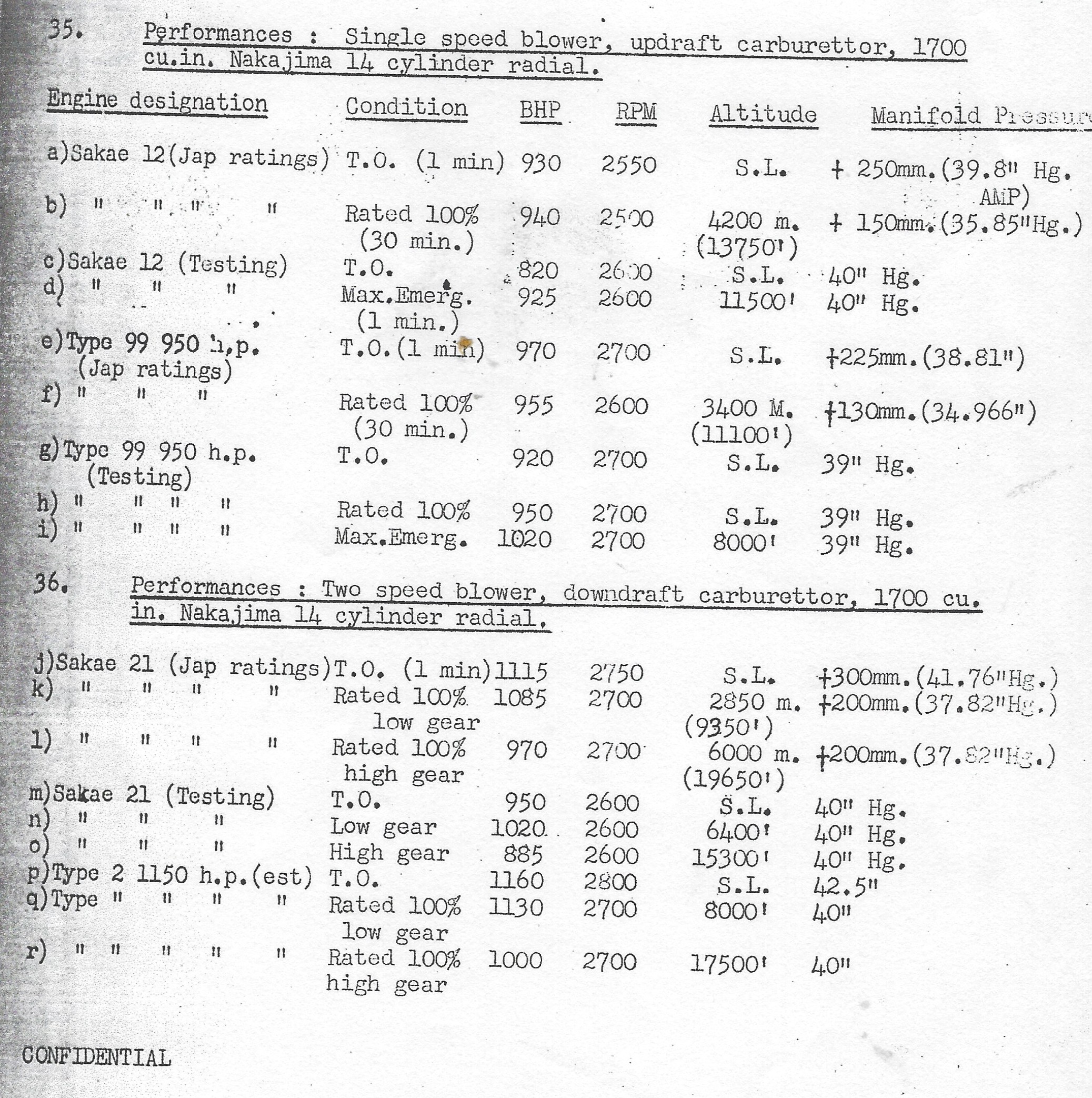
A recently captured document… revealed the hitherto unknown enemy performance ratings of the Sakae 12 and Sakae 21 engines. Those two Nakajima 14-cylinder radials were previously dynamometer-tested, and results thus obtained are compared below with the Japanese ratings and the performances of the corresponding Army versions of the two engines—e.g., Type 99, 950 h.p., and Type 2, 1150 h.p.
The performance attributed by the Japanese to the Sakae 21 falls beyond the range of engine speed and manifold pressure estimated previously to this engine testing, and consequently superior to those measured. The enemy ratings of the Sakae 21 are very close to the performance estimated for its Army version, the Type 2 1150 h.p. It is recalled that the characteristics of the engine speed and boost were selected, in the absence of documentation and before dynamometer testing, after checking initial settings of both propeller governor and boost controller, which were measured to be respectively 2600 R.P.M. and 40” Hg maximum in the Sakae 21 and Type 2 1150 h.p. inspected. The foregoing setting therefore restricted the practical performance available of the Sakae 21 and Type 2 1150 h.p. to the powers measured while testing the Sakae 21.
In addition to lacking correct documentation, the engines tested had been refurbished after, in some cases, spending months exposed to the elements. Even the Sakae 12 from the Zero captured at Akutan Island—which was later test-flown in the U.S.—spent more than a month exposed in a tundra bog.
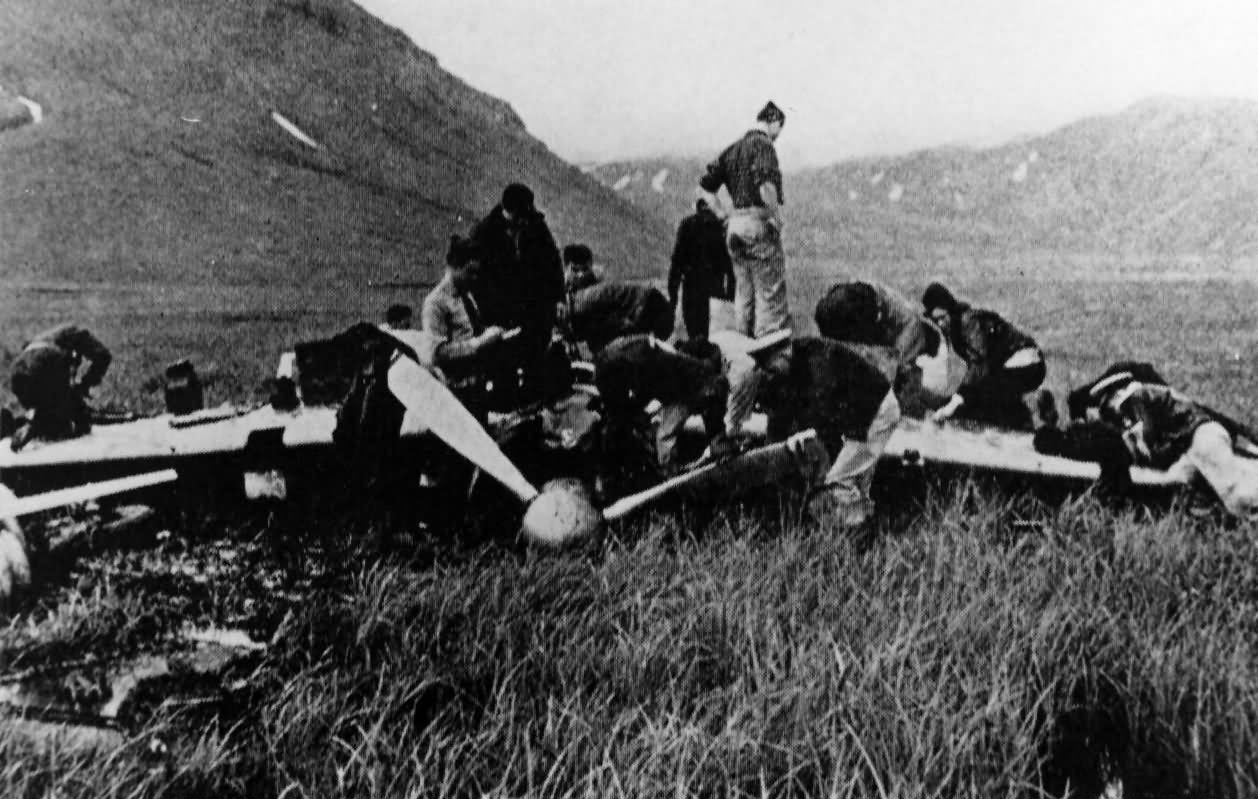
Zero at Akutan before reconstruction
The table below shows that Allied testing yielded a Zero 21 (Sakae 12) take-off (1 min.) rating of 820 h.p. compared to the Japanese rating of 930 h.p. Allied testing gave maximum emergency (1 min.) power as 925 h.p., while the Japanese rated power (30 min.) was 940 h.p. at 4,200 meters. The Zero’s rated maximum speed of 316 mph at 5,000 meters corresponds to the 150 mm manifold pressure rating. This was not its true maximum speed, as I noted in my earlier article. The Zero could be operated at 250 mm Hg well beyond one minute. Allied maximum speeds are typically those achieved at war emergency power—usually a 5-minute rating. Inaccurate engine performance data contributed to inaccurate aircraft performance estimates.

Nakajima Sakae 12 Engine Akutan Zero
In my earlier article, I pointed out that Japanese pilots often operated the Zero 21 “over boost” for periods of up to ten minutes. In discussing the Japanese Army version of the Sakae 21 engine (Type 2, 1150 h.p.), an Allied intelligence summary noted: “350 millimeters or 43 in. is maximum boost which may be employed in this engine for ten minutes.” (AAF, SWPA, Intelligence Summary No. 98). Japanese Navy tests showed that the Sakae 12, though rated at 250 mm, could be operated well above 250 mm for several minutes before encountering continuous detonation (knock) and the potential for serious damage.
In summary, a pilot who flew the Zero 21—Saburo Sakai—knew exactly what its maximum speed at rated altitude was:
Normal maximum speed: 275 knots (316 mph)
Maximum speed on overboost: 300 knots (345 mph)
Earlier Article: https://rldunn.com/mitsubishi-zero-21/
Excellent analysis.
https://shorturl.fm/jYS1n